Relationship intelligence data for financial advisor prospecting

Download the LLM 2026 Prompting Guide
Teach your AI to think like your firm with 10+ customizable prompts
Download TodayMost financial advisors already know who they want to reach. A qualified prospect, a defined target market, a clear sense of which wealth events create the right timing. What they often lack is the path.
A CRM stores what you already know: contacts logged, interactions tracked, relationships manually entered. It does not show you the connections that exist between your clients and the people you are trying to reach, and it does not tell you that your best client sits on a board with your top prospect, or that a former colleague is married to someone who just sold a business.
That is what relationship intelligence data does. It maps the connections between people across professional history, community affiliations, household relationships, and shared organizational memberships, then surfaces the shortest, strongest path from your existing network to a target prospect. A relationship intelligence platform for advisors built on verified network data makes those paths visible and actionable, rather than leaving them to chance or memory.
What is relationship intelligence data?
Relationship intelligence data is not a single dataset. It is a composite of multiple data layers that, combined, reveal connections in ways no individual source can, distinguishing it from a contact database, a CRM export, or a social media graph.
Connection mapping across personal and professional networks: the relationship mapping data layer
The foundation of relationship intelligence is connection mapping: who knows whom across shared employers, co-board memberships, alumni networks, charitable organizations, neighborhood proximity, and family relationships. This goes well beyond a LinkedIn graph or contact list. The value is in surfacing connections the advisor would not discover through their own memory, CRM records, or social media profiles. A client who sat on a nonprofit board with a target prospect eight years ago does not appear in either CRM. Relationship intelligence data finds that path and scores it.
Relationship strength and recency: the client relationship intelligence layer
Not all connections are equal. A shared employer from fifteen years ago scores differently than a current co-board member. Relationship intelligence data ranks connections by strength and recency, then surfaces the highest-probability introduction path rather than a flat list of options. That prioritization is what prevents advisors from wasting introduction capital on the wrong route.
Degree-of-separation path analysis
Relationship intelligence data shows not just that a connection exists, but the shortest path between the advisor and a target prospect. First-degree connections are direct. Second-degree connections require one intermediary. Third-degree connections require two.
Household and family context: relationship data for wealth management
For wealth management prospecting, individual connections tell only part of the story. Relationship intelligence data that includes household-level context, spousal connections, family relationships, and shared property or business ownership, gives advisors a fuller picture of who is connected to whom and through what channels.
A prospect's spouse may have a stronger connection to an advisor's existing client than the prospect does. That path would be invisible without household data. Consumer-layer relationship data is what separates wealth management relationship intelligence from professional network tools built for enterprise sales. See how relationship intelligence as an enrichment layer adds household context to records that professional data alone cannot reach.
Where network intelligence data comes from
Most advisors assume relationship intelligence data comes from social media scraping or LinkedIn. In practice, high-quality platforms draw from a much broader set of verified sources. Career history creates a map of professional co-occurrence: two people who worked at the same company during the same period share a connection scored by duration and recency, while organizational affiliations, board memberships, and alumni networks add layers that no CRM or social graph captures.
Career history across companies, roles, and industries creates a map of professional co-occurrence. Two people who worked at the same company during the same period share a professional connection that can be scored by duration and recency. A year of overlap at a growing company in the same business unit scores significantly higher than a shared employer listing where the tenures did not overlap.
Board memberships and organizational affiliations
Nonprofit board service, industry association memberships, and advisory roles create high-signal connections. Co-board membership implies a level of personal familiarity and mutual trust that makes introductions more likely to succeed, and these connections are rarely captured in CRM records or social media profiles. They require dedicated data sourcing from public filings, nonprofit disclosures, and organizational directories. See how relationship intelligence for HNW prospecting depends on this layer to surface the strongest introduction paths.
Public records and verified consumer data
Property records, household composition data, and verified consumer databases add the personal layer that professional data alone misses, revealing neighborhood connections, family relationships, and shared community ties. Without consumer-layer sourcing, a platform can only see the professional surface of a network, leaving the personal connections that often run deepest untouched.
Compliance and data sourcing standards
Relationship intelligence data for financial services must come from verified, legally obtained sources. Advisors evaluating platforms should ask where the data originates, whether it complies with relevant privacy regulations, and whether it relies on scraped social media, which carries both accuracy and compliance risks, or on licensed and verified databases.
This is standard vendor diligence, not a reason to avoid the category. The question is not whether to use relationship intelligence data but which platform sources it responsibly. See how relationship intelligence in Salesforce integrates verified relationship data directly into compliant advisor workflows.
How relationship intelligence for financial advisors changes prospecting
The practical shift is a move from reactive to systematic. The question changes from "do I happen to know anyone who knows this person?" to "which of my existing relationships is the strongest path to this prospect, and how do I activate it?"
From cold outreach to warm introductions
Without relationship intelligence data, advisors identify a qualified prospect and either reach out cold or wait for an organic referral. With it, the advisor sees which existing clients or contacts share a strong, current connection with that prospect and can request a specific introduction.
The conversion difference between a cold outreach and a warm introduction is well documented in advisory practice. What relationship intelligence adds is the ability to manufacture warm introductions systematically rather than waiting for them to occur organically. See how relationship intelligence for client acquisition changes when warm paths are surfaced before outreach begins.
Combining relationship intelligence with wealth event data
Relationship intelligence data becomes significantly more powerful when combined with wealth event monitoring. Knowing that a prospect just sold a business is useful. Knowing that the same prospect shares a board membership with your top client is what turns that timing signal into an actual meeting.
Relationship intelligence solves the introduction problem. Wealth event monitoring solves the timing problem. Combined, they produce the complete prospecting signal. Explore how AI-powered relationship intelligence surfaces both layers simultaneously.
Prioritizing outreach by relationship strength
When multiple paths exist to the same prospect, relationship intelligence data helps advisors prioritize. A first-degree connection through a current board co-member is a stronger path than a third-degree connection through a former colleague from a decade ago. Strength scoring prevents advisors from burning introduction capital on weak paths and from underutilizing strong connections they did not realize they had. See how using relationship intelligence in prospecting shapes outreach at the individual prospect level.
How to evaluate relationship data platforms
Not all relationship intelligence data is created equal. Three criteria separate useful relationship intelligence from low-quality connection data that produces dead-end introduction paths.
Coverage depth: what relationship intelligence software must include beyond professional records
Relationship intelligence data that only maps professional connections, job titles, companies, and LinkedIn graphs, misses the personal networks that drive most advisor introductions. Board memberships, alumni ties, charitable involvement, family relationships, and neighborhood connections are where the strongest introduction paths often live.
If a platform does not cover these layers, it is a professional directory, not relationship intelligence. The test is whether the platform surfaces connections the advisor genuinely did not know about, not whether it confirms connections they could have found themselves. See how relationship intelligence as a research tool differs from a contact database in the types of connections it uncovers.
Freshness and continuous updates
Relationship data degrades quickly. People change jobs, leave boards, and move between cities. A static relationship map from six months ago produces dead-end introduction paths. A platform that refreshes quarterly is providing a historical snapshot, not a live network view. See how relationship intelligence in your prospecting stack requires freshness to be operationally reliable.
Integration with the existing CRM workflow
Relationship intelligence data that lives in a separate platform gets checked once and forgotten. Data that integrates natively into the advisor's CRM, surfacing relationship paths directly alongside prospect records and wealth event alerts, becomes part of the daily workflow.
CRM integration with Salesforce, Redtail, HubSpot, Lofty, and Wealthbox is the practical requirement. Without it, relationship intelligence is a research tool the advisor has to remember to use. With it, it is part of every prospecting decision automatically. See how relationship intelligence data in your CRM changes the adoption pattern for advisors already working in a CRM-first workflow.
How Aidentified puts relationship intelligence data to work for your practice
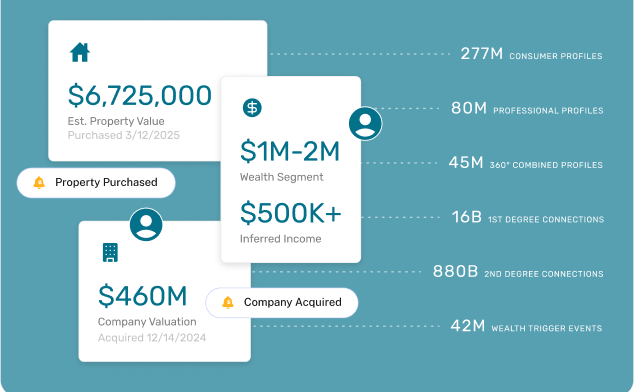
Your existing clients are already connected to the prospects you most want to reach. Aidentified makes those paths visible by mapping 16B+ connections across professional history, board memberships, alumni networks, and household relationships, scoring each path by strength and recency so advisors know exactly which introduction to request and through whom.
When a prospect enters a financial decision window, Aidentified surfaces the strongest introduction path from your network at that exact moment. Explore how relationship intelligence for warm leads combines event monitoring and relationship mapping into a single prospecting workflow.
If you are ready to see who your network already connects you to, try Aidentified for free.
FAQs: relationship intelligence data
How is relationship intelligence data different from CRM data?
CRM data stores relationships the advisor has already identified and entered manually: contacts logged, interactions recorded, and deals tracked. Relationship intelligence data reveals connections the advisor does not yet know about, mapping paths through shared professional history, board memberships, alumni ties, and household relationships across an entire network.
The CRM holds what you know. Relationship intelligence reveals what you do not. Together they cover both sides of the prospecting problem: managing the relationships you have and discovering the paths to the relationships you want. See how relationship intelligence for referral sourcing extends the value of existing CRM records into undiscovered network paths.
Does relationship intelligence data require LinkedIn access?
Some platforms rely heavily on LinkedIn for their connection graphs, which limits coverage to public professional networks and excludes personal connections, board affiliations sourced outside LinkedIn, and household-level relationships. More comprehensive platforms draw from verified professional history, board records, alumni databases, and consumer data sources.
For financial advisors, the strongest introduction paths often run through personal networks that LinkedIn does not capture. A platform built only on social media data will miss the co-board membership, the alumni relationship, and the neighborhood connection that represent the highest-probability introduction routes. See how relationship intelligence for lead generation draws from sources beyond social media to surface those paths.
How current is relationship intelligence data?
The value of relationship intelligence data depends directly on freshness. People change jobs, join and leave boards, and move between cities. Platforms that update continuously provide the most reliable introduction paths. Static datasets from months ago will surface connections that no longer exist, wasting the advisor's time and introduction capital.
If the platform cannot tell you when a connection was last verified, the data is a historical record, not a live network map. See how relationship intelligence in mapping software handles continuous updates.



growth engine with the
LLM Prompting Guide.
Reveal the power of your network with Aidentified’s industry-leading AI.
Discover how Aidentified can transform your specialty services business. Contact us today for a personalized consultation and demo.
Explore a demo