Financial advisor prospecting ideas that turn wealth events into clients

This is a div block with a Webflow interaction that will be triggered when the heading is in the view.
Download the LLM 2026 Prompting Guide
Teach your AI to think like your firm with 10+ customizable prompts
Download TodayTL;DR
Financial advisor prospecting ideas convert best when a wealth event, and not the calendar, decides who you contact this week.
Segment your list by wealth band and profession first, so one job change or business sale carries real meaning.
Referrals, COI partnerships, LinkedIn, webinars and content all lift when a recent event frames the first message.
A weekly review of who moved replaces hours of research and hands you a shortlist worth calling.
Most financial advisors have no shortage of names. The list is long, the outreach is steady, and the conversion rate stays flat. The financial advisor prospecting ideas that move that number start somewhere other than the channel. People hire a financial advisor after something changes in their financial life.
A promotion into a C-suite seat. A business sale. An inheritance. A property transaction. Each one raises questions your prospective clients cannot answer alone, and each one opens a short window where your call reads as useful. Catching those windows across a full list is the work wealth event monitoring does. What follows covers how to segment, which ideas earn your hours, and how to wire the whole thing into your CRM.
What makes prospecting strategies work now
Prospecting strategies for financial advisors earn their keep by shortening the list. At any moment, a small slice of the people in your customer relationship management (CRM) system has experienced something that creates readiness for financial planning.
So the weekly question changes shape. Instead of asking who to call, you ask who just gained a reason to need you. That reframe cuts research time and lifts conversion, because the shortlist arrives pre-qualified.
Segment your target market first
Define your financial advisor target market and hold it. Wealth band, profession, geography, life stage. The tighter the segment, the more any single event tells you.
A senior title change means one thing for a dual-income household in the mass affluent segment and another for a founder holding pre-IPO equity. Your segment also decides which service leads the conversation, whether that is estate planning, concentrated stock or a first financial plan. Write your value proposition for that segment before you write a single email.
Rank prospects by wealth events
Weight every name by what just happened to it. New wealth ranks above restructured wealth, and restructured wealth ranks above a quiet year.
Business sales and liquidity events sit at the top. Career moves and property sales come next. Market volatility ranks low for new prospects, and it ranks high for the clients you already serve, who want to hear from a trusted advisor that week. Advisors prospecting high-net-worth clients work this ranking hardest, because at that level the window closes fast.
7 financial advisor prospecting ideas ranked by impact
These seven ideas are ordered by what they return per hour spent. The first one changes every idea that follows it.
1- Prospect around one wealth event
Pick the trigger before the channel. A recent business sale, a new senior role, a property transaction, a verified mortality record in the household. Every name should clear one of those tests before it reaches your calendar.
2- Turn referrals into a system
Referrals stay the highest-converting source in the business, and most advisors ask for them at random. Knowing who your clients actually know changes the ask.
Household ties, alumni links, former employers and board seats show which client sits one step from the person you want to meet. Working from relationship intelligence data turns a vague request into a named introduction with a reason attached.
3- Partner with CPAs and attorneys
Centers of influence (COIs) sit beside their clients at the moment a wealth event happens. CPAs, estate attorneys and business brokers see the business sale before you do.
Frame the ask around events. Asking a CPA which clients sold a company this year produces a specific answer, and building referral sources for financial advisors around that question turns a polite lunch into pipeline.
4- Time LinkedIn outreach to milestones
LinkedIn works as a listening channel first. Role changes, funding news and company milestones surface there before they surface anywhere else.
Send the note while the person is still rethinking their financial planner. Comment on what changed, ask one question, and leave the pitch for the second exchange.
5- Run webinars and appreciation events
Webinars and client appreciation events give a prospect a low-commitment way to judge you. Build each one around a single event type, such as proceeds from a business sale, and a narrower room shows up better qualified.
Enrich the registration list afterwards. Twelve attendees with household and wealth context beat a hundred email addresses, and tools for financial advisors close that gap in an afternoon.
6- Publish content built for search
Content marketing and search engine optimization (SEO) bring in prospects who have already self-selected. Answer the questions your segment types into Google, one page per question.
Keep the calls-to-action specific. A page about selling a dental practice should offer a review of sale proceeds, not a generic consultation.
7- Screen lists before cold outreach
Cold calling, cold emails and direct mail still generate leads, and their economics live or die on list quality. A call placed three weeks after a property sale is a warm call in cold clothes.
Screen for wealth range and a recent event before anyone dials. Most advisors using AI for financial advisors apply it right here, sorting the list before a single message gets written.
Wire lead generation strategies into your CRM
The handoff is where financial advisor lead generation strategies fall apart. A name arrives, nobody enriches it, and it waits in a queue until it goes cold.
Your CRM should hold the event history, not the contact record alone. A record that looks current and carries no event history is the most expensive kind of stale.
Enrich every inbound qualified lead
Append wealth range, household composition and employment history the moment a name lands. Qualified leads reveal themselves in minutes instead of after a discovery call.
Independent financial planners and RIAs benefit from the same discipline. Pairing your CRM with sales intelligence tools means the first call opens with context in place of questions.
Track prospecting methods that convert
Log which prospecting methods produced each closed household, then review the numbers quarterly. Most advisors discover that two channels carry the book while the rest carry the calendar.
Digital marketing and email marketing deserve the same scrutiny as cold calling. Measure the return per hour spent, and reallocate.
Where client acquisition compounds over time
Growth runs in two directions: the prospective clients you win, and the book of business you already hold. Reading the same wealth events across both lists makes client acquisition for financial advisors and client service one workflow.
The advisor who calls a client the week their company gets acquired earns the referral that follows. That is relationship-building with a calendar attached.
Serve the book you already hold
Your existing clients generate events too. A promotion, a home purchase, a parent's death, a stretch of market volatility. Each one is a reason to call before they wonder why you did not.
More AUM often sits inside current households than in any prospect list. Financial professionals who watch their own book find held-away assets they never thought to ask about.
Plan for the coming wealth transfer
Estate planning conversations are the entry point to the next generation of clients. Cerulli Associates projects $124 trillion will transfer between generations through 2048, with 42% of it coming from high-net-worth and ultra-high-net-worth households.
Meet the children of your clients now. Verified mortality data makes the timing visible, and warm leads inside a family you already serve convert faster than anything you buy.
Run advisor prospecting at scale with Aidentified
Platforms that monitor wealth events across a large profile universe answer the bottleneck these seven ideas create. Nobody tracks a few hundred prospects across every event category by hand and still sees clients.
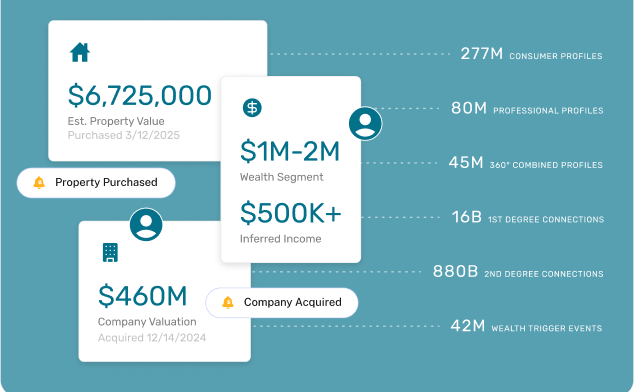
Aidentified holds 300M+ unified consumer and professional profiles, tracks 16 wealth event types, and maps 16B+ first-degree connections, so the reason to call arrives with the warmest path to the person. Every profile carries a wealth estimate, backed by a 100% fill rate on wealth and income ranges, and profiles update continuously as new data becomes available through a six-layer verification process.
It sits on top of the CRM you already run, whether that is Salesforce, HubSpot, Redtail or Lofty. Better data produces better decisions across prospecting, client management, service and strategic growth, which is what next best action means in practice.
Start prospecting on better timing
Without an event feed, your prospect list ages quietly. The contact record still looks current. The opportunity already went to whoever heard about the business sale first. Aidentified shows you who moved, what the household looks like behind the move, and who in your network can make an introduction. Book your demo to watch it run against your own list.
FAQ: Do you have any questions?



growth engine with the
LLM Prompting Guide.
Reveal the power of your network with Aidentified’s industry-leading AI.
Discover how Aidentified can transform your specialty services business. Contact us today for a personalized consultation and demo.
Explore a demo