Salesforce data enrichment tools financial advisors need go beyond standard B2B platforms

Download the LLM 2026 Prompting Guide
Teach your AI to think like your firm with 10+ customizable prompts
Download TodaySalesforce is the CRM most financial advisory firms already run on. The salesforce data enrichment tools they reach for first are almost always built for a different buyer: B2B sales teams prospecting software buyers and procurement managers, not wealth managers building relationships with high-net-worth individuals.
The result is a CRM that looks current, with verified emails and updated job titles, but is missing the consumer-layer data that actually drives advisor outreach: household composition, estimated net worth, property ownership, equity holdings, and the wealth events that signal when a prospect is in a financial decision window.
This guide covers the five data enrichment tools for Salesforce financial advisors should know, what each one does well, where it falls short, and which data layer it actually covers.
Why most crm data enrichment tools leave gaps for financial services
Standard crm enrichment tools were built to fill firmographic fields: company name, headcount, industry, job title, verified email. That data model works for B2B sales cycles where the prospect's relevance comes from their professional role.
For financial advisors, the prospect is a person. Their relevance comes from their personal financial situation, not their employer alone. A business owner six months from an exit, a recently retired executive with a concentrated equity position, a dual-income household with no existing advisor relationship: each of these is a prospecting opportunity driven by attributes no B2B database tracks.
B2B contact data decays at roughly 30% per year, and standard enrichment handles that well for professional fields. But a contact who sells a property, receives vested equity, or changes household composition does not flag as changed in a standard enrichment pass. The record looks current. The financial context is missing. That is the gap that determines whether financial advisor lead generation from Salesforce produces results or just fills a pipeline with unqualified names.
5 Salesforce data enrichment tools worth evaluating for financial advisory practices
1. Aidentified
Best for: financial advisors who need consumer-layer data, wealth event monitoring, and relationship mapping in Salesforce
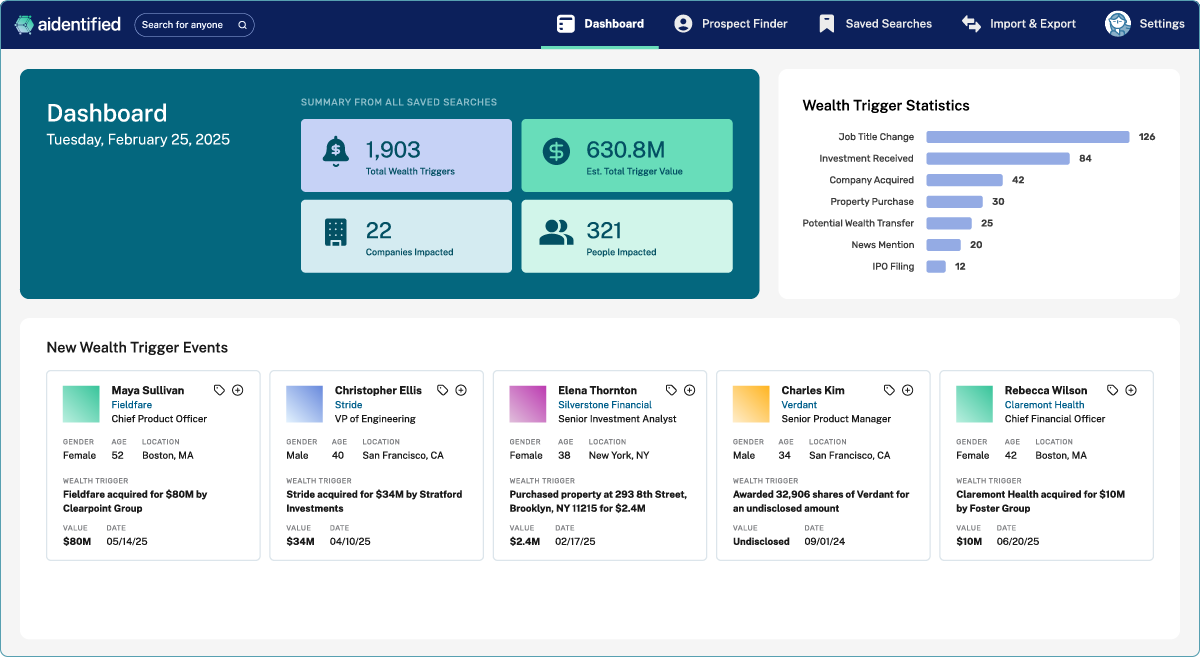
Aidentified is the only salesforce data enrichment platform built specifically for financial advisor prospecting. Where B2B tools fill professional fields, Aidentified adds the consumer data layer that actually informs advisor outreach: estimated net worth, household composition, property ownership, equity holdings, and continuous monitoring of the wealth events that signal when a prospect has entered a financial decision window.
The platform monitors wealth events across 300M+ profiles and maps relationship paths through 16B+ connections, surfacing warm introduction routes through household data, alumni networks, and board affiliations. For advisors already using a prospecting tool for financial advisors, the Salesforce integration closes the gap between prospect identification and enriched CRM records.
In practice, that means a Salesforce contact record becomes more than a name with a verified email. It becomes a qualified prospect with a financial profile, a timing signal based on a recent wealth event, and a relationship path to a warm introduction.
Key capabilities
- Wealth event monitoring across career changes, business sales, real estate transactions, equity distributions, and inheritance activity
- Household-level profiles combining professional and consumer data in a single enriched record
- Relationship mapping through 16B+ connections to surface warm introduction paths. See crm relationship intelligence for how this layer works alongside standard enrichment.
- Native Salesforce integration with field mapping across Lead, Contact, and Account objects
- Continuously updating profiles, not monthly or quarterly batch refreshes that miss timing windows
Ideal for
Financial advisors and RIAs prospecting high-net-worth individuals who need a lead generation tool for RIAs built around wealth data, not B2B firmographics. Also well-suited for firms using an AI tool for financial advisors that need their Salesforce records enriched with the same consumer-layer data their prospecting platform relies on.
2. B2B firmographic enrichment platforms
Best for: keeping professional contact data current across large contact databases
These are the most widely adopted crm data enrichment tools on the market. They pull from large professional databases to fill and refresh fields like job title, company name, industry, headcount, and verified business email. Most offer native Salesforce connectors, automated refresh schedules, and field-level mapping across Lead, Contact, and Account objects.
For financial advisors, these tools cover the professional baseline. They reduce manual data entry, improve email deliverability, and flag when a contact changes roles or employers, which can signal new compensation complexity or a pending liquidity event worth monitoring.
Where they fall short for wealth management
The data model stops at the professional layer. Property records, household composition, estimated net worth, equity holdings, and wealth events are not in any B2B database. These tools were not designed to carry them. For advisors whose outreach decisions depend on financial context, firmographic enrichment is the floor, not the ceiling.
What to look for: Native Salesforce integration, automated refresh on record creation, field-level override controls so enrichment does not overwrite manually verified data, and career history depth beyond current title and employer.
3. Intent data and behavioral signal platforms
Best for: identifying accounts showing active interest in relevant financial topics
Intent platforms track online behavioral signals, content consumption, topic research, and web activity, then score accounts based on likelihood to be in a purchase window. They sync those scores into Salesforce, allowing teams to prioritize outreach based on demonstrated interest rather than static profile data.
For advisors prospecting business owners and executives, intent data can surface accounts actively researching wealth management, business exit planning, or estate strategies. That behavioral signal adds useful context when layered on top of other salesforce data enrichment tools in your stack.
Where they fall short for wealth management
Intent data captures what someone is reading online, not what has happened in their financial life. A prospect who just sold their company may not be searching for a financial advisor yet. The events that actually open decision windows, business sales, equity distributions, inheritance, real estate transactions, are not discoverable through behavioral tracking. Intent data supplements timing signals but does not replace them.
What to look for: Topic-level intent signals relevant to wealth management and financial planning, account-level scoring that maps to your target wealth segments, and a clean Salesforce sync without middleware dependencies.
4. Data warehouse and reverse ETL enrichment tools
Best for: enterprise firms with dedicated data engineering resources
Reverse ETL tools move data from a central data warehouse back into Salesforce as enriched contact and account records. For firms with a mature data stack, this approach allows highly customized enrich crm data workflows using first-party behavioral data, internal event tracking, and third-party data sources combined in a single pipeline.
The advantage is control. Teams can define exactly which fields are enriched, from which sources, on what schedule, with transformation logic applied before data enters Salesforce. For large enterprise advisory firms with dedicated data engineering resources, this architecture produces the most customized enrichment output.
Where they fall short for wealth management
These tools are infrastructure, not data sources. They move and transform data you already have; they do not generate the consumer-layer attributes, household data, or wealth event monitoring that advisors need. The enrichment output is only as good as the data sources feeding the warehouse. Most advisory firms also lack the engineering resources to build and maintain custom pipelines.
What to look for: Native connectors to your existing warehouse, row-level sync controls, field-level transformation support, and a clear way to incorporate external wealth data sources alongside internal behavioral data.
5. Identity resolution and contact verification tools
Best for: deduplication, data accuracy, and contact record hygiene
Identity resolution tools match and merge duplicate contact records, verify email and phone accuracy, and standardize data formats across a Salesforce instance. They are a prerequisite for any crm enrichment strategy because enrichment built on top of duplicate or inaccurate records produces unreliable output.
For advisory firms with large, manually built contact databases, identity resolution solves a real problem. Duplicate records, misspelled names, outdated emails, and inconsistent formatting reduce the effectiveness of every other enrichment layer. Cleaning the foundation before enriching on top of it is the right operational sequence.
Where they fall short for wealth management
Identity resolution improves data you already have. It does not add the consumer-layer context, wealth signals, or wealth management prospecting tools capabilities that advisors need to prioritize outreach. A deduplicated, verified contact record is still a contact record without financial profile context. This category is a prerequisite for good enrichment, not a substitute for it.
What to look for: Automated deduplication on record creation, email and phone verification with clear accuracy ratings, merge logic that preserves the highest-confidence field values, and Salesforce-native operation without exporting records to external systems.
Build smarter Salesforce contact records with Aidentified
Most salesforce data enrichment tools will give you accurate job titles and verified emails. For advisors, that is the baseline. What drives outreach prioritization is the consumer-layer context: household profile, property ownership, estimated net worth, equity holdings, and the wealth event that tells you the timing is right.
Aidentified is the only platform on this list built specifically for that data layer. It monitors wealth events across 300M+ profiles, maps relationship paths through 16B+ connections, and integrates natively with Salesforce so every contact record carries the financial context your practice actually runs on. For a closer look at how enrichment fits into a full prospecting workflow, see how financial advisors build and qualify their prospect pipeline.
Book your demo and see what your Salesforce contacts look like with the consumer data layer applied.
FAQs: Salesforce data enrichment
Does Salesforce have native data enrichment?
Salesforce deprecated Data.com, its native enrichment product, in 2021. There is no built-in enrichment in Salesforce today, and every firm needs a third-party tool to keep contact records accurate and current. Options range from general B2B platforms to consumer-layer solutions like Aidentified, depending on the data attributes your prospecting workflow depends on. Advisors evaluating options should cross-reference their enrichment criteria against what any given platform actually sources, particularly if they use a lead generation tool for RIAs that relies on enriched Salesforce records.
What is the difference between B2B data enrichment and consumer data enrichment?
B2B enrichment fills professional fields: company name, job title, verified business email, headcount, and firmographic attributes. Consumer data enrichment pulls from public records and household data sources to fill individual-level attributes: property ownership, household composition, estimated net worth, and equity holdings.
For financial services prospecting, both layers serve different functions. B2B enrichment keeps professional contact data current. Consumer enrichment adds the financial profile context that shapes how advisors prioritize their outreach. Most standard crm data enrichment tools cover the B2B layer only. Platforms designed for financial advisor lead generation are built to carry both.
What fields should advisors prioritize when enriching Salesforce contacts?
Beyond the standard professional fields that most enrichment tools cover, the attributes that matter most for financial services prospecting are: household composition, property ownership and valuation, estimated net worth derived from public records, equity holdings, and extended career history including company stage and tenure.
The goal is a contact record that describes not just who the prospect works for, but what their financial profile looks like. That is the record that supports how financial advisors get clients rather than just filling a database.
How does CRM data enrichment fit into a broader financial advisor prospecting workflow?
Enrichment is the data layer that sits between prospect identification and outreach. It takes a contact record and adds the context an advisor needs to assess fit and prioritize the list. The best prospecting workflows treat crm data enrichment as an ongoing process rather than a one-time import. Data changes, and enrichment platforms that refresh continuously ensure the CRM reflects the current state of each contact's financial profile. For a closer look at how enrichment fits into a full workflow, see how financial advisors build and qualify their prospect pipeline.
{{banner}}



growth engine with the
LLM Prompting Guide.
Reveal the power of your network with Aidentified’s industry-leading AI.
Discover how Aidentified can transform your specialty services business. Contact us today for a personalized consultation and demo.
Explore a demo