5 wealth management prospecting tools ranked by how much they tell you before you reach out

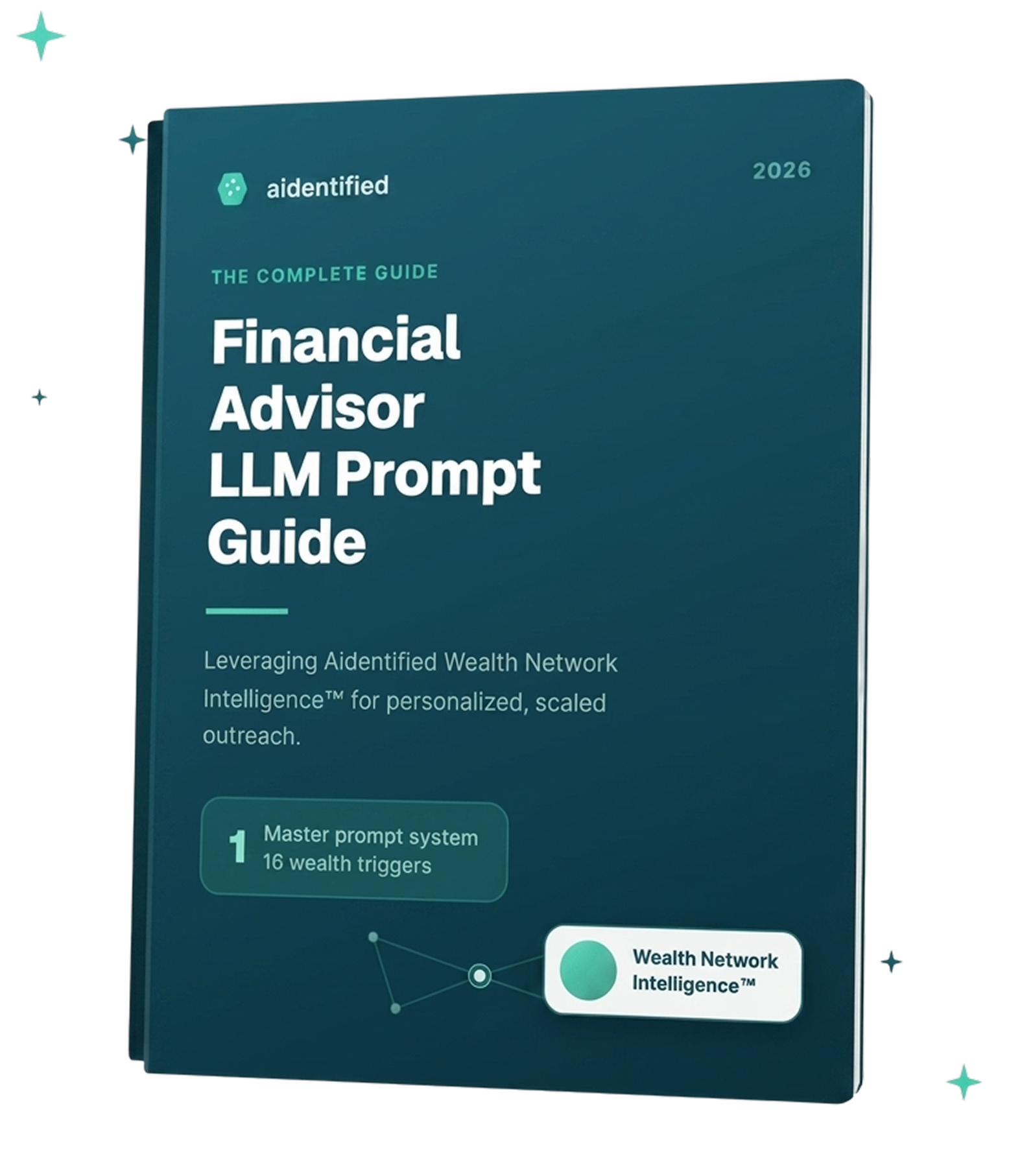
Download the LLM 2026 Prompting Guide
Teach your AI to think like your firm with 10+ customizable prompts
Download TodayMost advisors who have been in wealth management long enough have added several tools to their prospecting process over the years. Something for finding names, a CRM to manage relationships, a scoring layer on top. Each one is built to answer a different question. The one that actually drives new client acquisition, who should I be talking to right now and what is the right reason to reach out, tends to fall in the gaps between them.
This guide ranks the five main categories of wealth management prospecting tools by how much actionable intelligence each one delivers before you pick up the phone. Understanding what each category can and cannot tell you is the fastest way to identify what your stack is actually missing.
Why most wealth management prospecting stacks leave a gap
Financial advisor prospecting does not work like B2B sales. You are not looking for any decision-maker at a company that fits a firmographic profile. You are looking for individuals who have the assets to be a valuable client, whose financial situation is complex enough to need advice, and who are at a point in their lives where they are actually open to a conversation about it.
That last part is the hardest. A prospect who fits your ideal client profile perfectly is still a long shot if nothing has changed in their financial life recently. The ones who make a move tend to be those going through something: a career transition, an inheritance, a business sale, or a significant real estate transaction. Timing and qualification together are what make outreach effective. Most prospecting tools for financial advisors answer one of those questions but not both. The tool that answers both is the one worth building a practice around.
5 wealth management prospecting tools evaluated by intelligence level
1. Aidentified
Best for: financial advisors who need wealth qualification, event timing, and warm introduction paths answered from the same platform
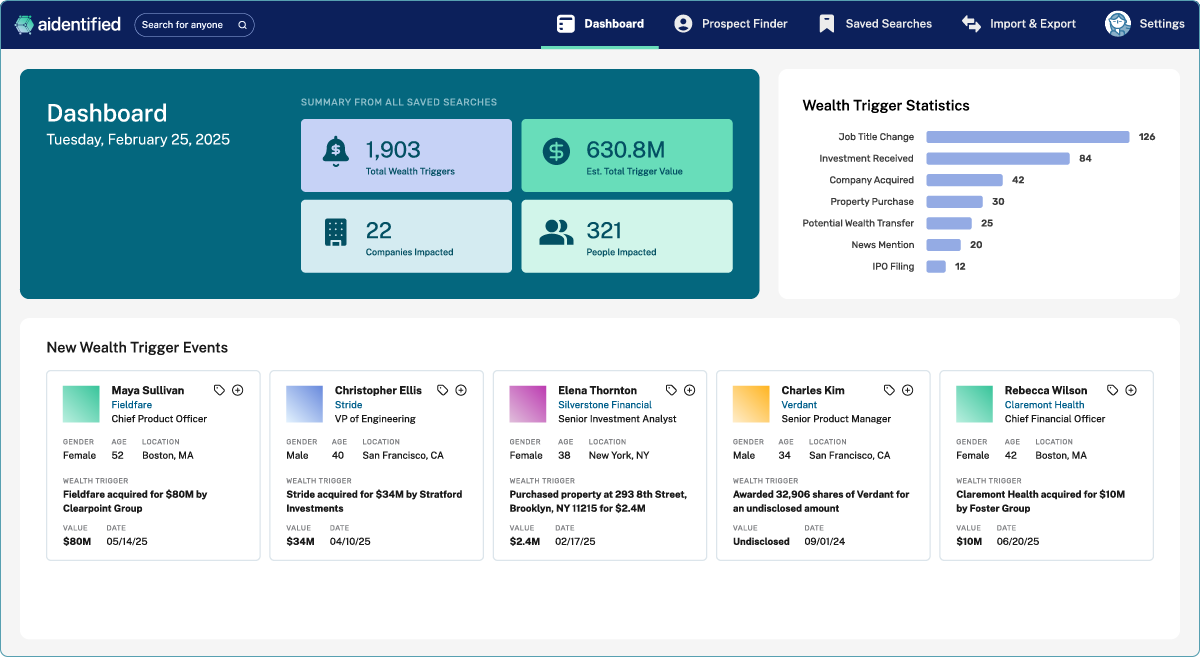
Aidentified is the only wealth management prospecting tool that answers all three questions, who to prospect, when to reach out, and how to get there, from a single platform. Where every other category on this list answers one of those questions in isolation, Aidentified combines them: wealth-qualified prospects, verified wealth event timing, and relationship mapping through your existing network, all visible in the same interface.
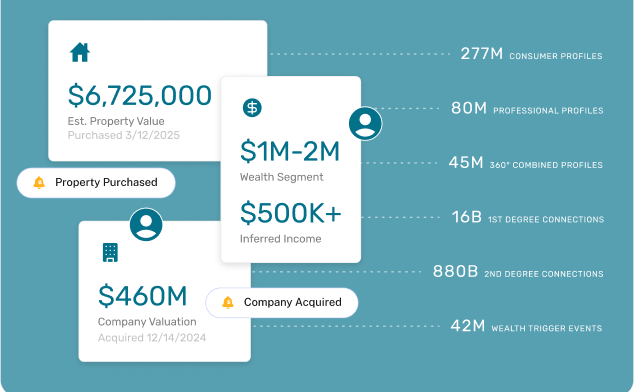
The platform monitors wealth events across 300M+ profiles and maps relationship paths through 16B+ connections. When a prospect on your list experiences a qualifying event, a business sale, an equity distribution, a real estate transaction, a career change into a senior role, you see it. When you want to know who in your existing client base or COI network can make a warm introduction to that prospect, that path is visible too, scored by connection strength so you know which ask is most likely to land.
In practice, the difference is what you walk into the first conversation with. With Aidentified, you have a specific event that just happened, a financial profile that confirms the prospect meets your minimums, and a shared connection who can make the introduction feel relevant rather than cold. That is a fundamentally different starting point than dialing through a ranked list and hoping the timing is right. For more on how this fits into a full prospecting approach, see prospecting strategies for financial advisors.
Key capabilities
- Wealth event monitoring across business sales, career changes, real estate transactions, equity distributions, IPO participation, and inheritance activity
- Estimated net worth and income modeling that distinguishes liquid from illiquid capital, so qualification happens before outreach, not during it
- Full household-level profiles including spouse employment, career history, and property activity. See financial advisor lead generation for how household context changes the lead qualification process.
- Relationship mapping through 16B+ connections to surface warm introduction paths through existing clients and COI networks
- Configurable prospect profile criteria so the platform continuously surfaces new matches as they emerge, not just when you log in to search
- Native CRM integration so event alerts and connection data surface inside the workflow advisors already use
What to keep in mind
Aidentified is purpose-built for financial advisor prospecting software use cases. It is not a general-purpose B2B sales tool. The consumer data and household attributes layer should be reviewed with your compliance team before integrating into client-facing workflows, particularly at registered firms.
Ideal for
Financial advisors and RIAs at any practice size who want to move from reactive referral generation to a systematic, event-driven prospecting process. Also well-suited for firms already using an AI tool for financial advisors or a lead generation tool for RIAs that needs wealth event timing and relationship intelligence layered on top. Try Aidentified for free and run your first search against your own prospect universe.
2. CRM and contact management systems
Best for: organizing existing relationships and tracking outreach activity
A CRM is where a prospecting practice lives, but it is not where it grows. It tracks conversations with potential clients, their stages in the pipeline, follow-up timing, and relationship history. For staying organized across an active book, it is the right tool. For finding new names worth pursuing, it is not.
The constraint is scope. A CRM can only reflect what you have already entered into it. The prospect who fits your ideal client profile is not flagged unless someone added them. The executive who sold her company last quarter, or the business owner your best client plays golf with every month, will not surface on their own. A CRM is a record of what you already know, not a system for discovering what you do not. For the research side, see financial advisor research tools.
Where it falls short for wealth management prospecting
No wealth qualification. No event monitoring. No relationship mapping beyond what has been manually logged. As a standalone wealth management prospecting tool, a CRM answers none of the three core questions. It is the infrastructure layer every advisor needs, and the ceiling most practices accidentally treat as the floor.
What to look for: Native integration with enrichment and event monitoring platforms so CRM records stay current without manual updates, field-level mapping that supports wealth-specific attributes, and workflow automation that triggers follow-up sequences based on external events rather than just internal activity dates.
3. Lead generation databases and list-building tools
Best for: building initial prospect lists filtered by professional attributes
Lead generation databases let advisors filter large contact sets by geography, title, industry, company size, or income proxy, and export a list of names matching those criteria. For advisors who need to expand beyond their existing network quickly, list-building tools produce results faster than manual research.
For wealth management prospecting tools use cases, the filters stop short of what actually matters. Knowing that someone is a VP of Engineering at a Series C company tells you about their role. That role tells you nothing about their equity, whether anything has shifted in their household recently, or whether this is remotely the right moment to reach out. The output is a plausible list of names with no context about whether any of them should be your next client.
Where it falls short for wealth management prospecting
Professional attributes are a starting point, not a qualification. A list filtered by job title and company stage still requires significant enrichment work before any name on it is worth contacting. Without wealth event data layered on top, a lead generation list is a cold call list: efficient to acquire and expensive to convert.
What to look for: Filters that go beyond title and company to include compensation signals, equity indicators, or career stage. Prioritize platforms that allow enrichment with consumer-layer data after export, or that integrate directly with a wealth intelligence platform to append the context the list itself cannot provide.
4. Prospect scoring and prioritization platforms
Best for: ranking existing pipeline contacts by estimated conversion likelihood
Prospect scoring platforms analyze behavioral signals, firmographic data, or CRM activity to produce a ranked list of prospects ordered by estimated conversion probability. For advisors managing large pipelines, scoring reduces the time spent deciding who to contact this week and increases the proportion of outreach directed at warmer names.
A ranked list is a step forward from an unordered one. As a prospecting tool for financial advisors, scoring platforms solve the prioritization problem without solving the timing or access problems. You know one name scores higher than the next. You do not know if something important has taken place in their financial life that would make your outreach timely rather than random. And there is nothing here about how to get in front of them.
Where it falls short for wealth management prospecting
Scoring based on behavioral signals and CRM activity reflects what the prospect has done digitally, not what has happened in their financial life. A business sale, a large equity grant, or an upcoming liquidity event does not appear in a behavioral scoring model. For advisors whose outreach depends on catching a prospect in a genuine decision window, scoring alone produces a better-ordered list of names, with the same underlying gap in timing intelligence. For a deeper look at how timing drives conversion, see how financial advisors build and qualify their prospect pipeline.
What to look for: Scoring methodology that incorporates wealth event signals, not just digital behavior. Confirm whether the platform can ingest external data sources alongside CRM activity, and whether scores update in near real-time or on a monthly batch cycle that misses timing windows.
5. COI referral networks and relationship management tools
Best for: organizing and activating centers of influence for warm introductions
COI referral tools help advisors manage relationships with attorneys, CPAs, and other professionals who can generate introductions to qualified prospects. Some platforms automate outreach cadences to COI partners, track referral volume by source, and flag COI relationships that have gone dormant. For advisors whose practice is built heavily on referral networks, dedicated relationship management tools reduce the administrative overhead of maintaining those relationships at scale.
Among prospecting tools for financial advisors, COI management platforms occupy a specific niche: they improve the organization and consistency of an existing referral strategy. They do not generate new prospects directly, but they increase the yield from the COI relationships an advisor has already built.
Where it falls short for wealth management prospecting
COI referral tools are passive. They help advisors stay in front of existing partners, but they do not identify which COI is connected to a specific high-value prospect, surface the wealth event that makes this week the right moment to make a specific ask, or map the shortest path through a shared connection to a prospect who has not yet been referred. For advisors who want to move from reactive referral generation to a proactive introduction strategy, COI management tools need to be combined with a wealth intelligence platform that surfaces the event and the path together. See best referral sources for financial advisors for how to build a referral strategy that goes beyond passive network maintenance.
What to look for: Integration with your CRM so COI activity is tracked alongside prospect activity, event-triggered prompts that suggest specific asks rather than generic check-ins, and relationship strength scoring that distinguishes high-value COI relationships from low-yield ones.
What to look for when evaluating wealth management prospecting tools
Most evaluations of prospecting software for advisors focus on database size, filter options, and CRM compatibility. For wealth management use cases, those factors matter less than the three questions the tool can answer. Here is how to frame the evaluation.
Does it answer who to prospect, not just who exists?
A tool that returns names filtered by job title or company stage tells you who exists in a category. A tool that answers who to prospect returns names that are wealth-qualified, meaning estimated investable assets meet your minimums and the financial profile suggests complexity that warrants professional advice. Those are different outputs. Wealth qualification before outreach is the filter that separates a prospecting tool from a contact list.
Does it answer when to reach out, not just that a name exists?
Timing is the most underrated variable in advisor prospecting. A perfectly qualified prospect who has not experienced a recent financial shift is still unlikely to move. Wealth event monitoring that flags when a qualifying event has occurred for a specific prospect on your list transforms a static qualification into an actionable outreach trigger. Ask any platform directly: how does it tell you that now is the right time to contact a specific name?
Does it answer how to get there, not just that a prospect exists?
Knowing a prospect is qualified and in a decision window is not enough if the only path is a cold call. Relationship mapping that surfaces warm introduction paths through existing clients and COI networks changes the first conversation from an interruption into a referral. Ask whether the platform maps personal and professional connections, scores those connections by strength, and integrates that data into the same workflow where the wealth event alert surfaced.
Does it integrate natively with your CRM?
A wealth management prospecting tool that requires a separate login and a dedicated context switch gets checked occasionally, not daily. Daily use is the only version that compounds into a systematic prospecting advantage. Confirm whether integration is native or middleware-dependent, whether event alerts surface inside your CRM as actionable notifications, and whether enriched prospect data writes back to contact records automatically. For more on how enrichment fits into a CRM workflow, see Salesforce data enrichment for financial advisors.
Find the right prospects at the right time with Aidentified
Most advisors recognize their current stack somewhere in levels two through four: a list tool, a scoring layer, and a CRM holding it all together. The gap is not the tools themselves. The gap is that none of them answers who to prospect, when to reach out, and how to get there from the same place at the same time.
Aidentified is the only platform on this list that closes that gap. It combines wealth qualification, wealth event monitoring, household-level context, and relationship mapping into a single intelligence layer that integrates with the CRM you already use. Most advisors who connect their existing client base to Aidentified find introduction paths they did not know existed and prospects already in a decision window they had no way to see. Try Aidentified for free and run your first search against your own prospect universe.
FAQs: Wealth management prospecting tools
What is the difference between a CRM and a wealth management prospecting tool?
A CRM records and organizes the relationships and activities you already have. A wealth management prospecting tool surfaces new prospects you have not yet engaged, qualifies them against your ideal client criteria, and identifies when and how to initiate contact. The two categories are complementary, not interchangeable. A CRM without a prospecting layer keeps you organized. A prospecting layer without a CRM has nowhere to send the output. For more on how the two work together, see financial advisor lead generation.
What data should wealth management prospecting tools include?
The attributes that matter most for wealth management prospecting are: estimated investable assets and net worth, wealth event data including business sales, equity distributions, and real estate transactions, household composition including spouse employment and career history, relationship mapping data that surfaces warm introduction paths through existing networks, and career history depth that distinguishes current role from compensation trajectory. Standard B2B databases carry professional fields only. Platforms built for financial advisor prospecting software use cases are designed to carry both professional and consumer-layer attributes in the same profile.
How do wealth event alerts improve financial advisor prospecting?
Wealth event alerts notify advisors when a qualifying financial event has occurred for a specific prospect on their list: a business sale, a senior role change, an equity distribution, a real estate transaction, or an inheritance. That event opens a window during which the prospect is actively thinking about their financial situation and is genuinely receptive to a relevant conversation. Outreach timed to a wealth event converts at significantly higher rates than fixed-cadence outreach to the same prospect because the timing matches the prospect's actual decision moment rather than the advisor's outreach schedule. For a full breakdown of how to build a timing-first prospecting approach, see prospecting high-net-worth clients.
How many prospecting tools does a financial advisor actually need?
The right number depends on what each tool in the stack answers. Most stacks of financial advisor research tools settle around a CRM, a list-building tool, and a scoring layer, covering contact management, name generation, and prioritization. What is typically missing is the layer that combines wealth qualification, event timing, and relationship mapping into a single actionable output. Adding a wealth intelligence platform as the fourth layer closes that gap without requiring additional tools for each individual function. The goal is not more tools. It is fewer gaps between the questions that drive new client acquisition.



growth engine with the
LLM Prompting Guide.
Reveal the power of your network with Aidentified’s industry-leading AI.
Discover how Aidentified can transform your specialty services business. Contact us today for a personalized consultation and demo.
Explore a demo