What CRM for financial advisors actually needs to do for new business prospecting

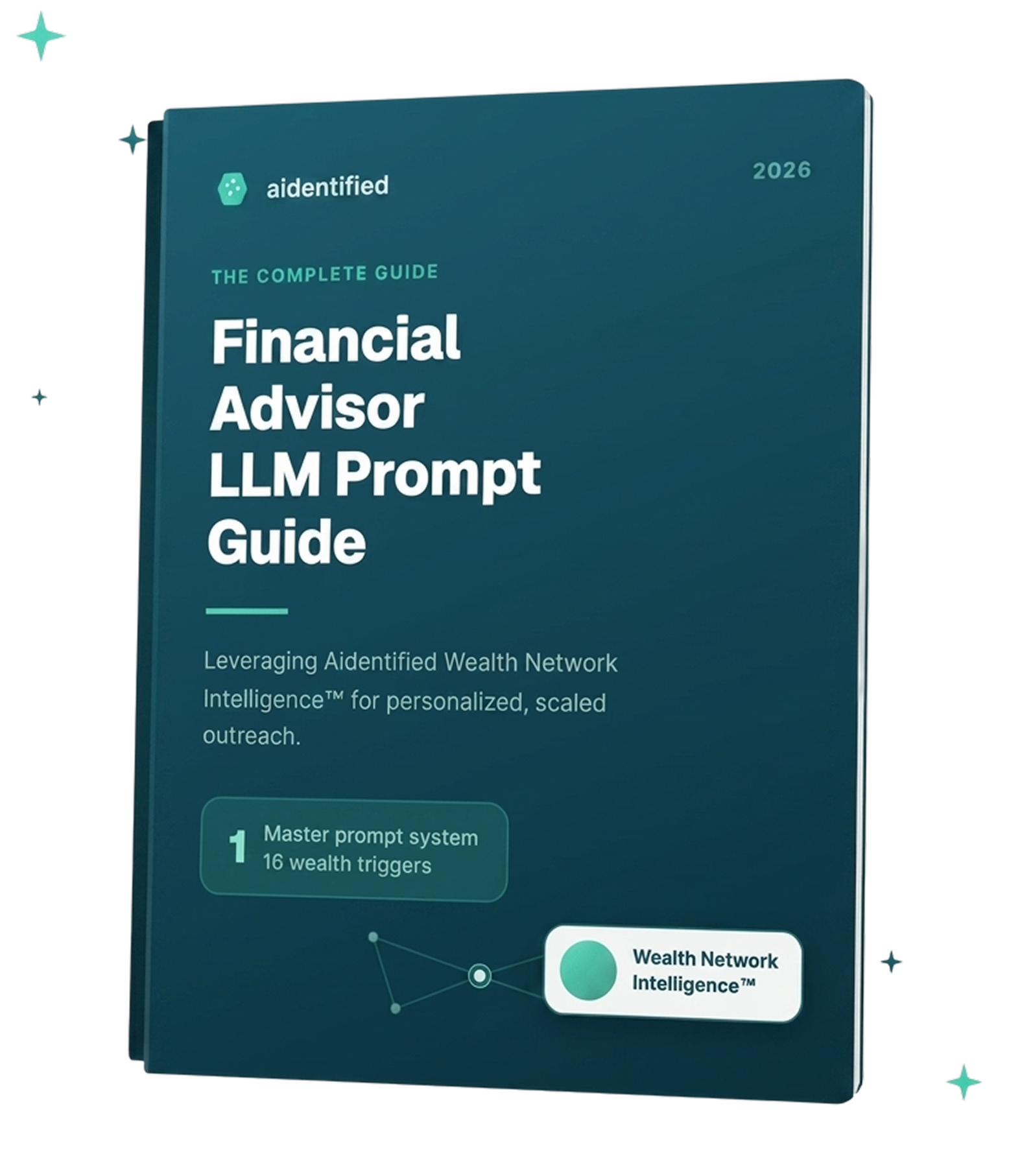
Download the LLM 2026 Prompting Guide
Teach your AI to think like your firm with 10+ customizable prompts
Download TodayNearly every financial advisor has a CRM. Having one and having the right one are different things. Most CRM software was built for sales teams chasing corporate buyers on defined cycles, and it does that job well. Financial advisors are doing something different: building long-term relationships with individuals whose financial situations change in ways that either open or close opportunity windows. The right AI tool for financial advisors is designed around that reality, not around sales cycles.
A CRM that stores contacts reliably but never surfaces when those contacts enter a financial decision window is a record-keeping tool, not a prospecting one. This article is a practical guide for advisors evaluating whether their current setup is actually built for the kind of prospecting they do, or whether a dedicated prospecting tool for financial advisors would serve them better.
What financial advisor CRM software gets right, and where it stops
Financial advisor CRM software solves real problems. Contact management, pipeline visibility, activity logging, and basic compliance workflows are well-handled by most platforms. The category has matured enough that the operational side of an advisory practice is covered reliably across purpose-built and general platforms alike.
The issue is not what CRMs do well. It is what they were never designed to do: surface wealth events, monitor household changes, or show the fastest path to a warm introduction. The gap is not a feature request. It is a structural mismatch between what CRM software tracks and what advisor prospecting actually requires.
What most financial advisor CRM software handles well
Purpose-built and general CRMs alike handle the operational side of an advisory practice reliably. Contact records, task reminders, compliance logging, and pipeline stages are table stakes that most platforms deliver. Advisors should not expect to differentiate here. The question is what sits on top of those foundations, and whether the answer is anything at all for HNW prospecting.
Why your CRM knows who to reach but not when
The core limitation of financial advisor CRM software is timing. A contact record captures a snapshot. It does not update when a prospect sells a business, receives equity, changes roles at a high-growth company, or completes a property transaction. Those are the moments when an advisor's outreach is genuinely relevant. Without a layer that monitors for those events and surfaces them automatically, the CRM is a storage tool, not a prospecting one.
The household data gap most financial advisor CRM software leaves unfilled
Financial decisions are rarely made by individuals in isolation. Household composition, a spouse's employer, shared property holdings, and family wealth relationships shape the picture in ways that a single contact record never captures.
Most financial advisor CRM software stores one record per contact without household context. Advisors evaluating their setup should ask whether the platform supports household grouping that actually carries data, not just a label that links two separate records with no additional insight.
What CRM for wealth management actually needs to do
A CRM for wealth management has a different job than a CRM for a software sales team. It is not just tracking conversations. It is knowing which contacts are in an active financial decision window, what the household context looks like, and how to reach a prospect through someone they already trust.
Here are the three capabilities that separate a wealth management CRM setup from a standard one.
Wealth event monitoring as a prospecting advantage
Timing is the variable most CRM software ignores entirely. A business sale, a liquidity event, a senior role change at a pre-IPO company, or a significant real estate transaction: these are the moments when a prospect is actively thinking about their wealth. A CRM for wealth management needs to either monitor for these events natively or integrate with a platform that does. Advisors who know about a wealth event before it passes have a structural advantage over those working from a static contact list.
For a practical look at how timing-first prospecting changes outreach results, see this guide to financial advisor prospecting.
Household context and how financial decisions get made
The most useful prospect profiles in wealth management include data that sits outside any professional database. Property records, household composition, estimated net worth, equity holdings, and family relationships are what determine whether a lead is worth reaching out to and when.
A contact who looks unremarkable by title and employer looks entirely different with household and wealth context layered in. That same person may be the gateway to a multi-generational client relationship, or the start of a referral chain through a spouse's network. Household context is not a nice-to-have. For HNW prospecting, it is often the entire decision.
CRM integrations for financial advisors that add intelligence
The quality of CRM integrations for financial advisors varies significantly. Some integrations append contact details and job title updates. Others surface wealth events, household data, and relationship maps directly inside the advisor's workflow.
Enrichment that fills fields is useful but passive. Enrichment that flags when a contact has entered a financial decision window is what changes how an advisor spends their day. Advisors should evaluate integrations specifically on what triggers they support, not just what data they append.
Top CRM tools and integrations for financial advisors
The five categories below cover the main types of platforms advisors use. Each has a distinct strength and a distinct limitation for HNW prospecting. The goal is not to find the most feature-rich platform. It is to find the right foundation and understand what it needs alongside it.
1. Aidentified: the intelligence layer for HNW prospecting

Aidentified is not a standalone CRM and is not designed to replace one. It is the data and intelligence layer that connects to whichever CRM an advisor already uses and fills in what CRMs do not natively carry.
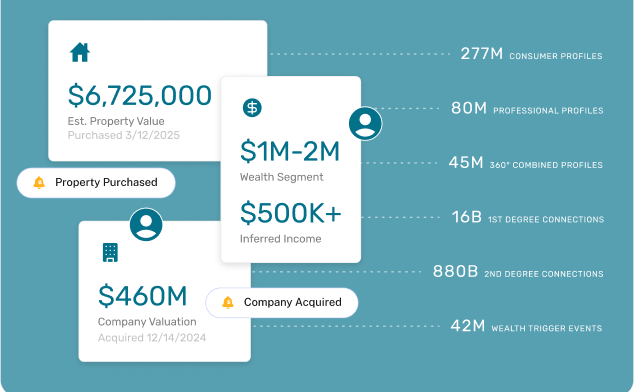
It monitors 300M+ profiles continuously, combining consumer and professional signals to surface household-level wealth data, real-time wealth events across 16 event types, and relationship paths through 16B+ connections. When a qualifying event happens, it surfaces automatically in the advisor's CRM workflow. Best for: any advisor who wants their existing CRM to function as an active prospecting tool rather than a contact database.
Aidentified integrates natively with leading advisor and enterprise platforms. For advisors already using a prospecting tool for financial advisors or evaluating the category, it adds the wealth intelligence layer that no standalone CRM carries natively.
2. Purpose-built advisor CRM platforms
This category covers platforms built specifically for financial advisors and registered investment advisers. Their strength is alignment with the operational structure of an advisory practice: compliance-aware workflows, account aggregation hooks, and integrations with custodian and portfolio management systems.
Their limitation for HNW prospecting is the data layer: contact records are well-organized but static, and these platforms do not monitor for wealth events or surface relationship paths natively. They integrate with Aidentified for enrichment. Best for: advisors and RIAs who need a compliance-ready foundation with flexibility to add intelligence on top.
3. Enterprise CRM platforms adapted for financial services
This category covers highly configurable platforms built for enterprise financial services, with large ecosystems of industry-specific packages and deep integration options. They offer greater flexibility for larger or more complex practices, but require significantly more setup and administration than purpose-built advisor platforms.
Native data enrichment capabilities are limited or deprecated in most platforms in this category, so adding wealth data, event monitoring, or relationship intelligence requires a third-party integration. Aidentified integrates natively to fill that gap. Best for: larger practices or enterprise firms that need configurability and already have technical resources for implementation.
For context on what that enrichment gap looks like in practice, see this guide to Salesforce data enrichment for financial advisors.
4. Marketing-focused CRM platforms
This category covers platforms that combine contact management with marketing automation. Pipeline visualization, email sequences, and reporting are well-developed. For advisors who rely on campaigns and nurture workflows alongside relationship management, they offer a meaningful operational advantage.
Their limitation is the data model: these platforms were built for B2B marketing and sales teams, which means they track professional activity and company-level relationships well but lack the consumer-layer data HNW prospecting depends on. Household context, wealth estimates, and financial event monitoring are not part of their native dataset. Aidentified integrates with platforms in this category to add that layer. Best for: advisors with a significant marketing automation need alongside relationship management.
5. General CRMs adapted for advisory use
This category covers general-purpose platforms that some advisors use because of familiarity, cost, or an existing tech stack. They offer solid contact management and pipeline tracking but were not built for financial services workflows: compliance features, household data models, and wealth event monitoring are absent.
Advisors using these platforms for HNW prospecting are working around the tool rather than with it. The customization required to approximate advisor-specific functionality adds overhead that rarely justifies the cost savings. Best for: solo advisors in early stages who need a lightweight starting point and plan to migrate as the practice grows.
How to choose the right CRM for financial advisors
The right CRM for a practice depends on three variables that advisors rarely think through explicitly before choosing.
First, compliance and reporting complexity determines whether a purpose-built RIA platform or a more configurable enterprise option is the right foundation. Second, the balance between proactive HNW prospecting and referral-driven growth determines how much weight the enrichment and intelligence layer should carry relative to the CRM itself. Third, the need for marketing automation determines whether a platform with built-in campaign tooling makes sense or whether a leaner CRM with a separate integration is more efficient.
Most advisors get the CRM right and underinvest in the layer on top of it. The CRM category is well-solved. The intelligence layer sitting inside or connected to any CRM is what determines whether an advisor can prospect HNW clients effectively. For a broader view of how to build that layer, see this guide to wealth management prospecting tools.
Make your CRM for wealth management work harder with Aidentified
Most advisors who connect Aidentified to their existing CRM for the first time find two things: contacts they thought were cold are in a financial decision window right now, and the path to a warm introduction runs through a client they already have. The CRM already holds the starting point. Aidentified makes what it's connected to visible.
If you're ready to add the intelligence layer your CRM is missing, try Aidentified for free.
FAQs: CRM for financial advisors
Does financial advisor CRM software include wealth data?
Most do not include wealth data natively. Purpose-built advisor CRMs are built around contact management, compliance workflows, and portfolio integrations, not wealth intelligence. Adding household-level wealth data, financial event monitoring, and relationship mapping requires a third-party integration. That is the gap platforms like Aidentified fill. For advisors considering their options, see this guide to financial advisor lead generation for context on what the full prospecting stack looks like.
What's the difference between a financial advisor CRM and a general CRM?
Advisor-specific CRMs come pre-built with features like household account linking, AUM tracking, compliance activity logs, and custodian integrations. General CRMs require heavy customization to replicate those workflows, which increases both cost and maintenance overhead. For most advisory practices, starting with a purpose-built platform and adding a wealth intelligence integration is more efficient than customizing a general CRM from scratch. See how that intelligence layer fits into a broader lead generation tool for RIAs workflow.
How long does it take to implement a CRM as a financial advisor?
A solo advisor with clean data can be operational in one to two weeks. Ensemble practices or firms migrating from another system typically need four to twelve weeks, depending on data complexity, integration requirements, and staff training. Adding a wealth intelligence integration like Aidentified on top of an existing CRM is typically faster: the platform connects to the existing data structure rather than replacing it.



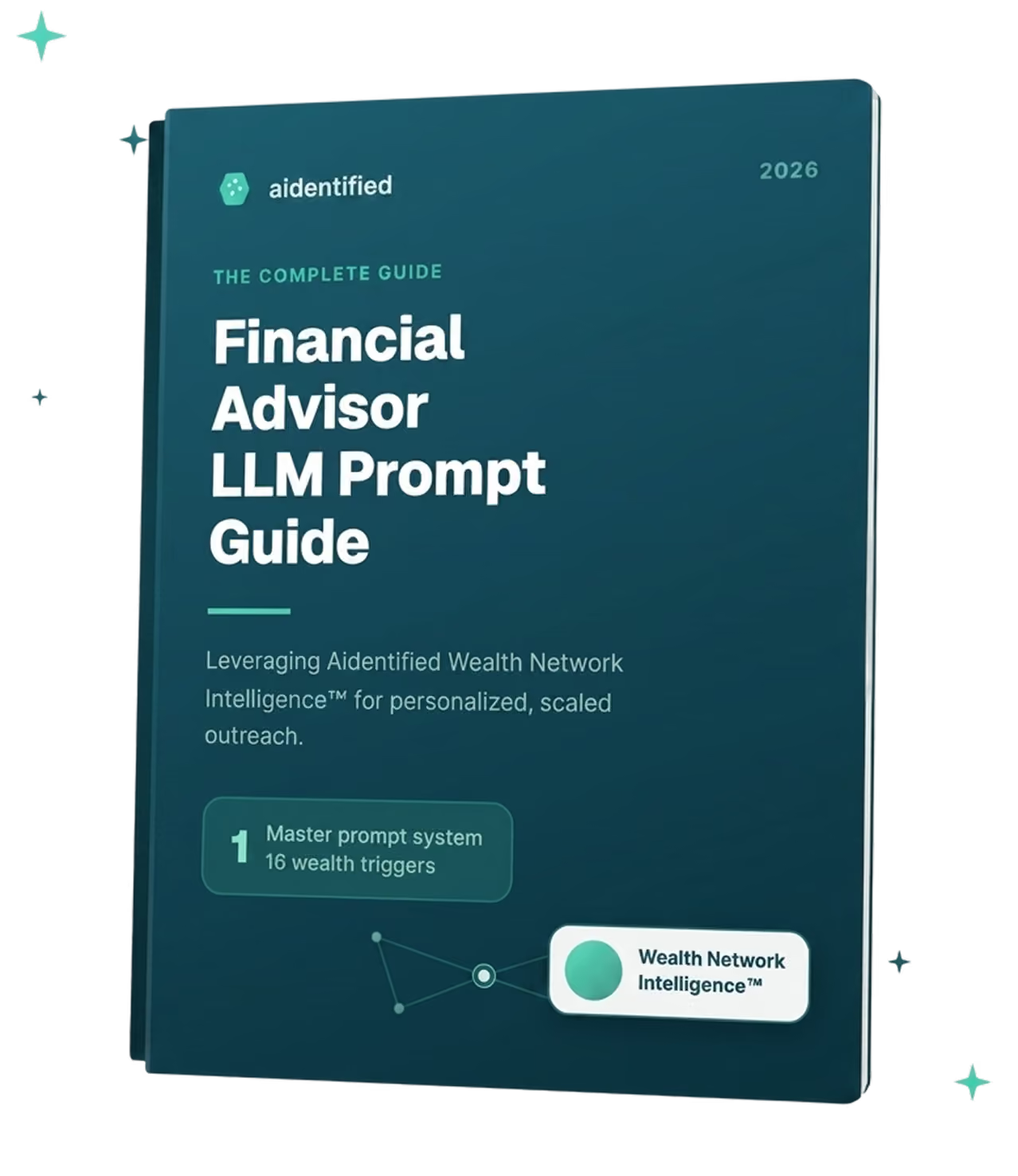
growth engine with the
LLM Prompting Guide.
Reveal the power of your network with Aidentified’s industry-leading AI.
Discover how Aidentified can transform your specialty services business. Contact us today for a personalized consultation and demo.
Explore a demo