Financial advisor lead generation that fills your pipeline with qualified leads

This is a div block with a Webflow interaction that will be triggered when the heading is in the view.
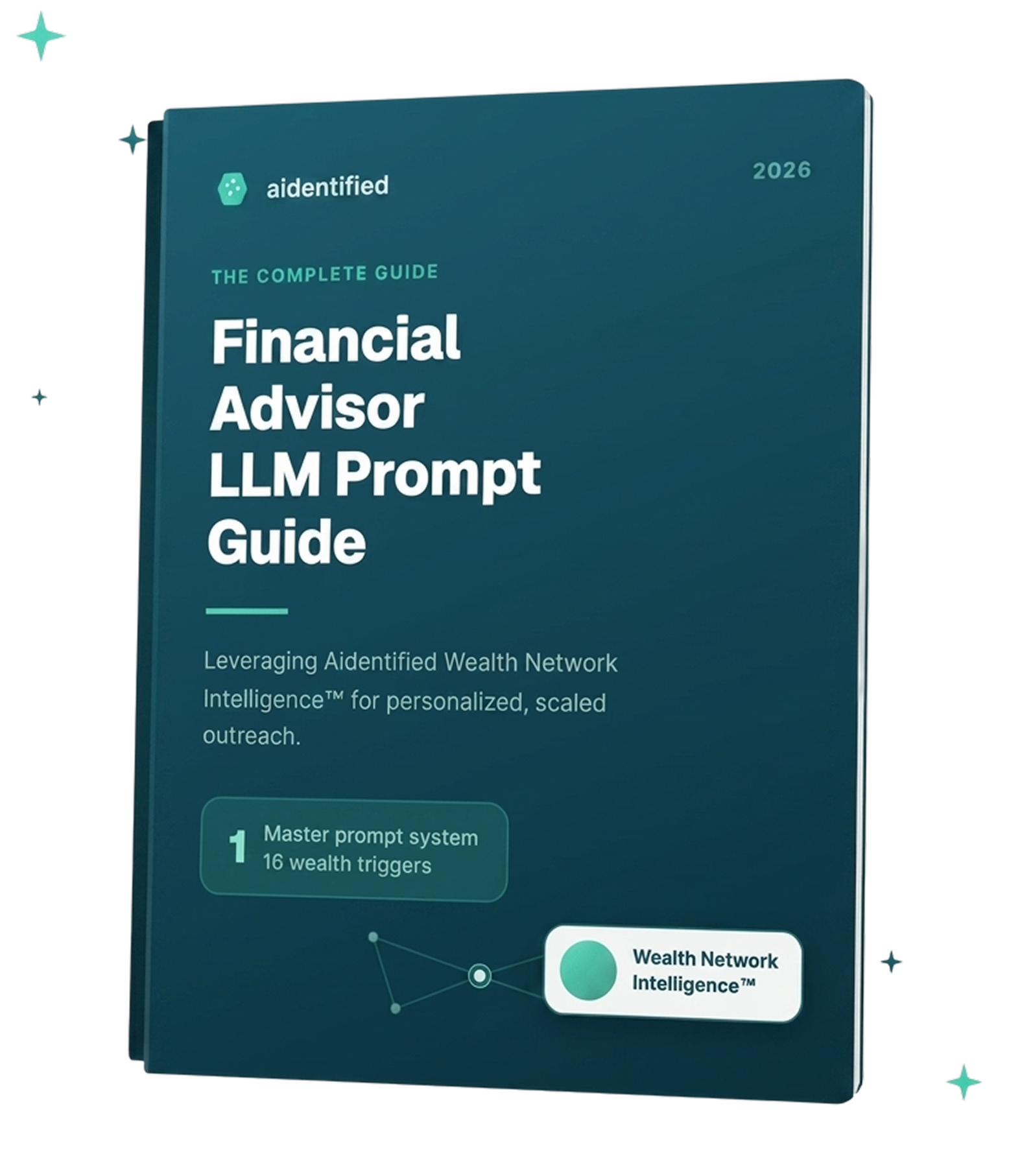
Download the LLM 2026 Prompting Guide
Teach your AI to think like your firm with 10+ customizable prompts
Download TodayTL;DR
Lead quality comes from what you know before first contact, not from the channel you picked or the volume you pushed through it.
Four questions decide whether a prospect is worth contacting now: liquidity, recent wealth events, a warm path in, and their current advisor relationship.
Referrals and COI introductions carry the most context by default. Webinars, LinkedIn and inbound need enrichment before the first follow-up.
Aidentified monitors 16 wealth event types across 300M+ profiles and maps the introduction paths that turn a name into a warm conversation.
Financial advisor lead generation breaks down at a predictable point. You have names, a channel, and a calendar reminder telling you to reach out. What you rarely have is a reason for this person to talk to you this week.
That gap explains why two advisors running identical lead generation strategies report completely different conversion rates. One is working a list. The other is working people whose financial lives just changed, using a prospecting tool for financial advisors to see the change before the outreach happens.
The channels below run from highest to lowest default insight, and every one of them improves when you feed warm leads for financial advisors into the top of the funnel.
What lead generation for financial advisors requires
Most lead generation for financial advisors gets measured by volume. Leads in, meetings booked, close rate at the end of the quarter. The number that actually moves is how much you know about each person before you say hello.
A prospect you understand converts at a rate a stranger never will. That holds across referrals, seminars, cold outreach and inbound, and it explains more variance than any of the marketing strategies you layer on top.
Four questions to ask first
Answer four things before you make contact:
- Does this person have liquidity available, and roughly how much?
- Has something changed in their financial life in the past ninety days?
- Is there a warm path to them through someone you already know?
- Is there any sign their current advisory relationship is in flux?
A prospect who clears two of the four belongs at the top of today’s list. The rest belong on a watch list, monitored until something moves.
Where traditional prospecting stalls
Traditional prospecting answers none of those four questions. Cold calling a purchased list or running the same digital marketing campaign as everyone else treats every name as equally ready, and these prospecting ideas for advisors cover better starting points.
Contact data also decays at roughly 30% a year, so a target market list built eighteen months ago is partly fiction. The record looks current. The opportunity is gone.
How lead generation for financial services differs from B2B
Financial services buyers do not behave like software buyers, and lead generation financial services programs have to account for that. Someone placing twenty years of accumulated wealth moves through people they trust, on a timeline set by events in their own life.
That changes what a single lead is worth. In wealth management, one relationship can carry more AUM than a hundred marketing qualified leads pulled from a general B2B playbook.
Compliance shapes every channel
Registered investment advisors work under advertising and testimonial rules that shape what a client referral can look like and how it gets documented. Mass automated outreach creates review burden quickly, and it converts poorly with high-net-worth individuals anyway.
Warm introductions carry less compliance friction and more credibility at once. That is the practical case for building lead generation strategies on relationships.
Five channels that produce financial advisor leads
The five channels below produce financial advisor leads at very different levels of insight. Order matters more than count, because a low insight channel outperforms a high one the moment you enrich what comes through it.
1. Referrals and COI introductions
If you want to win UHNW referrals, referrals from clients and centers of influence carry the most context of any channel. A COI relationship with a CPA or estate attorney puts you in the room when a business sale closes or a retirement planning conversation starts.
Most advisors treat these relationships passively, checking in quarterly and hoping. The advisors who get real volume from COIs arrive with a specific name and a specific event. Mapping a client’s network before you ask makes the request concrete, and there are repeatable mechanics behind getting more referrals fast.
2. Wealth event monitoring
A wealth event is a change that puts money in motion for mass affluent clients and the ultra-wealthy alike: a company sale, an IPO, an executive role change, a property transaction, an inheritance. Each one opens a window where a new advisor conversation is welcome.
Cerulli Associates projects $124 trillion transferring between generations through 2048, with 42% of it coming from high-net-worth and ultra-high-net-worth households. Most of that money announces itself through an event before it moves. Monitoring beats scheduling, and it only scales when the watching is continuous.
3. LinkedIn and thought leadership
LinkedIn surfaces job changes, promotions and company news across your target market, and consistent thought leadership makes you recognizable before you reach out. Both cost little and both compound.
LinkedIn shows the professional change and stops there. It says nothing about household wealth, available liquidity, or who could introduce you. Use it as the follow-up layer after a wealth event surfaces somewhere else.
4. Webinars, seminars and events
Webinars and seminars produce self-selected attendees, which is a genuine interest signal. Someone who spends an hour with you on estate planning has told you something a purchased list never will.
What you hold afterward is a name and a topic. Enrich the attendee list before the first follow-up so you know which registrants deserve a call this week. That one step changes the conversion rates of every event you run.
5. Content marketing and lead capture
Content marketing and well-placed calls-to-action on advisor websites bring people to you. Lead capture forms, gated guides and clear CTAs turn traffic into contacts your team can work.
Inbound hands you behavioral signal and little else. Wealth, household composition and timing get added after the form submission, which is why the strongest inbound programs treat enrichment as a required workflow step.
Choosing a financial advisor lead generation service
Buying leads and buying data insights are different purchases. A financial advisor lead generation service that sells contact lists hands you volume. A data platform hands you the reason to call.
Ask what a vendor knows about the person, not how many people they have. The prospecting strategies for financial advisors that survive contact with a real pipeline are built on that distinction.
What to check before buying
Ask whether the wealth estimate covers every profile or only the ones someone happened to research. Ask how often profiles update and what the verification process looks like. Ask whether household members are included, because a spouse’s board seat is often the warm path.
Then ask about your CRM. A lead generation tool for RIAs that fails to write back into Salesforce, HubSpot or Redtail creates a second system your team will quietly stop opening.
Questions about fit and scale
A solo practitioner and a hundred-advisor firm need different things from the same data. The independent advisor wants qualified leads and a warm path in. The enterprise firm wants network coverage across the advisor force, plus the reporting a CIO will ask for during procurement.
Both cases come back to one test: does this tell you who to talk to, when, and how to reach them? For the tactical side of the channel mix, these financial advisor prospecting ideas go deeper.
Turn wealth events into qualified leads with Aidentified
Aidentified is the insights layer that sits on top of the CRM you already run. It combines household consumer data with professional data into unified profiles, tracks the events that put money in motion, and maps the relationship paths that lead to an introduction.
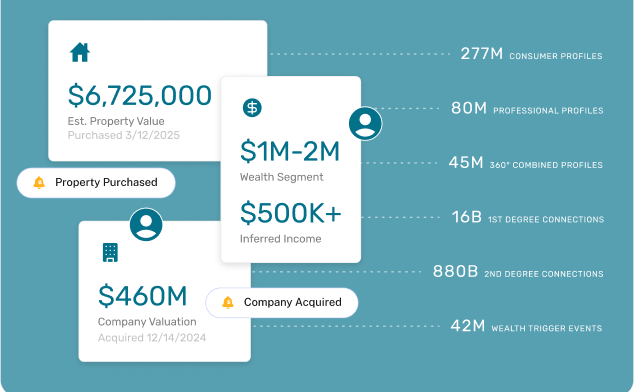
The platform monitors 16 wealth event types across 300M+ profiles, and a 100% fill rate on wealth and income ranges means every profile carries a wealth estimate. Profiles update continuously through a six-layer verification process. Relationship mapping across 16B+ first degree connections shows you who in your network can make an introduction, ranked by strength.
That combination powers better decisions across prospecting, client management, service and strategic growth. The same data that flags a prospect who just sold their company tells you which existing client needs a call this quarter, which is why prospecting high-net-worth clients and serving your existing book can run on one dataset.
Build a lead generation system that compounds
Right now you are probably choosing who to call based on when you last called them. That is a scheduling system, and it produces the conversion rates you would expect from one. When the list reorders itself around who moved this week, the same outreach effort lands on people who have a reason to answer. Book your demo to see it run against your own book.
FAQ: Do you have any questions?



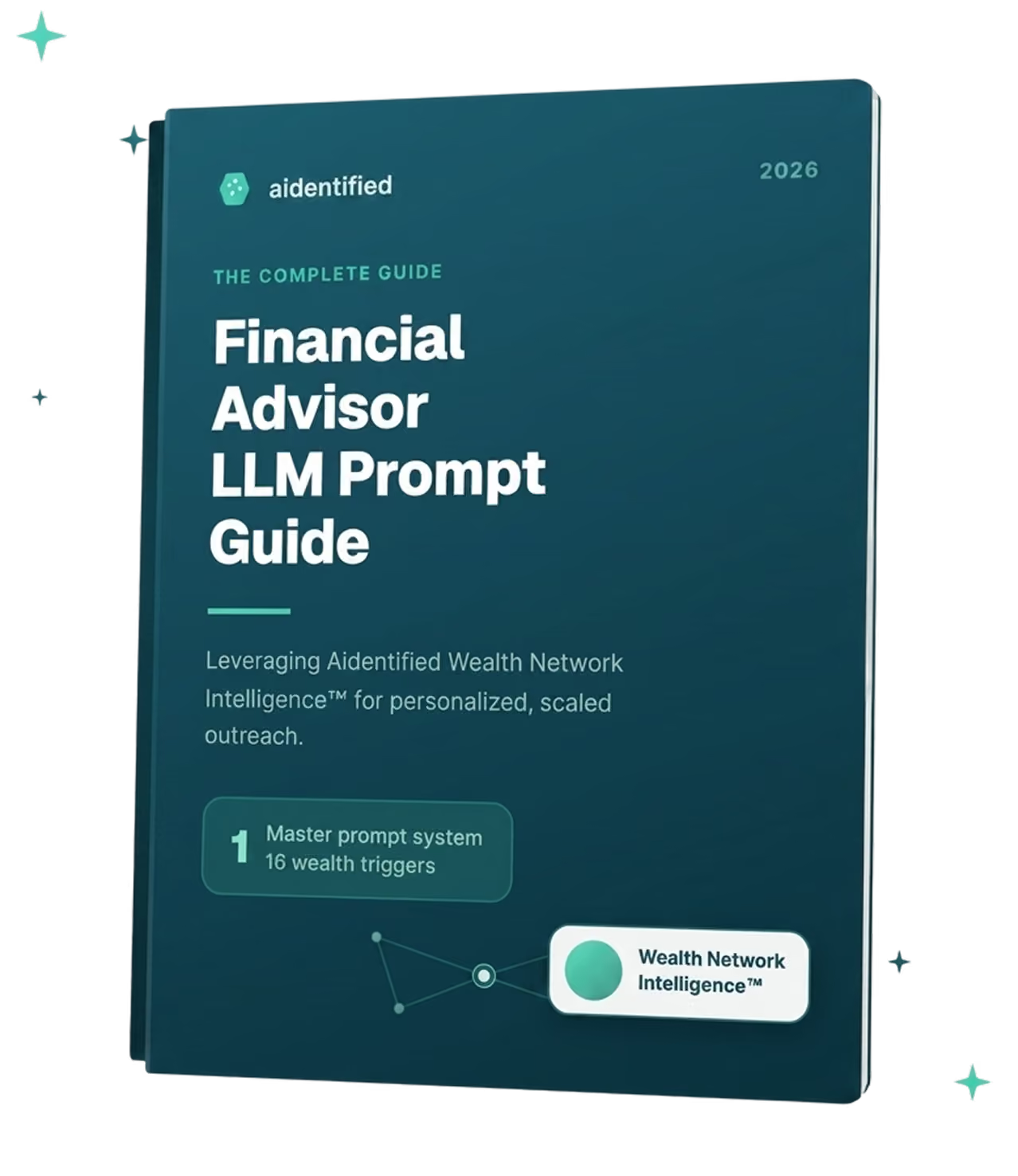
growth engine with the
LLM Prompting Guide.
Reveal the power of your network with Aidentified’s industry-leading AI.
Discover how Aidentified can transform your specialty services business. Contact us today for a personalized consultation and demo.
Explore a demo