8 Prospecting strategies for financial advisors that convert in 2026

This is a div block with a Webflow interaction that will be triggered when the heading is in the view.
Download the LLM 2026 Prompting Guide
Teach your AI to think like your firm with 10+ customizable prompts
Download TodayTL;DR
Timing informs conversion. A prospect who had a wealth event last month answers. Six months later, that person has already chosen someone.
Your wealth segment shapes the method. Mass affluent prospecting can reward scale, and high-net-worth work leans on household depth and warm introduction paths.
The highest-converting move pairs one specific introduction ask with one wealth event, made through a client who knows the prospect personally.
Aidentified tracks 16 wealth event types across 300M+ profiles and ranks the introduction paths already sitting inside your book of business.
Prospecting strategies for financial advisors get judged by activity: calls placed, emails sent, connection requests accepted. Activity is easy to count, but explains little about why one advisor adds fifteen households a year and the advisor down the hall adds three.
Timing is what explains most of it. A prospect who sold a business last month has questions that need answers this week, and those events are what advisor prospecting software exists to surface. That is why warm leads for financial advisors close at rates a purchased list never reaches.
The eight strategies below are ordered by the trust signal each one carries. One filter changes how you apply all of them: the wealth segment you serve.
Why most financial advisor prospecting tips underperform
Most financial advisor prospecting tips come from B2B software playbooks, which optimize for activity volume because the buyer universe is large.
Advisory conversion depends on whether a prospect's financial life changed recently enough that guidance feels urgent. A qualified prospect who has not recently experienced a financial event is a contact who might become a prospect someday.
Contact data decays at roughly 30% a year, so a list built two years ago is partly fiction. The record looks current. The opportunity is gone. The useful question is who entered a decision window this month.
Wealth segments change what prospecting requires
Cerulli Associates projects $124 trillion transferring between generations through 2048, with 42% of it coming from high-net-worth and ultra-high-net-worth households. Each of those households enters a decision window through a different door.
Advice that ignores segment produces the inconsistent results advisors blame on the channel. A tactic that fills a mass affluent pipeline rarely lands with a family office.
Build a prospecting strategy by segment
Name the segment your practice serves, then set your prospecting strategy against it. Wealth level, life stage, industry and geography give every decision a filter: which connections to pursue, which centers of influence to cultivate, which wealth events to watch.
Advisors serving several segments run separate plays: one target audience, one channel mix, one cadence.
Mass affluent prospects reward scale
Mass affluent households often make advisory decisions around life stage: a new job title, a first inheritance, a retirement date coming into view. Volume can reward you here, because planning needs across the segment rhyme even when households differ. That is what makes mass affluent wealth management a scale discipline.
This is where lead generation mechanics earn their keep. Digital marketing, a clear value proposition on your site, and search engine optimization that answers financial planning questions generate leads at scale, and the qualified leads often cost less than HNW channels. Scale gets you the meeting, and household detail still wins it.
High-net-worth prospects reward depth
At higher wealth levels the prospect already has an advisor, so the entry point is a warm introduction timed to an event the incumbent relationship was never built to handle. Research replaces volume here, and one household can carry the AUM of fifty mass affluent clients.
Household composition, board seats, business ownership and the estate attorneys already involved shape that conversation, which is why prospecting high-net-worth clients rewards the advisor who arrives informed.
8 prospecting strategies for financial advisors
The first five build the pipeline and the last three scale it. Every one works better when you know what changed in a prospect's financial life this quarter.
1. Define your target market first
Unfocused prospecting is the most common reason advisory pipelines stay thin. When every outreach targets a different type of prospect, none of it connects.
A defined target market is the precondition for everything else on this list. You cannot monitor wealth events without knowing whose events to watch. Write the definition in one sentence and check every prospect against it.
2. Map your second-degree network
Your clients are already connected to the prospective clients you want to reach. Before building a cold list, map what your book of business contains: former colleagues, business partners, fellow board members, neighbors approaching a transition.
Most advisors find warm paths to dozens of prospects they never approached. That pipeline costs nothing to acquire, and relationship-building inside it moves faster because trust arrives before you do.
3. Prospect around wealth events
A wealth event is a change that puts money in motion, and it shifts a prospect's situation in ways their current advisor may not be equipped to handle.
The events that consistently open a window include business sales and liquidity events, equity vesting and company acquisitions, senior role changes with complex compensation, inheritance and estate settlement, and divorce or widowhood. The event is what makes outreach timely instead of intrusive.
4. Ask for specific introductions
Referrals stall on vagueness. "If you know anyone who might benefit from working with me" hands your client an impossible task: scanning a whole social network against loose criteria. Most will nod and forget.
The ask that converts names one person and gives one action. "I saw your former colleague sold their stake last quarter. If you two are still close, I would welcome an introduction, and I can draft a note you could forward." Specificity turns a request into a single yes-or-no question.
5. Build COI relationships with professionals
CPAs, estate attorneys and business brokers meet clients at the moment a wealth event happens, which places them earlier in the decision window than most financial professionals reach on their own.
COI relationships take patience and real exchange: share useful information, make introductions yourself, show your work with the client type they serve. Credibility transfers from the referring professional to you, which is why centers of influence rank among the best referral sources you can develop.
6. Use LinkedIn as a credibility layer
LinkedIn works best as the thing a referred prospect checks before replying. A LinkedIn profile that states who you serve turns a lukewarm introduction into a booked meeting.
Treat every visibility channel the same way. A podcast appearance, a white paper, webinars, educational events, SEO and steady posting on social media platforms all support warm introductions. Cold outreach through them converts poorly, for the reason cold calling does: no trust exists yet.
7. Segment outreach by prospect readiness
Sorting your pipeline by contact type wastes your best hours. Sort it by readiness. Prospects inside an active wealth event window get specific outreach from you personally.
Qualified prospects with nothing moving get light maintenance: email marketing, a quarterly check-in, an invitation to the next event. Concentrating your best hours on the moments that convert is the cheapest gain in your sales process.
8. Scale with relationship insights
The first seven strategies work by hand until they do not. Once a book passes twenty or thirty households, tracking who your clients know and who just had an event needs digital tools for financial advisors built for it.
Relationship insight platforms map the connections between your book and your target market, score each path by strength, and watch for the events that signal readiness. Compare wealth management prospecting tools on those three functions, because event detection varies widely.
Scale prospecting as a financial advisor with Aidentified
Aidentified is the insights layer that sits on top of the CRM you already run. It combines household and professional data into unified profiles, tracks the events that put money in motion, and maps the paths to an introduction.
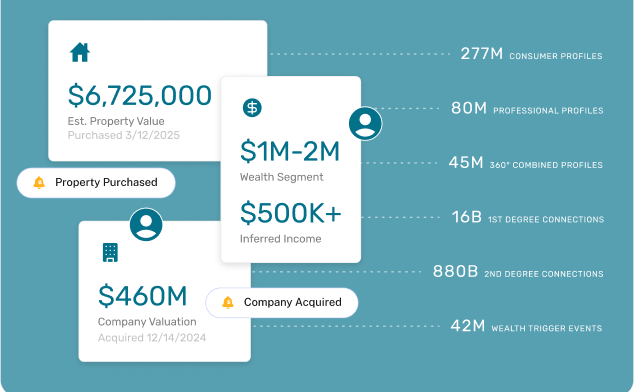
The platform tracks 16 wealth event types across 300M+ profiles, and a 100% fill rate on wealth and income ranges means every profile carries a wealth estimate. Profiles update continuously through a six-layer verification process. Relationship mapping across 16B+ first degree connections shows who in your network can make an introduction, ranked by strength.
That combination powers better decisions across prospecting, client management, service and strategic growth. The data that flags a prospect who just sold a company also names the client who deserves a call, and it flows into Salesforce, HubSpot, Redtail, Lofty and Wealthbox so client acquisition and service run on one dataset.
Put timing at the center of your prospecting
Right now you are probably deciding who to contact based on when you last contacted them. That is a calendar, and it converts like one. When the list reorders itself around who moved this week, the same effort reaches people with a reason to answer. Book your demo to see it run against your own book.
FAQ: Do you have any questions?



growth engine with the
LLM Prompting Guide.
Reveal the power of your network with Aidentified’s industry-leading AI.
Discover how Aidentified can transform your specialty services business. Contact us today for a personalized consultation and demo.
Explore a demo