How to grow your client base as a financial advisor

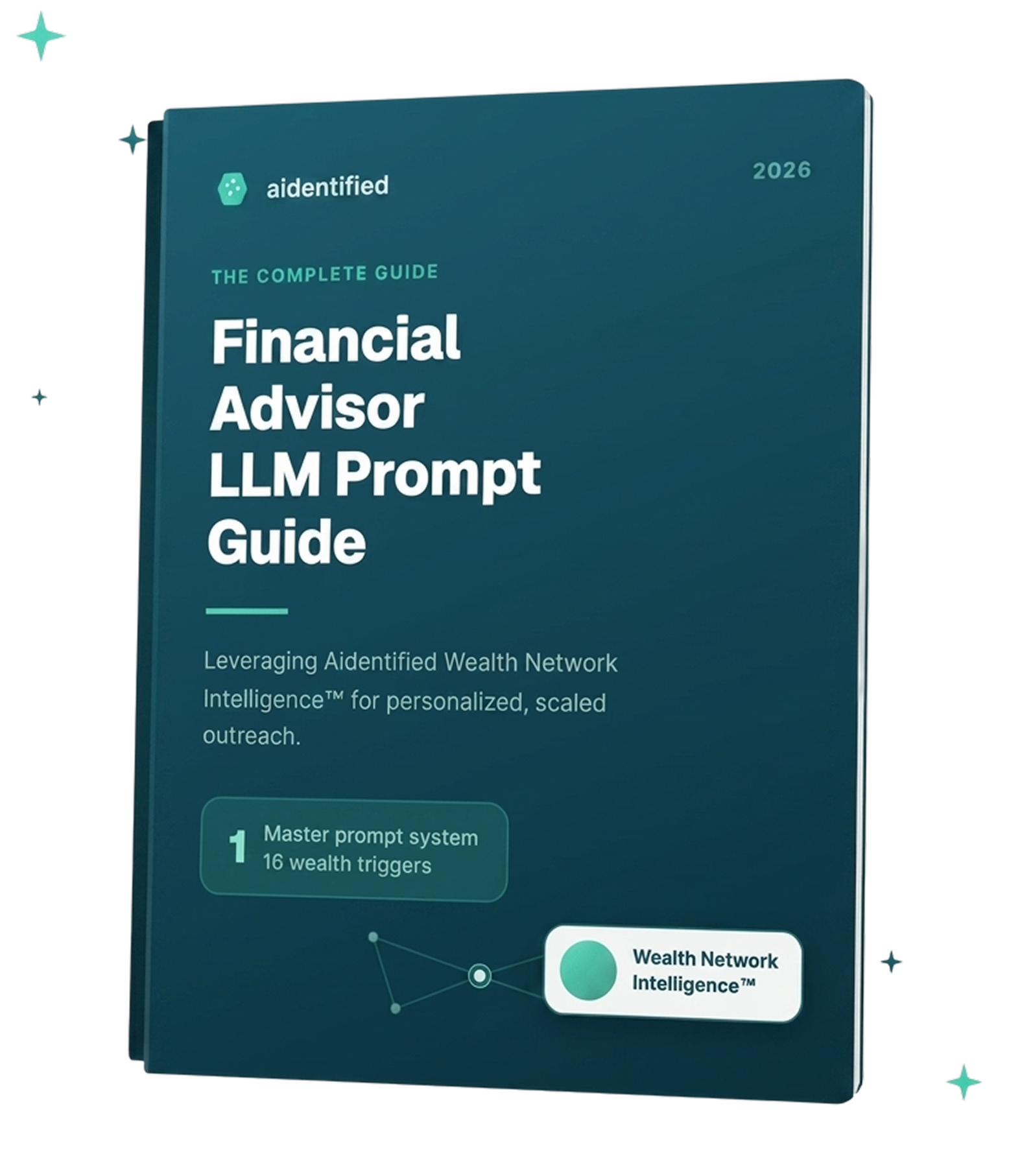
Download the LLM 2026 Prompting Guide
Teach your AI to think like your firm with 10+ customizable prompts
Download TodayThere's a space between when wealth starts forming and when it becomes public. A tech executive in your market gets promoted to CFO. She's been in the role three weeks.
The equity package is more complex than anything she's navigated before, her current advisor mostly handles her retirement account, and she's quietly asking around. That window where she's open, looking, and not yet committed to anyone might last four or five months.
These are warm leads for financial advisors, they exist before any public record confirms them. The growth problem worth solving is reaching the right prospects while their financial life is changing and their advisory relationships lag behind. An AI wealth management tool built around early wealth events does exactly that.
What emerging wealth looks like before it goes public
Why reading the news makes you late
The default approach to prospecting anchors to events you can read about. A company gets acquired, so you look up the executives. An IPO gets announced, and you search for employees with vested equity.
Those are not bad prospects, but by the time the news is out, so are five other advisors, and the prospect is already in triage mode.
What emerging wealth means for advisors
Emerging wealth is what happens before any of that. It's the period when the financial complexity is forming but the wealth isn't yet visible, the decisions haven't been made, and the prospect's advisory relationships are still in flux.
These are the four categories most advisors underwatch.
1. Company funding rounds and pre-IPO equity
When a company closes a Series B or C, founders and early employees suddenly hold significant paper wealth alongside financial planning questions they've never faced.
What happens to their equity if the company gets acquired before an IPO? Are they making the right tax decisions now? Does their current advisor understand equity compensation at this stage?
They don't have liquid assets yet, but they have the complexity that becomes the opening. If you track funding rounds in industries or geographies you know well, you find these prospects months before anyone else is calling.
2. Senior executive promotions and equity compensation
A promotion to CFO, VP, or any senior leadership role at a growth-stage company typically comes with a compensation package the person has never navigated.
Deferred compensation, RSU vesting schedules, 10b5-1 plans, or nonqualified options are unfamiliar to someone stepping into that role for the first time.
Promotions are trackable, they happen continuously, and they create a financial planning need that didn't exist the day before.
3. Insider stock transactions and early SEC filings
Form 4 filings, which show when corporate insiders buy or sell shares, and S-1 or S-4 filings, which signal an impending IPO or merger, are available to anyone.
Few advisors build a system around monitoring them. Those who do get a multi-week head start before the news reaches TechCrunch or the Wall Street Journal, and a significantly less crowded field when they reach out.
4. Real estate activity and estate transfers
A large property sale, especially an investment property, often means liquid capital looking for a destination. Estate transfers are a different kind of signal.
A high-net-worth prospect who just inherited significant assets typically has no financial advisor relationship built around that level of wealth, and they know it. Both are trackable through property records, probate filings, and verified estate data.
Why advisors who find early wealth events win more clients
Why liquidity events are the crowded moment
Getting there early changes the entire nature of the relationship, not just the timing of your approach. When you reach a prospect after a liquidity event, you're one of several advisors competing for an allocation.
The prospect has already processed the emotional arc of the exit, made some early decisions, and maybe parked the proceeds somewhere temporary. Your job is to convince them to move. That's a harder sale, and the relationship starts on a transactional basis.
What reaching prospects early changes
Reach them six months earlier while the deal is still in progress and the estate plan isn't built for what's coming. They're still forming opinions about who they want in their corner, and you're having a different conversation entirely.
You're helping them think through something before it happens. A client relationship that starts pre-exit tends to go deeper. You help shape the tax strategy on the exit, what to do with the proceeds, and how to structure the next phase.
That's a different relationship than inheriting someone's assets after the wire clears. The AUM could be the same, but the trust is greater.
The wealth transfer making early outreach urgent
Nearly half of the $124 trillion in wealth projected to transfer between generations through 2048 will be from high-net-worth and ultra-high-net-worth households. The advisors positioned to grow AUM from that wave will be the ones who built systems to find those moments early.
{{banner}}
How to turn wealth data into a client growth system
Why manual tracking breaks down
Catching the right signals in time is where most approaches fall apart. Funding rounds, Form 4 filings, executive hire announcements, and probate records require active, ongoing monitoring across your prospect list.
Google Alerts and LinkedIn checks can keep you current if you're actively tracking 20 or 25 prospects. But your ideal client profile probably describes hundreds of people across your target geography and industry, which is where advisor prospecting software earns its keep.
The approach that covers the ground is a platform that monitors wealth events across your prospect universe continuously and surfaces the relevant ones automatically.
What every wealth event needs to convert
Having an alert is only the starting point. What turns a wealth event into a real opportunity is having three things at once:
- The wealth event
- Enough financial context on the prospect to have a relevant conversation
- A warm path in through someone who already knows them
That combination turns prospecting into real client acquisition strategies. It's a system that produces results whether or not you remember to check every signal.
How to personalize outreach to each event
The system doesn't work if the outreach itself is templated. When a wealth event surfaces, the message you send should be specific to that event.
A prospect who just got promoted to VP of Finance at a pre-IPO company needs a different conversation than someone who inherited assets after a parent passed away. The event gives you the context. It's on you to use it.
Grow your client base from the clients you already have
Early wealth events fill the top of the funnel, but your current clients are often the fastest way in. Most advisors already know someone who knows the prospect.
Ask for a specific introduction instead of a general referral, and use the best referral sources for financial advisors to decide who to ask first.
Keep networking for financial advisors focused on the next generation of client families, since that is where assets move during a transfer. For more tactics, see these financial advisor prospecting ideas.
Track wealth events before the news with Aidentified
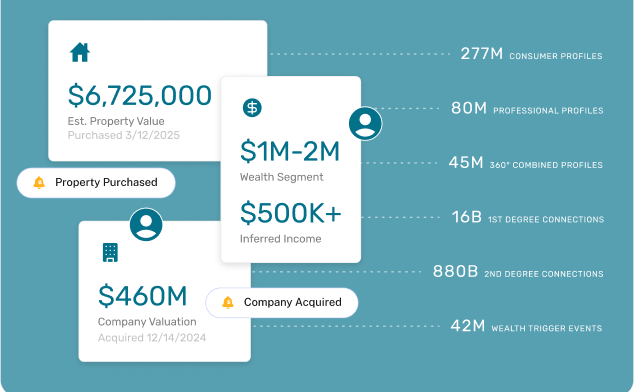
Building this kind of signal-based approach manually hits a ceiling fast. Aidentified monitors wealth events continuously across 300M+ profiles, including the pre-public signals like funding rounds, executive promotions, insider transactions, real estate activity, and estate transfers.
When something relevant happens for someone on your prospect list, you see it. What it adds beyond the alert is the context. You see the prospect's estimated wealth range, their household data, their career history, and the relationship path between them and your existing network.
So when you reach out, you already know who can introduce you, and you know enough about their situation to have a real conversation rather than a templated pitch. Try Aidentified for free and start finding prospects before everyone else does.
FAQ: Do you have any questions?



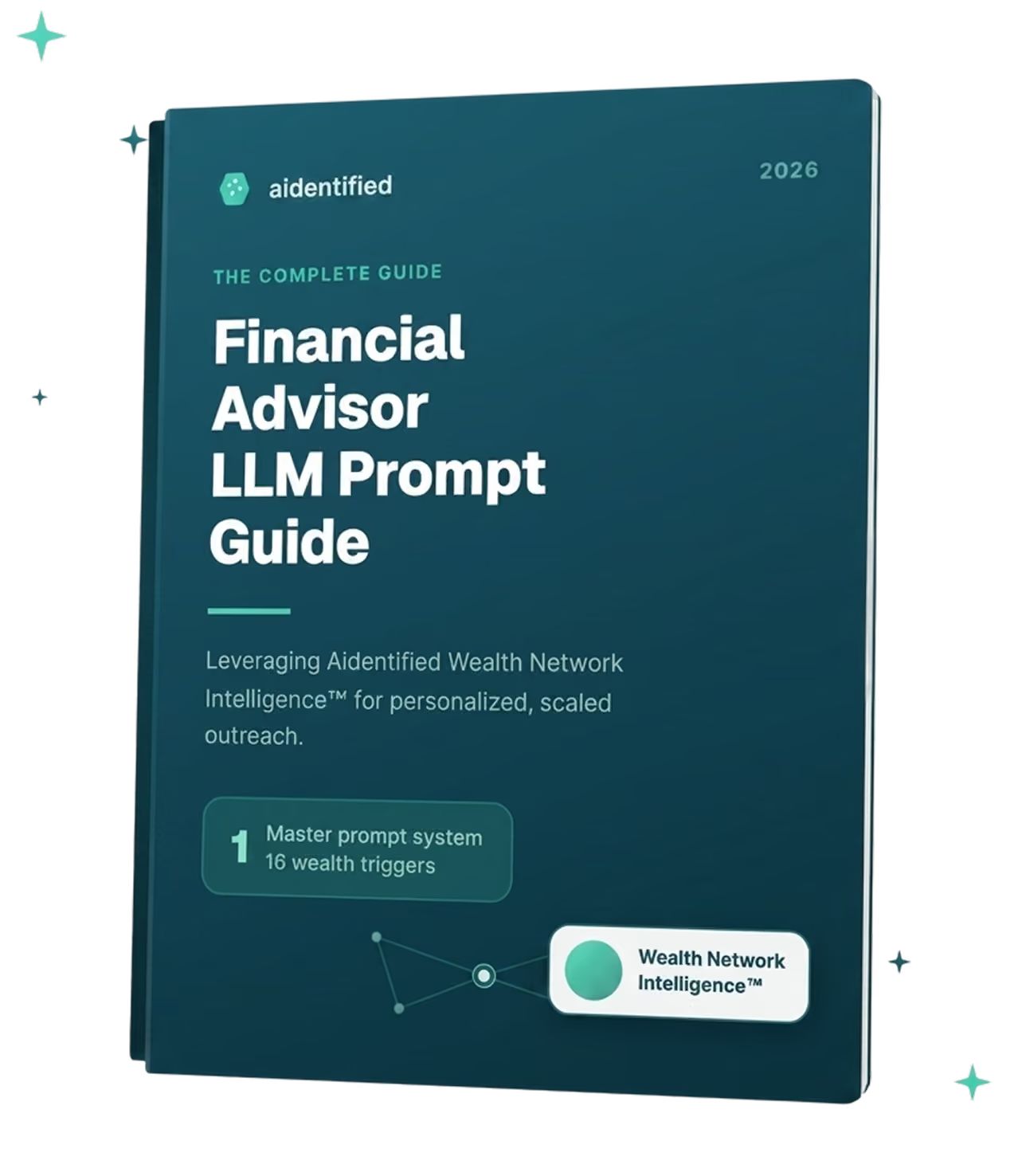
growth engine with the
LLM Prompting Guide.
Reveal the power of your network with Aidentified’s industry-leading AI.
Discover how Aidentified can transform your specialty services business. Contact us today for a personalized consultation and demo.
Explore a demo