Wealth screening tools for financial advisors to improve prospecting

This is a div block with a Webflow interaction that will be triggered when the heading is in the view.
Download the LLM 2026 Prompting Guide
Teach your AI to think like your firm with 10+ customizable prompts
Download TodayTL;DR
Most wealth screening tools were built for nonprofit donor research, not financial advisor prospecting.
Wealth screening tells you who has assets. A wealth intelligence platform tells you who has assets, when to reach out, and how to get a warm introduction.
The four criteria that matter for advisor use: household data depth, real-time event monitoring, ultra high net worth research depth, and relationship intelligence.
Of the five tool categories reviewed, only one was purpose-built for financial advisor prospecting.
Most wealth screening tools were built for nonprofit fundraising. The use cases overlap just enough to make them seem interchangeable, but the data that makes an introduction timely and relevant for an advisor goes well beyond what donor screening tools were designed to surface. This is a practical comparison ranked by what actually drives results for a prospecting tool for financial advisors workflow rather than what drives major gift decisions.
What wealth screening software does, and what it does not
Wealth screening software is built around one core function: estimating the financial capacity of an individual using publicly available and proprietary data. Real estate records, SEC filings, business ownership, and estimated net worth are the inputs. Most tools then produce a wealth score or profile that tells you whether a prospect clears a financial threshold.
That is where the useful work stops for most platforms. A wealth score tells you a prospect has assets. It does not tell you whether anything has changed in their financial life, whether they have an existing advisory relationship, or how to reach them without a cold call. The gap between wealth screening and wealth intelligence is where most advisor prospecting workflows break down, and it's a big part of why our ai for financial advisors guide exists.
Wealth screening tools covered in this guide
This guide compares five categories of wealth screening tools for financial advisors and ranks them based on how well they support advisor prospecting, wealth qualification, event monitoring and warm introductions:
- Aidentified
- Traditional Wealth Screening Platforms
- Ultra High Net Worth Prospect Research Platforms
- CRM-Integrated Data Enrichment Tools
- AI-Powered Lead Scoring Platforms
Each category is evaluated based on the criteria that matter most for financial advisor prospecting: household data depth, real-time wealth event monitoring, UHNW research quality and relationship intelligence.
The 5 wealth screening tool categories ranked for advisor prospecting
1. Aidentified
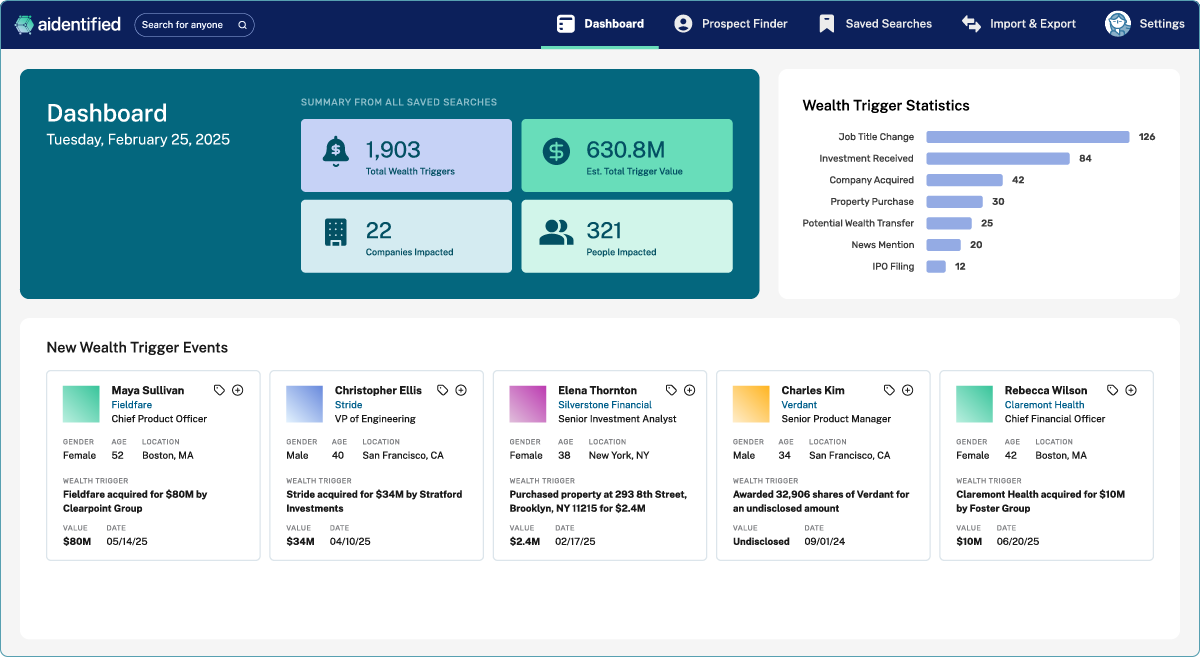
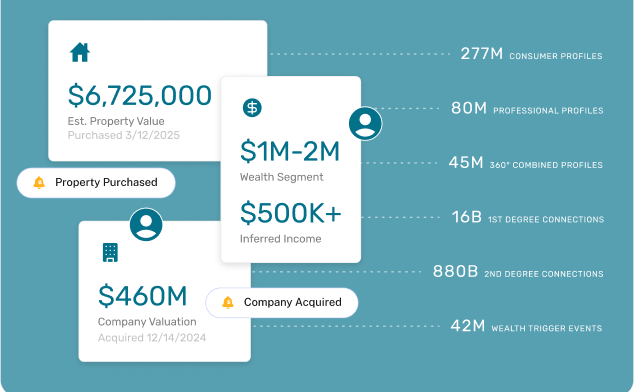
Aidentified is the only tool in this list built specifically for financial advisor prospecting, rather than adapted from a nonprofit or B2B data platform. It monitors 300M+ profiles continuously, combining consumer and professional signals to surface household-level wealth data, real-time wealth events, and relationship paths to warm introductions.
Wealth event monitoring across 16 event types, relationship mapping across 16B+ connections, and a household context layer that goes well beyond a net worth estimate. It integrates natively with Salesforce, HubSpot, Redtail, Lofty, and Wealthbox. Best for: financial advisors and RIAs who need a single platform that handles wealth qualification, event monitoring, and warm introduction paths together.
For a full breakdown, see resources on financial advisor prospecting workflow best practices. Start for free.
2. Traditional wealth screening platforms (nonprofit-origin)
This category covers tools originally built for fundraising and major gift officer workflows. They are strong at batch screening large contact lists against wealth indicators: real estate holdings, stock ownership, philanthropic giving history, and estimated capacity scores.
Strong for:
- Quickly qualifying a large list against a minimum wealth threshold
- Advisors working the mass affluent tier where a basic capacity score is sufficient
Where it falls short for wealth management: Scoring models prioritize giving propensity, not financial decision windows. No event monitoring, no relationship mapping, no household depth.
3. Ultra high net worth-focused prospect research platforms
This category covers platforms built around ultra high net worth prospect research, drawing on SEC filings, private company data, estate records, and global wealth data. Strong for advisors targeting the very top of the wealth spectrum and firms that need international or family office coverage.
Strong for:
- Firms focused exclusively on ultra high net worth individuals where wealth structure depth matters more than timing signals
- Advisors who need international coverage or detailed family office intelligence
Where it falls short for wealth management: These platforms surface who the prospect is but not when to reach out or how to get a warm introduction. Depth without timing is not a complete prospecting solution. Advisors at this tier should also review prospecting strategies that layer event data on top of wealth structure research.
4. CRM-integrated data enrichment tools
This category covers tools that enrich existing CRM records with wealth and professional data, keeping contact records current and adding wealth context to an existing prospect list. The best tools update records automatically and flag when data has changed significantly.
Strong for:
- Advisors looking to deepen data on known contacts rather than discover new prospects
- Practices with a large existing database that needs regular enrichment and cleanup
Where it falls short for wealth management: They depend on contacts the advisor already has. No active event monitoring, no relationship paths to new prospects outside the existing database.
5. AI-powered lead scoring platforms for financial services
This category uses predictive scoring to rank prospects by likelihood to convert, drawing on behavioral signals and public data. They produce a prioritized list but typically lack the consumer data depth that makes outreach to high net worth prospects relevant.
Strong for:
- Firms prospecting at scale in the mass affluent segment where conversion probability is a useful signal
- Practices running high-volume outreach where a ranked list is more useful than event-level timing data
Where it falls short for wealth management: Estimated wealth ranges and specific wealth events are often not surfaced at the depth that high net worth work requires. At this wealth level, relationship context and timing matter more than a conversion score.
How a wealth intelligence platform differs from standard screening
Wealth screening and wealth intelligence are related but not the same category. Wealth screening answers one question: does this prospect have financial capacity? A wealth intelligence platform answers three: who has the capacity, when is the right moment to reach out, and who in the advisor's existing network can make the introduction.
A prospect who had a liquidity event six months ago and has already engaged an advisor is a different contact than the same person a week after selling their company. One category produces a qualified list. The other produces a qualified list with timing and access. For advisors focused on prospecting high net worth clients, that difference determines whether outreach converts.
What to look for in wealth data providers for advisors
The four criteria below are specific to advisor use, not donor research.
Depth of consumer and household data
The most useful prospect profiles for advisors include household-level data: spouse employment, family composition, property ownership, and equity holdings. A net worth estimate without household context leaves out the relationships that often shape financial decisions. A contact who looks average on their own may be the entry point to a household with significantly more complexity.
Continuously updated wealth event monitoring
A static wealth profile tells you who a prospect is. A platform that monitors for financial changes tells you when something has shifted in their financial life: a business sale, a liquidity event, a senior role change, a property transaction.
For advisors, this is not a premium feature. A message sent to someone who is not in a decision window lands as noise. The same message sent the week after a qualifying event lands as relevance. Real-time wealth event monitoring is the baseline that makes the rest of the tool useful.
UHNW prospect research depth
At the ultra high net worth level, standard wealth estimates are often insufficient. The tools that serve advisors at this tier need deeper sourcing: SEC insider transaction data, estate activity, investment round participation, and family office structures. Advisors here should evaluate platforms on their ultra high net worth data depth, not just general coverage.
Relationship intelligence and warm introduction paths
No wealth screening tool is complete if it only surfaces who a prospect is and not how to reach them. Relationship mapping that overlays a prospect's network against the advisor's existing connections converts a qualified name into a reachable opportunity.
Knowing a prospect has assets is step one. Knowing your best client went to graduate school with them is what gets the meeting. The most effective wealth management prospecting tools combine screening depth with network intelligence.
Find the right wealth screening approach for your practice with Aidentified
Most advisors who run a prospect list through a traditional wealth screening tool get a qualified list with no indication of who on it is in a decision window or reachable through someone they already trust.
Aidentified was built to answer those questions, not just the first one. When a prospect on your list experiences a qualifying wealth event, you see it. And you see who in your network can make the introduction.
{{banner}}
FAQ: Do you have any questions?



growth engine with the
LLM Prompting Guide.
Reveal the power of your network with Aidentified’s industry-leading AI.
Discover how Aidentified can transform your specialty services business. Contact us today for a personalized consultation and demo.
Explore a demo