6 Advisor research tools to close the prospect intelligence gap

Download the LLM 2026 Prompting Guide
Teach your AI to think like your firm with 10+ customizable prompts
Download TodayTL;DR
Most financial advisors have investment research tools covered but are missing prospect intelligence tools entirely — that's the real gap
Prospect research tools do three things investment tools don't: identify who to target, time outreach to wealth events (business sales, equity distributions, etc.), and map warm introduction paths through your existing network
Wealth screening qualifies prospects against minimums but doesn't tell you when to reach out — event monitoring does
LinkedIn only shows what people make public — no wealth signals, no household data, no continuous monitoring
Financial advisors invest heavily in investment research tools. Fund screeners, portfolio analytics platforms, and market data terminals are table stakes for client service, and most practices have that side of the stack covered. The gap most advisors are missing is not on the investment side.
It is on the prospect side: the intelligence that identifies who to target, surfaces warm leads for financial advisors at the moment they are ready to move, and reveals the introduction path. Most advisors still do this manually, if at all, which means they are running half a research stack while competing against advisors who have built the other half.
This guide covers the six financial advisor research tools that close that gap, what each one does well, where it falls short, and how to evaluate which ones belong in your stack.
The two types of research that drive every advisory practice
Investment research and prospect research serve different purposes and feed different parts of the practice. Investment research supports client service: it informs portfolio construction, performance conversations, and planning recommendations. Prospect research supports practice growth: it determines who to pursue, when to reach them, and how to get an introduction.
Most advisors have invested significantly in the first category. The second is often a patchwork of LinkedIn searches, outdated contact databases, and CRM guesswork. That asymmetry explains why a well-stocked financial advisor tech stack can still underperform on client acquisition. The tools are there. The prospect intelligence layer is not.
6 financial advisor research tools evaluated for prospect intelligence
1. Aidentified
Best for: financial advisors who need wealth event monitoring, household-level prospect profiles, and relationship mapping in a single platform
Aidentified is the only financial advisor research tool built specifically around the prospect intelligence gap most practices are missing. Where investment research tools support client service, Aidentified supports practice growth: it identifies who to pursue, when to reach them, and who in your existing network can make the introduction. That is the combination no other tool on this list delivers from a single platform.
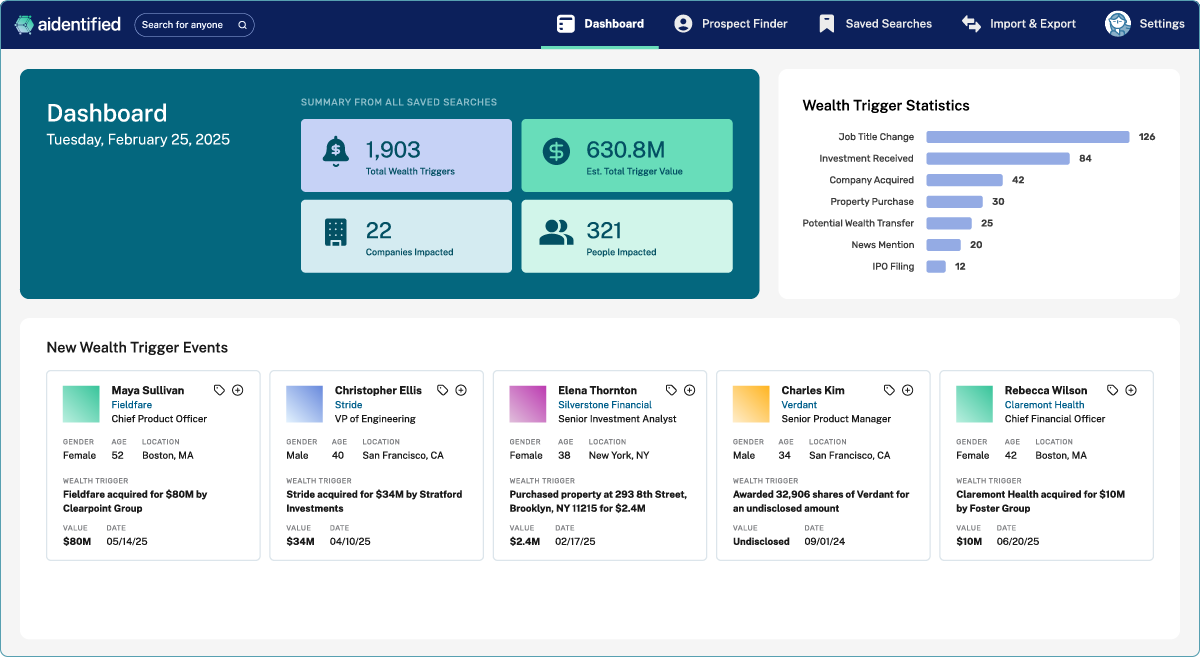
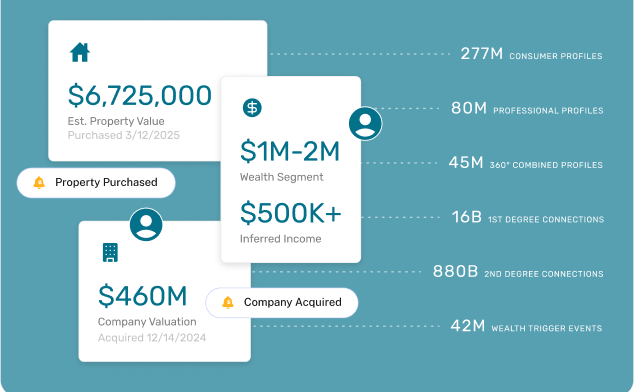
The platform monitors wealth events across 300M+ profiles and maps relationship paths through 16B+ connections, combining professional network data with consumer signals: board memberships, alumni ties, property records, and household data. When a qualifying event occurs for a prospect on your list, a business sale, a senior role change, a real estate transaction, an equity distribution, you see it inside the CRM you already use, alongside the strongest introduction path through your existing client base.
Most advisors who map their client network for the first time find introduction paths they did not know existed, running through clients they have had for years. The prospect intelligence was already latent in the practice. Aidentified makes it visible and surfaces the right moment to act on it. For a closer look at how this fits into a full growth strategy, see prospecting strategies for financial advisors.
Key capabilities
- Wealth event monitoring across 16 event types: business sales, career changes, real estate transactions, equity distributions, IPO participation, and inheritance activity
- Household-level profiles including estimated net worth, property ownership, spouse employment, and career history. See client research tools wealth management for how this household context changes targeting decisions.
- Relationship mapping through 16B+ connections, scoring introduction paths by strength across professional history, shared networks, alumni ties, and board affiliations
- Configurable ideal client profile criteria so the platform continuously surfaces new matching prospects as they emerge
- Native CRM integration so event alerts and connection data surface as actionable notifications inside the advisor's existing workflow
- Continuously updating profiles, not periodic batch refreshes that miss timing windows
What to keep in mind
Aidentified is purpose-built for advisor prospecting software use cases in financial services. It is not a general investment research tool. Advisors at registered firms should review the consumer data and household attributes layer with their compliance team before integrating it into client-facing workflows.
Ideal for
Financial advisors and RIAs who have investment research covered and need to build the prospect intelligence side of their stack. Also well-suited for practices already using a prospecting tool for financial advisors or an AI tool for financial advisors that needs wealth event timing and relationship intelligence layered in. Try Aidentified for free and build your first enriched prospect profile.
2. Contact enrichment and prospect database tools
Best for: appending professional data to existing contact records at scale
Contact enrichment platforms append professional fields to existing contact records: verified email, current employer, job title, company size, industry, and headcount. They reduce manual data entry, improve email deliverability, and flag when a contact changes roles or employers. For advisors with large CRM databases that have gone stale, enrichment tools restore basic data integrity quickly.
For advisor research platforms use cases, professional enrichment is the baseline layer. Knowing a contact's current title and employer is the starting point for qualification, not the end of it. A prospect who looks unremarkable by title and employer can look entirely different with household and wealth context layered in. That same person may be the gateway to a multi-generational client relationship, or they may be a single-asset contact with limited growth potential.
Where they fall short for financial advisor research
No consumer data layer. No wealth event monitoring. No household composition or estimated net worth. Professional enrichment tools are built around the same firmographic data model as B2B sales platforms, which stops well short of the financial profile context that informs advisor targeting decisions. As a standalone financial advisor research tool, contact enrichment is necessary but not sufficient.
What to look for: Accuracy rates on professional fields, refresh frequency, native CRM integration, and field-level override controls so enriched data does not overwrite manually verified records. Prioritize platforms that can be combined with a consumer-layer enrichment source rather than treating professional data as the complete picture.
3. Wealth screening and net worth estimation tools
Best for: qualifying prospects against minimum asset thresholds before outreach
Wealth screening tools estimate net worth and investable asset ranges using public records: property ownership, equity filings, business ownership data, and income proxies. For advisors who need to confirm a prospect meets their minimums before investing outreach time, wealth screening provides a qualification filter that professional databases cannot.
These tools are the bridge between a professional profile and a financial profile. A prospect who passes a wealth screening check is at least plausibly worth pursuing. Without that filter, advisors spend outreach time on names that do not meet their minimums and discover that fact only after several conversations.
Where they fall short for financial advisor research
Static estimates do not tell you when to reach out. A prospect who clears your minimum threshold today was probably above that threshold six months ago and will remain above it six months from now. Wealth screening qualifies. It does not time. The event that actually opens a financial decision window, a business sale, an equity distribution, an inheritance, does not appear in a static net worth estimate. Advisors who rely on wealth screening alone are qualifying against the right criteria but prospecting on the wrong schedule.
What to look for: Data sources that distinguish liquid from illiquid capital, not just total estimated net worth. A prospect with $5M in a private company that is years from a liquidity event is a different opportunity from one with $5M in recently settled assets. See wealth management prospecting tools for how wealth screening fits into a broader prospecting stack.
{{banner}}
4. Wealth event and life trigger monitoring platforms
Best for: identifying when a prospect has entered a genuine financial decision window
Wealth event monitoring platforms track financially significant events across a prospect database and alert advisors when a qualifying moment occurs: a business sale, a major real estate transaction, a senior role change at a high-growth company, equity events tied to an IPO or RSU vesting schedule, or inheritance activity. These are the moments when a prospect is actively thinking about their financial future and is genuinely receptive to a relevant conversation.
Among wealth intelligence tools, event monitoring is the category that produces a timing advantage. Static profiles tell you a prospect is qualified. Event monitoring tells you this is the week to reach out. That distinction drives conversion rates in ways that qualification alone cannot, because the same message to the same prospect lands completely differently depending on whether something has just happened in their financial life.
Where they fall short for financial advisor research
Event monitoring tells you when but not always how. A timing signal without an introduction path still requires a cold call or a cold email to act on. The most effective use of event monitoring is in combination with relationship intelligence that surfaces a warm path through the advisor's existing network at the same moment the event alert fires. Platforms that deliver only the event without the introduction path leave the hardest part of the outreach, getting the prospect to take the meeting, still unsolved. For more on timing-first outreach, see how financial advisors build and qualify their prospect pipeline.
What to look for: Event type coverage across the full range of financially significant moments, refresh frequency that produces real-time alerts rather than weekly summaries, CRM integration so alerts surface as actionable notifications rather than a separate report, and whether the platform combines event data with relationship mapping in the same interface.
5. Investment research and market data platforms
Best for: supporting client service through portfolio analytics, fund screening, and market intelligence
Investment research platforms, including fund screeners, portfolio analytics tools, market data terminals, and performance reporting platforms, are the category most advisors have already built out. They inform portfolio construction, support performance conversations with existing clients, and provide the analytical foundation for planning recommendations. For client service, they are essential.
This category belongs in every financial advisor tech stack. The reason it appears here is to draw the distinction clearly: investment research supports the clients you already have. It does not help you find the clients you want. Advisors who conflate the two categories often discover they have built a sophisticated client service infrastructure and a nearly empty prospect research stack sitting next to it.
Where they fall short for prospect research
Investment research tools are not designed to identify prospects, qualify them against wealth criteria, time outreach to financial decision windows, or map introduction paths through existing networks. That is not a limitation of the tool. It is a description of a different job. The gap is not that investment research tools are inadequate. It is that prospect research tools are absent from most practices entirely.
What to look for: Integration with your CRM and financial planning software, data coverage across the asset classes and geographies relevant to your practice, and update frequency sufficient to support timely client conversations. For most advisors, this category is already well-covered. The question is what sits next to it on the prospect side.
6. LinkedIn and professional network research tools
Best for: surface-level prospect research and event-triggered outreach on publicly visible signals
LinkedIn and professional network tools give advisors access to a prospect's publicly visible career history, shared connections, and recent professional announcements. For quick background research before a meeting, confirming a prospect's current role, or identifying mutual connections for a warm introduction, professional network tools are the most accessible starting point in any advisor prospecting software stack.
The most effective use case for advisors is event-triggered: connecting with a prospect the week they announce a new executive role or a company milestone, when they are already in a transition mindset. That timing gives an outreach message a context it would not have six months later.
Where they fall short for financial advisor research
LinkedIn covers what people choose to make public. Business sales, equity events, inheritance activity, and household wealth signals are not. The consumer data layer, the one that distinguishes a qualified prospect from an unqualified one with the same title, is entirely absent. Professional network tools also do not monitor continuously. They surface information when the advisor actively searches, not when a qualifying event occurs. For advisors whose competitive advantage depends on seeing opportunities before other advisors do, passive discovery is not a research strategy. See financial advisor lead generation for how to build an active monitoring layer on top of passive network tools.
What to look for: Saved search and alert functionality so the tool notifies you when a specific prospect signals a transition, rather than requiring you to check manually. CRM integration so connection data does not live in a separate system. And a clear plan for combining professional network data with a consumer-layer enrichment source that carries the wealth context LinkedIn does not.
Complete your research stack with Aidentified
Most advisors who assess their research stack honestly find the same thing: the investment side is well-covered, and the prospect side is nearly empty. The intelligence that identifies who to target, when to reach them, and how to get an introduction is the half most practices have not yet built.
Aidentified is built specifically to fill that second half. It monitors 300M+ profiles continuously, surfaces wealth events across 16 event types, and maps relationship paths through 16B+ connections, all delivered inside the CRM the advisor already uses. Try Aidentified for free and see what the prospect intelligence side of your research stack looks like when it is actually built out.
FAQs: financial advisor research tools
What research tools do financial advisors use to monitor clients for life events?
Most financial advisor research tools track signals like job changes, business transactions, property purchases, and equity events to surface moments where a contact's financial situation has shifted. The most effective tools monitor these events continuously and deliver alerts inside the advisor's CRM rather than in a separate dashboard. Aidentified focuses specifically on the wealth events most likely to trigger a financial conversation, flagging those moments before they resolve. For a practical look at how event monitoring fits into a broader strategy, see wealth management prospecting tools.
What is the difference between investment research tools and prospect research tools for financial advisors?
Investment research tools support client service: they inform portfolio construction, performance conversations, and planning recommendations for existing clients. Prospect research tools support practice growth: they identify new prospects worth pursuing, qualify them against wealth criteria, time outreach to financial decision windows, and map introduction paths through existing networks. Most advisors have built out the investment side. The prospect side is the gap that advisor prospecting software built for financial services is designed to close.
How should a financial advisor evaluate data quality when comparing research tools?
Ask vendors three things: what are the primary data sources, how frequently are they refreshed, and what is the error correction process when records are outdated or misattributed. Platforms that maintain their own data pipeline rather than reselling aggregated feeds tend to have more reliable and timely records. For wealth intelligence tools specifically, also ask whether the platform distinguishes liquid from illiquid capital in its net worth estimates, since that distinction materially changes how a prospect should be prioritized.
Do financial advisor research tools cover international or cross-border clients?
Coverage drops significantly outside the U.S., where public records infrastructure is less standardized and proprietary data partnerships are harder to maintain at scale. Most tools in this space, including Aidentified, are optimized for domestic prospecting and rely on U.S. public records and proprietary data partnerships as their primary sources. Advisors with significant international client bases should evaluate tools specifically on their cross-border coverage before committing, and should not assume that domestic data quality translates directly to international profiles.



growth engine with the
LLM Prompting Guide.
Reveal the power of your network with Aidentified’s industry-leading AI.
Discover how Aidentified can transform your specialty services business. Contact us today for a personalized consultation and demo.
Explore a demo