5 Relationship mapping software tools for financial advisors

Download the LLM 2026 Prompting Guide
Teach your AI to think like your firm with 10+ customizable prompts
Download TodayNearly 80% of high-net-worth investors find their primary financial advisor through a personal introduction. Most advisors already know referrals are their best source of new clients. The problem is not knowing that referrals matter. It is having no systematic way to generate them from the network that already exists.
If you search for relationship mapping software right now, almost every top result is written for B2B sales teams mapping org charts and tracking buying committees. That is a completely different problem from the one financial advisors face. Advisors do not navigate buying committees. They identify individuals whose financial complexity has grown to the point where they need professional guidance, and they find a credible way to start a conversation before someone else does.
This guide covers the five relationship mapping software options financial advisors should evaluate, what each one is built for, and where each one falls short for wealth management use cases.
What relationship mapping software actually needs to do for financial advisors
Enterprise relationship mapping software was built to navigate the internal politics of large organizations: mapping influence hierarchies, flagging budget owners, and tracking which stakeholder needs to be warmed up before a proposal moves forward. Advisors do not have that problem.
The right tool for an advisor answers three questions: who in their existing network already has a trusted relationship with the prospect they want to reach, how strong that connection is, and whether a recent wealth event has made that prospect more likely to be receptive right now. None of those three requirements involve org chart functionality. They require a platform built on personal and professional network data, layered with real-time household wealth context, the same layer covered in our ai for financial advisors guide.
A prospect who recently sold a company, received equity from a pre-IPO employer, or inherited a significant estate is in a different headspace than the same person two years earlier. Relationship mapping software built for advisors surfaces both the connection path and the timing signal together. That is what turns a data point into a meeting. For more on timing-first outreach, see this guide to prospecting high-net-worth clients.
5 relationship mapping software tools evaluated for financial advisory use cases
1. Aidentified
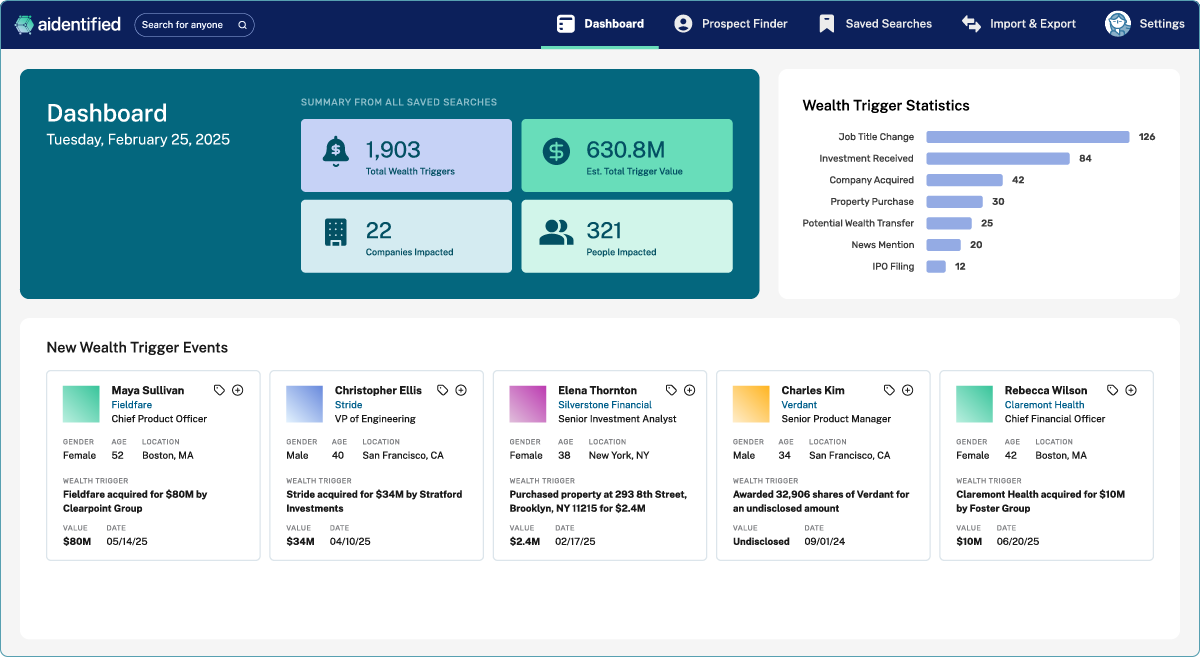
Best for: financial advisors who need wealth event monitoring, relationship strength scoring, and warm introduction paths in a single platform
Aidentified is the only relationship mapping software built specifically for financial advisor prospecting. Where enterprise tools map org charts and buying committees, Aidentified maps the personal and professional networks that actually determine whether a warm introduction is possible, then layers in real-time wealth event monitoring to surface the right moment to ask for one.
The platform monitors wealth events across 300M+ profiles and maps relationship intelligence through 16B+ connections, combining professional network data with consumer signals: board memberships, alumni ties, property records, and household data. When a qualifying wealth event occurs for someone in your network, you see the event, the connection path, and a strength score for the introduction, all inside the CRM you already use.
Most advisors who map their client network mapping for the first time find introduction paths they did not know existed, running through clients they have had for years. The network is already there. Aidentified makes it visible, and tells you when the timing is right to use it. For more on how this fits into a full prospecting workflow, see how financial advisors build and qualify their prospect pipeline.
Key capabilities
- Wealth event monitoring across business sales, career changes, real estate transactions, equity distributions, and inheritance activity
- Relationship strength scoring across professional history, shared networks, alumni ties, and board affiliations, not just communication volume. See warm leads for financial advisors for how scored introduction paths change the outreach dynamic.
- Household-level consumer data layered on professional profiles, including estimated net worth and property ownership
- Native CRM integration so connection data and wealth event alerts surface inside the workflow advisors already use
- Continuously updating profiles, not quarterly batch refreshes that miss timing windows
What to keep in mind
Aidentified is purpose-built for financial services prospecting. It is not a general-purpose ai relationship mapping tool for enterprise sales teams or project managers. Advisors at registered firms should clear the platform with their compliance team before integrating it into client-facing workflows, particularly the consumer data and household attributes layer.
Ideal for
Financial advisors and RIAs who want to stop waiting for referrals and start finding them systematically. Also well-suited for firms using a prospecting tool for financial advisors or an AI tool for financial advisors that needs a relationship intelligence layer connected to wealth event timing.
2. Enterprise key account management platforms
Best for: large B2B sales teams managing complex buying committees across named accounts
Enterprise relationship mapping software platforms in this category are designed to map stakeholder influence within target organizations. They visualize decision hierarchies, flag budget owners, score engagement levels across a buying group, and track which contacts need to be warmed up before a proposal can move forward. Most integrate natively with major CRM platforms and offer real-time collaboration for sales teams working the same account.
For advisors, the core functionality, org chart visualization and buying committee tracking, maps to a problem they do not have. Advisor prospects are individuals, not organizations. The decision to hire a financial advisor is personal, not institutional. Enterprise platforms that score stakeholder influence within a company do not carry the household-level data or wealth event monitoring that determines whether an individual is worth reaching out to this week.
Where they fall short for wealth management
No consumer data layer. No wealth event monitoring. No household composition or estimated net worth. These platforms were built to answer "who approves this purchase?" not "who in my network knows this prospect and is this a good week to ask for an introduction?" For advisors whose outreach depends on personal financial context, enterprise network mapping tools advisors in this category are the wrong fit.
What to look for if evaluating this category: Native CRM integration, real-time data updates, and relationship strength scoring. Those capabilities transfer. The org chart functionality does not.
3. CRM-native relationship intelligence add-ons
Best for: advisors who want relationship context without leaving their existing CRM
Several major CRM platforms offer native or marketplace relationship intelligence add-ons that surface connection data and communication history inside the existing CRM interface. These tools analyze email volume, meeting frequency, and response rates to score relationship strength automatically, then display those scores alongside contact records.
For advisors, the appeal is workflow simplicity. Relationship intelligence that surfaces inside the CRM rather than requiring a separate login gets used more consistently. Tools in this category reduce context-switching and keep prospecting activity anchored to the system advisors already operate in.
Where they fall short for wealth management
Relationship strength scoring based on communication data alone, email opens, meeting counts, reply rates, reflects how much contact has happened, not how valuable the connection is as an introduction path. A client who exchanged a few emails with a prospect years ago scores differently than a client who co-founded a company with that prospect, but communication-only scoring may not capture that distinction accurately.
These add-ons also do not carry wealth event monitoring. They tell you about the strength of existing connections; they do not tell you when a prospect has entered a financial decision window that makes this the right week to activate one of those connections.
What to look for if evaluating this category: Scoring methodology beyond communication volume, compatibility with your specific CRM, and whether the tool can incorporate external signals beyond email and calendar data.
4. Visual diagramming and network mapping tools
Best for: manually building and presenting relationship maps for specific accounts or prospects
Visual diagramming tools allow users to manually build relationship maps, connecting individuals, organizations, and influence paths in a drag-and-drop interface. Some offer templates specifically for org charts, stakeholder maps, and network diagrams. Most integrate with productivity suites and allow real-time collaboration, making them useful for team-based account planning sessions.
For advisors who want to visually document the relationship context around a specific high-value prospect, or present a network map to a colleague or COI, diagramming tools offer flexibility that more automated platforms do not. They are particularly useful for referral path software use cases where the advisor wants to map a specific introduction chain manually before making an ask.
Where they fall short for wealth management
Manual. Everything in this category requires the advisor to build and maintain the maps themselves. There is no automated wealth event monitoring, no relationship strength scoring, and no data layer beyond what the advisor inputs. At a list size of 20 to 30 prospects, manual mapping is feasible. At the scale most practices need, it becomes a part-time job with significant gaps wherever the advisor has not yet mapped a connection.
What to look for if evaluating this category: Ease of use, collaboration features for team-based planning, and export options for sharing maps with COIs or in client presentations.
5. LinkedIn Sales Navigator and social graph tools
Best for: surface-level connection discovery and event-triggered outreach on publicly visible signals
LinkedIn Sales Navigator and similar social graph tools surface connection paths and mutual contacts based on professional network data. For advisors, the most useful application is event-triggered outreach: reaching out to a prospect the week they announce a new role, a company milestone, or a board appointment, when they are already in a transition mindset and a connection request does not land as a cold pitch.
These tools are widely accessible, require no CRM integration to start using, and cover a broad enough professional graph that most advisors will find meaningful connection paths to the prospects they are already tracking. For ai relationship mapping at the entry level, social graph tools offer a meaningful starting point without a significant setup investment.
Where they fall short for wealth management
LinkedIn covers what people choose to make public. Job changes are often visible. Business sales, equity distributions, inheritance activity, and household wealth events are not. The connection data is limited to professional relationships that both parties have acknowledged on the platform, which excludes the personal network ties, alumni connections, and household relationships that often represent the warmest introduction paths.
Social graph tools also do not carry the consumer data layer that lets advisors qualify a prospect before reaching out. A mutual connection on LinkedIn tells you a path exists. It does not tell you whether the prospect has available liquidity, what their household looks like, or whether a recent wealth event makes this the right week to activate that path. For more on how to build a financial advisor lead generation system that goes beyond public signals, that article covers the full framework.
What to look for if evaluating this category: Event-triggered alert settings for job changes and company milestones, saved search functionality to monitor specific prospect lists, and integration with your CRM so connection data does not live in a separate system.
What to look for when evaluating relationship mapping software for financial advisory
Most feature comparisons for relationship mapping tools focus on visualization quality, template libraries, and collaboration options. For financial advisors, the evaluation criteria are different. These are the four questions that actually matter.
Does it carry personal network data, not just professional data?
The warmest introduction paths often run through personal connections: shared alumni networks, co-investors, board affiliations, and household relationships. Relationship mapping software that only maps professional connections leaves those paths invisible. Ask specifically whether the platform combines professional and personal network data in its connection graph.
Does it score connection strength across multiple signals?
Not all connections are equal. A client who attended the same conference as a prospect five years ago is not the same as a client who co-founded a company with that prospect. Relationship intelligence platforms that score connection strength across recency, shared professional history, and social overlap help advisors focus on introduction paths that are actually likely to work, rather than treating every mutual connection as equivalent.
Does it include wealth event monitoring?
The window after a wealth event during which a prospect is actively thinking about their finances is finite. It opens, it closes, and it does not reopen on a schedule. Referral path software synchronized with wealth event monitoring gives advisors a timing advantage that relationship mapping alone cannot provide. If the platform only shows you the path and not the moment, you are still guessing at timing.
Does it integrate natively with your CRM?
Network mapping tools advisors cannot use inside their existing workflow get checked once a month at best. Effective platforms push connection data and wealth event alerts directly into the CRM the advisor already uses. Ask specifically whether the integration is native or middleware-dependent. Native integrations are meaningfully more reliable for day-to-day use.
Turn your existing network into new opportunities with Aidentified
Most advisors are surprised by how many high-value introduction paths run through clients they have had for years. The network is already there. What is missing is the tool that makes it visible and tells you when the timing is right to use it.
Aidentified is the only platform on this list built specifically for that combination: relationship mapping layered with wealth event monitoring, household data, and a relationship strength score, all inside the CRM you already use. If you are ready to stop waiting for referrals and start finding them, try Aidentified for free and build your first mapped prospect list.
FAQs: Relationship mapping software
How is relationship mapping software different from a CRM?
A CRM records what happened with a contact: notes, meetings, follow-up dates. Relationship mapping software shows how contacts connect to each other and to the prospects you are trying to reach. Aidentified extends this by layering network intelligence on top of contact data, so advisors can see not just who they know, but who those people know, and whether a recent wealth event makes this the right moment to ask for an introduction. It functions as both a prospecting tool for financial advisors and a relationship intelligence layer on top of an existing CRM.
How do relationship mapping tools measure relationship strength?
Most platforms analyze communication data, email volume, recency, and response rates to score relationship strength automatically. Aidentified factors in external signals as well, including professional connections, shared networks, alumni ties, and board affiliations, to surface warm paths that would not appear in a CRM alone. For advisors building a strategy around how to get clients as a financial advisor through warm introductions, that distinction matters significantly.
Does relationship mapping software require access to email and calendar data?
Usually yes, for automated strength scoring to work accurately. Platforms that pull from Gmail, Outlook, and calendar APIs can build relationship graphs passively, without requiring manual input. Advisors with privacy concerns can often opt for manual input instead, though that reduces accuracy. For wealth management use cases specifically, platforms like Aidentified supplement communication data with external signals, which means the relationship graph remains useful even when email access is limited. Check with your compliance team before enabling any email or calendar integration with a third-party financial advisor lead generation platform.
What data sources do the best relationship mapping tools use?
The strongest ai relationship mapping engines combine professional network data with consumer signals: board memberships, alumni ties, property records, and household data. Ask any vendor how many profiles the platform monitors, what data sources it combines, and how frequently data refreshes. A relationship map built on stale data creates confident outreach at the wrong time, which is often worse than no outreach at all. For a closer look at how data sourcing affects advisor prospecting outcomes, see wealth management prospecting tools.



growth engine with the
LLM Prompting Guide.
Reveal the power of your network with Aidentified’s industry-leading AI.
Discover how Aidentified can transform your specialty services business. Contact us today for a personalized consultation and demo.
Explore a demo