Data enrichment vs data appending for smarter advisor prospecting

Download the LLM 2026 Prompting Guide
Teach your AI to think like your firm with 10+ customizable prompts
Download TodayMost financial advisors have a contact list. What they often lack is a contact list that is complete, current, and qualified. Two different approaches address this problem, and they are regularly confused or used interchangeably when they should not be.
Data enrichment and data appending sound like variations of the same thing. They are not. Appending fills in what is missing. Enrichment adds what was never there. The distinction determines which tool to use, when to use it, and what kind of prospecting decisions each one can support.
For financial advisors, the distinction matters more than it does for B2B sales teams. The data layers that qualify a prospect, household wealth, financial events, relationship connections, are not fields any standard appending service carries. This guide covers each approach, the key differences, and how they work together in a complete enriched warm lead identification workflow. Getting both right starts with an enrichment platform for advisor prospecting built around wealth data, not B2B firmographics.
What is data enrichment?
Data enrichment is the process of taking existing contact records and adding new layers of information that enhance the profile without altering the core record. Enrichment adds context, not replacement. The original record stays intact, but the surrounding intelligence becomes richer.
Data enrichment adds context and depth
Enrichment takes what you know about a contact and layers in additional information that was never in the original record. For financial advisors, that typically includes:
- Household data and family composition
- Estimated net worth and wealth indicators
- Professional history and career connections
- Relationship connections and warm introduction paths
- Business ownership and equity holdings
- Financial events such as liquidity events, inheritance, or property transactions
A prospect who looks unremarkable by job title and employer alone may carry significant household wealth, a recent equity event, or a strong shared connection to one of your existing clients. Enrichment is what makes that visible. Appending cannot surface any of it. See how lead enrichment tools for advisors covers the full scope of what enrichment adds beyond standard contact fields.
Enrichment is ongoing, not one-time
Data enrichment platforms continuously update enriched records as new information becomes available. A prospect's household changes. A wealth event occurs. A new board membership is added. Continuous enrichment means your contact records stay current, revealing new opportunities and updated context as they emerge rather than capturing a single moment.
Static enrichment from months ago becomes stale quickly in wealth management. A prospect who had no notable financial events six months ago may have sold a business last week, and a one-time enrichment pass will never surface that. See how AI-powered wealth data enrichment automates continuous record updates as qualifying events occur.
What is data appending?
Data appending is the process of taking incomplete contact records and filling in missing standard data fields. Appending completes records. It does not deepen them.
Data appending fills in missing standard fields
Appending takes an incomplete contact record and adds missing standard information: email addresses, phone numbers, physical addresses, job titles, company names, or LinkedIn profiles. If you have a name and company but no email, appending finds and adds it. If you have a name but no job title, appending looks it up. These are standard fields most professional databases include, and appending services are optimized to match records against those databases quickly and at scale.
The scope is deliberately narrow. Appending is not trying to tell you whether a prospect is financially qualified or connected to your network. It is trying to make sure the record is complete enough to use. See how enrichment and appending in your CRM work together as sequential steps in the same workflow.
Appending is typically a one-time data cleaning exercise
Data appending is usually a batch process. You upload a list with missing information, the appending service fills the gaps from its database, and you download the completed records. Unlike enrichment, it is not an ongoing update engine, it is a data hygiene step useful for preparing a list before outreach, not for qualifying who deserves it.
Data enrichment versus data appending differences: a side-by-side comparison
Both approaches improve contact records, but they operate at different levels of the data stack and serve different decisions. Understanding the distinctions prevents advisors from expecting one to do the job of the other.
Scope of information added
Appending focuses on standard contact fields: email, phone, address, job title, company. Enrichment adds contextual layers beyond standard fields: household wealth data, financial events, relationship connections, estimated net worth, business ownership, and property records. A fully appended record can still be an unknown quantity from a prospecting standpoint: you know how to reach the person but not whether reaching them makes sense.
Data sources and verification
Appending relies on professional databases, email verification services, and directory databases, optimized for matching speed and field accuracy. Enrichment combines professional history, consumer data, public records, and proprietary relationship mapping, requiring more specialized sourcing and deeper expertise to produce intelligence rather than just verified contact fields.
Use case and timing: enrichment versus appending for advisors
Appending is useful for cleaning up lists or preparing records for outreach. Enrichment is useful for qualifying which records are worth reaching out to and understanding the right angle for engagement. In practice, appending is often a one-time process to improve record completeness, while enrichment runs continuously as prospect circumstances, signals, and data points change. See how enrichment and appending in prospecting strategy fits each approach into the right stage of the workflow.
Cost and complexity
Data appending is typically less expensive, often priced per record or in batch tiers. The matching logic is straightforward: match the record to a database and return available fields. Data enrichment is typically more expensive because it requires more specialized data sources, continuous monitoring infrastructure, and scoring logic that combines multiple inputs into actionable intelligence. The cost difference reflects the depth of what each approach produces.
Data enrichment and appending strategies that work together
Enrichment and appending are complementary, not competitive. The most effective prospecting workflows use both in sequence.
Clean and complete with appending, then deepen with enrichment
A practical workflow starts with appending. You upload a contact list and append missing email addresses, phone numbers, and job titles. This ensures your outreach list is complete and accurate before any prospecting activity begins. Then you apply enrichment to understand which records represent qualified prospects, which have recently entered a financial decision window, and which relationships can facilitate warm introductions.
Appending makes the list usable. Enrichment makes the list strategic. Skipping appending means outreach fails on delivery. Skipping enrichment means outreach reaches the wrong people at the wrong time. See how enrichment and appending in prospecting workflows fits both into a single qualified outreach system.
Enrichment reveals opportunities appending cannot detect
A fully appended record can still be a poor prospecting target without enrichment. Enrichment reveals whether the prospect has sufficient wealth, a recent financial event, or a warm introduction path through your existing network. Appending can make a record complete. Enrichment makes a decision about that record. See how enrichment for relationship intelligence adds the layer that appending cannot reach.
Data enrichment for financial advisors
Financial advisors have specific enrichment needs that differ fundamentally from B2B sales teams. B2B enrichment identifies decision-makers and tracks career moves. Advisor enrichment identifies individuals with financial complexity and surfaces the timing and relationship paths that make outreach productive.
Household and wealth context, not just professional data
B2B enrichment typically focuses on company data, decision-makers, and buying signals. Financial advisor enrichment requires household context: estimated wealth, business ownership, property holdings, and financial event triggers. These are fundamentally different data layers, and appending alone will never provide this depth.
The question is not what company a prospect works for. It is whether that prospect has the household wealth to benefit from an advisory relationship, and whether a recent wealth event has opened a decision window. See how enriched wealth management tools address the household data layer that B2B enrichment misses.
Wealth event monitoring and relationship intelligence
Standard B2B enrichment surfaces job changes and company information. Financial advisor enrichment surfaces liquidity events, business sales, inheritance, significant property transactions, and relationship paths to prospects through existing clients. These triggers are wealth-specific and require dedicated enrichment platforms built for the financial services use case, not adapted from B2B sales infrastructure.
B2B enrichment tells you when someone changed employers. Wealth-specific enrichment tells you when someone sold a company, received an inheritance, or vested a major equity position, and who in your network can introduce you to them. See how enrichment for advisor research combines event monitoring with relationship intelligence.
How Aidentified provides enrichment built for financial advisors
Appending completes your records. Enrichment qualifies and positions them. Together, they form the data foundation for effective prospecting, but only when the enrichment layer is built around wealth management data rather than B2B firmographics.
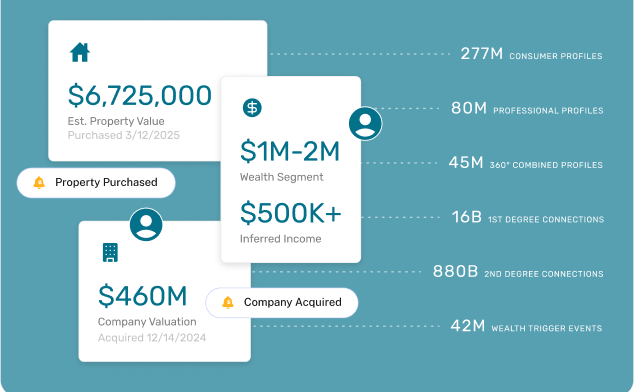
Aidentified provides enrichment designed specifically for advisor prospecting. It monitors 300M+ profiles continuously, surfaces wealth events across 16 categories as they occur, and maps 16B+ relationship connections to show the fastest warm introduction path from your existing network to a qualified prospect. CRM integrations with Salesforce, HubSpot, Redtail, Lofty, and Wealthbox mean enriched data flows directly into your existing workflow. See how enrichment tools and appending for wealth management compares across the advisor-specific data layers that standard platforms do not cover.
If you are ready to see how enrichment designed specifically for financial advisor prospecting works, try Aidentified for free.
FAQs: data enrichment vs data appending
Do I need both enrichment and appending?
Most advisors benefit from both, used in sequence. Appending ensures your contact records are complete with standard fields, email addresses and phone numbers. Enrichment then adds wealth context, financial events, and relationship intelligence that appending cannot provide.
Think of appending as data hygiene and enrichment as data intelligence. One makes your records usable. The other makes them actionable. See how enrichment and appending for lead generation combines both into a qualified outreach workflow.
Can enrichment replace appending?
In theory, a comprehensive enrichment platform could provide some appending-type data like email and phone. In practice, enrichment platforms focus on deeper data layers, and dedicated appending services offer better coverage, speed, and cost efficiency for basic field completion. Both tools serve a distinct purpose, and the cost of dedicated appending for standard fields is low enough that there is no reason to consolidate.
How often should enriched data be updated?
The value of enrichment depends directly on freshness. Continuous or near-real-time enrichment updates are ideal, especially for wealth events and relationship changes that open or close decision windows quickly. Enriched data that is months old misses opportunities and surfaces stale information about prospects whose circumstances have changed.
For financial advisor prospecting, real-time or weekly updates to enriched records are the baseline expectation, not a premium feature. See how enrichment strategies for client acquisition changes when enriched records update as events occur rather than on a quarterly schedule.
Is enriched data accurate enough to trust for prospecting decisions?
Enrichment accuracy varies by data type and source. Professional data from verified databases is typically highly accurate. Consumer and financial data from property records is more variable in completeness but accurate for the data points it does contain. Trust enriched data for screening and qualification, but verify critical information before outreach. Enrichment is a prioritization layer, not a source of verified facts. See how enrichment for relationship intelligence applies accuracy standards across data types.



growth engine with the
LLM Prompting Guide.
Reveal the power of your network with Aidentified’s industry-leading AI.
Discover how Aidentified can transform your specialty services business. Contact us today for a personalized consultation and demo.
Explore a demo