How to build centers of influence that send referrals

This is a div block with a Webflow interaction that will be triggered when the heading is in the view.
Download the LLM 2026 Prompting Guide
Teach your AI to think like your firm with 10+ customizable prompts
Download TodayTL;DR
For the typical practice that uses centers of influence (COIs), CPAs and estate planning attorneys supply the majority of COI referrals.
Choose COIs whose clients match your ideal client profile, and add a specialist tied to your niche alongside the CPAs and attorneys.
Build each relationship by referring first, handing over a one-page referral guide, and agreeing how introductions will work before the first one.
Aidentified’s relationship mapping maps the paths from your existing contacts to the COI you want to meet, so you can ask a mutual contact for the introduction.
What is a center of influence
Centers of influence for financial advisors are the CPAs and attorneys who already advise the clients you want to reach. Insurance agents, real estate agents, mortgage brokers, and community leaders can play the same role for the people who rely on them.
In the Kitces Research 2026 study of how financial planners market their services, client referrals and referrals from centers of influence (COIs) were the two most widely used marketing tactics, at 88% and 64%, respectively. COI referrals belong in your financial advisor lead generation strategy because each introduction comes from a professional the prospect already trusts.
Types of centers of influence for financial advisors
A center of influence is a professional whose work puts them in regular contact with people who need financial advice. Among advisors who use COIs in the Kitces study, the typical practice received the majority of its referrals from two referral sources: CPAs were used by 89% of those advisors, and estate planning attorneys by 79%.
CPAs and estate planning attorneys
A CPA who prepares a client's taxes works through their finances every year, so a business sale, a stock grant, or an inheritance comes up in that work. Estate planning attorneys draft the wills and trusts that decide where a family's assets go, and they meet the family while drafting them. Start your COI strategy with the CPAs and attorneys whose client lists look most like your own.
Insurance agents, realtors, and mortgage brokers
Realtors and mortgage brokers usually meet a client around one transaction, a home purchase or a refinance, and insurance agents meet them when coverage is bought or reviewed. Each one raises planning questions about cash flow, protection, and how a large purchase fits the household's plan. A real estate agent or insurance agent in your market can introduce you while those questions are open.
Community leaders and niche specialists
Community leaders, nonprofit board members, and local business association leaders often have connections across a town or industry. The Kitces study found that high-growth practices were more likely to work with COIs who serve their target market, such as an influential doctor at a hospital the advisor wants to reach. Among high-growth practices, 37% used this type of COI, compared with 21% of other practices. Our guide to referral sources for financial advisors explores fellow advisors and community connectors in more detail.
Choose COIs who serve your ideal clients
Choosing COIs starts with the client you want to serve, because a COI introduces you to the people they work with. A CPA whose practice is mostly retired teachers will not send you founders preparing to sell a company.
Start from your ideal client profile
Describe your ideal clients in a few lines: profession, life stage, assets, and the financial decisions ahead of them, like selling a business or retiring. If you have not narrowed your target audience yet, define your target market first, and your COI list follows from it. For instance, a practice built around business owners points to CPAs who prepare business returns, attorneys who handle business sales, and commercial bankers. List the professionals who serve your ideal clients before you list the ones you know.
Check fit before you invest time
Meet a candidate COI the way you would meet a prospect, and ask who their clients are, how they like to work, and whether they already refer clients to another advisor. A COI building their own practice may have more room for a new referral relationship. Your clients will judge you by the professionals you recommend, so hold each COI to the service standard you set for yourself.
How to build COI relationships on a clear value proposition
A COI who introduces you is vouching for you to their own client. Your value proposition has to show what their clients gain from you, and what the COI gains from a financial advisory partner who sends work back.
Step 1: Offer value before you ask
Open the relationship by sending the COI a client who needs tax, legal, or insurance work. A mutually beneficial relationship begins with evidence that referrals will travel in both directions.
Step 2: Hand over a referral guide
Give each COI a one-page referral guide naming the clients you serve, the situations you help with, like a business sale or an inheritance, and what happens after an introduction. A specific guide lets a COI recognize a fit while sitting with their own client.
Step 3: Plan for a shared client
Test the partnership with a client you both serve. With the client’s permission, involve the CPA in a planning question with tax implications, such as when to sell concentrated stock. This gives the CPA a chance to see how you approach planning and work with a shared client before referring someone new to you.
Step 4: Agree how introductions will work
Agree on the referral process before the first introduction. Decide whether you’ll connect by email, arrange a joint call, or meet together, and clarify what updates you’ll share afterward. If the arrangement involves compensation, consult your compliance team first to ensure it meets the regulatory requirements that apply to your firm.
Keep COI referrals coming after the first introduction
A COI relationship needs regular contact after the first introduction, on a schedule like the one you keep with clients. Treat it as part of practice management and your wider referral strategy, with notes on what you discussed and a regular look at which relationships produce introductions.
Report back on every referral
Tell the COI when you have met the person they introduced and what the next step is, within what your client agrees you can share. A COI who never hears what happened after an introduction has little reason to make the next one.
Track COI relationships in your CRM
Record each COI with the fields you keep for clients: last contact, referrals sent, referrals received, and next step. A CRM for financial advisors keeps that history in one place, so your quarterly review shows which referral relationships contribute to business growth.
Bring COIs into your marketing
COI marketing gives both practices a reason to stay in touch between introductions. Co-host a session for business owners with a CPA before tax season, split sponsorships of local events, or feature each other's articles in your digital marketing on LinkedIn and email. That community engagement puts your name in front of the COI's clients, next to the COI's own.
Map your path to the right COIs with Aidentified
Aidentified is a wealth and relationship intelligence platform that helps advisors make better decisions across prospecting, client management, client service, and growth. When reaching out to COIs, start by identifying who in your network already knows the professional you want to approach.
As a relationship mapping software, Aidentified maps the paths from your existing contacts to that person across household members, alumni ties, previous shared employment, and board affiliations. It ranks those paths by the strength of the connection, and each path shows how you're connected. The strongest path leads through the client or colleague best placed to introduce you.
With wealth event monitoring, you get alerted when someone on a saved list has a wealth event, such as a company acquisition or an IPO. If that person is a client, the alert gives you a reason to call and bring their CPA into the conversation about how the proceeds are invested and taxed.
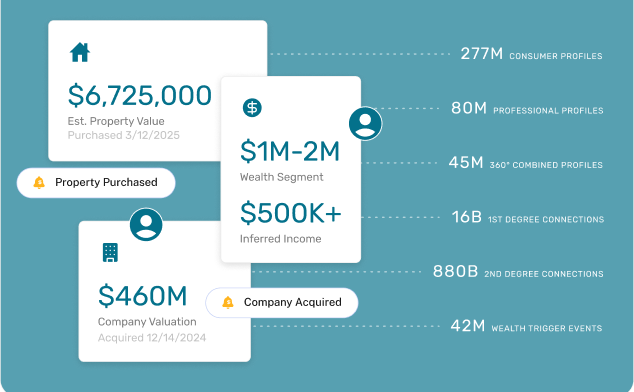
Aidentified covers 300M+ profiles with modeled wealth and income on every one, 16B+ first-degree connections, and 16 wealth event types. It runs alongside the CRM where you keep your COI and client records, as a tailored insights enrichment layer.
Start your next COI relationship with a warm path
A COI relationship starts more easily when a mutual contact makes the introduction. Your contact lists do not show which of your clients studied with, worked beside, or serves on a board with the professional you want to meet. Aidentified maps those paths from the contacts you already have, so you can pick the COIs you can reach through someone they trust.
Name the COI you most want to partner with, and we'll show you who in your network can make an introduction. try Aidentified for free.
FAQ: Do you have any questions?



growth engine with the
LLM Prompting Guide.
Reveal the power of your network with Aidentified’s industry-leading AI.
Discover how Aidentified can transform your specialty services business. Contact us today for a personalized consultation and demo.
Explore a demo