Mass affluent wealth management is a prioritization problem

This is a div block with a Webflow interaction that will be triggered when the heading is in the view.
Download the LLM 2026 Prompting Guide
Teach your AI to think like your firm with 10+ customizable prompts
Download TodayTL;DR
The mass affluent hold roughly $100,000 to $1 million in investable assets and need much of the same planning as wealthier households, for less revenue.
Segment on investable assets, not net worth. A household with $900,000 in home equity and $60,000 in a rollover IRA is not a $960,000 opportunity.
Asset thresholds tell you who can afford you. Wealth events tell you who is ready now, and Aidentified tracks 16 of them across a database of 300M+ people.
Mass affluent wealth management has a math problem. A household with $400,000 in investable assets needs most of the same advice a $4 million household requires, and pays a fraction of the fee for it. Serve them like your best clients and your margin disappears. Serve them with a script and they leave.
Most advice on this segment stops at the definition. None of that discloses which forty names on a list of a thousand deserve a call this month.
That is a data problem before it is a service problem. An AI wealth management tool that scores households on wealth and readiness moves your margin more than another process redesign, and a lead generation tool for RIAs that ranks a list by what recently changed turns a volume segment into a shortlist.
Why are the mass affluent breaking your service math
Every tier above this one pays for itself. A $5 million household covers a dedicated relationship, a planning specialist and quarterly reviews. A $400,000 household does not, and there are far more of them.
The constraint here is volume. This segment is too large to serve one household at a time the way you serve your best relationships.
The mass affluent definition, in investable assets
Most of the industry puts the mass affluent between $100,000 and $1 million in investable assets. Pick one and hold it, because the band decides your staffing.
Mass affluent vs high net worth clients
Mass affluent individuals research you before they call. They read your content, check your site, and decide over months. High-net-worth individuals have already sat across from an advisor, so entry runs through someone they trust, and ultra-high-net-worth households arrive with a team already around them.
Content wins the mass affluent. Introductions win everyone above them. Applying the second approach to the first segment burns your most expensive hours on people who were not ready to talk.
The usual bands put high-net-worth households at $1 million to $5 million in investable assets, very high net worth households at $5 million to $30 million, and ultra-high-net-worth households above $30 million. Some definitions also add an income test of about $75,000 to the mass affluent band, so confirm which one your firm uses.
4 financial needs of mass affluent clients
1- Retirement planning and rollovers
Retirement planning is why most of these households call anyone. They have a 401(k) from a job they left and no clear answer on whether they are on track.
2- Tax planning and account placement
Tax planning is where your advice pays for itself fastest. Contribution ordering, Roth conversion timing and account location all have a dollar answer the client can see.
3- Estate planning and inherited money
Estate planning gets treated as a high-net-worth service, which is how these households end up with a will from 2009 and a beneficiary naming an ex-spouse. Cerulli Associates projects $124 trillion moving between generations through 2048, with 42% coming from high-net-worth and ultra-high-net-worth households.
Read that the other way. Most of the great wealth transfer runs through households below the high-net-worth line, and receiving an inheritance turns a household that was not shopping for advice into one that is. Aidentified tracks those moments using verified mortality data.
4- Investment management, kept simple
Investment management is the part to standardize hardest. Model portfolios and a small set of risk-based allocations cover almost every household in this band.
{{banner}}
How firms make the service model work
The pattern that comes up most is deciding in advance what a household at each asset level receives, so relationships do not drift toward the attention your best client gets.
Tiering delivery without tiering quality
A common approach is three bands that differ in how advice is delivered rather than in the advice itself: a digital plan and annual review at entry, a named advisor and scheduled check-in in the middle, the full relationship at the top.
Where fintechs changed the economics
Fintechs showed that portfolio construction and rebalancing can be delivered at very low marginal cost, which has put pressure on what basic financial services carry on their own.
Response time beats everything else
Client experience in this band comes down to responsiveness and clarity. These households are not expecting a concierge. They want an answer within a day and a plan they can explain to their spouse.
Rank households by wealth events, not asset size
An asset threshold tells you who can afford you. It says nothing about whether this is the quarter they act. Two households with identical balance sheets can be a year apart in readiness, and the difference is almost always something that recently happened.
Step 1: Cut on investable assets
Filter on investable assets rather than net worth. That removes the house-rich names that were never going to fund an account this year, and it is the cut that does the most work on a large list.
Step 2: Sort by recent wealth events
A wealth event is a change in a household's financial life that creates a decision. A job change with equity, a company acquisition, a property sale, an inheritance, a stock transaction disclosed in an SEC filing.
Advisors who work from prospecting around timing get into the conversation while the question is still open.
Step 3: Find the warm path in
Referrals stay the highest-converting source in this segment, and most advisors underuse them by asking the same three clients. Knowing that an existing client's brother changed jobs last month is a service moment and an acquisition moment at once.
That is how warm leads for financial advisors get built at volume, and why getting more referrals stops being a seminar problem.
Scale mass affluent wealth management with Aidentified
Wealth management firms hit the same wall. The service model is fixable with a spreadsheet and some discipline. Knowing which of ten thousand households is ready is not, because that information sits outside the CRM and goes stale quickly.
Aidentified is a wealth network insights platform that sits on top of the CRM you already use.
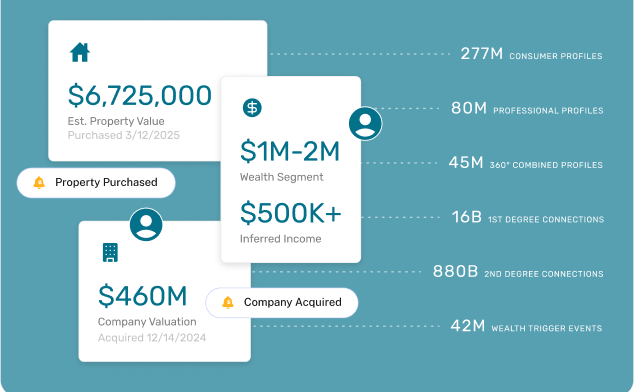
It combines household consumer data with professional data into unified profiles across 300M+ people, with 150 to 200+ attributes each and a 100% fill rate on wealth and income data, so a list sorts by estimated investable assets instead of guesswork.
It also tracks 16 wealth event types across careers, liquidity, stock transactions, property and wealth transfer, updating continuously through a six-layer verification process, and maps 16B+ first-degree connections so you can see who can make an introduction.
Decide who deserves your next hour with Aidentified
Most advisors already have more qualified mass affluent names than hours, and no way to tell which forty are in a decision window right now.
To see it against your own list, book your demo and we will rank a sample list by wealth and readiness.
FAQ: Do you have any questions?



growth engine with the
LLM Prompting Guide.
Reveal the power of your network with Aidentified’s industry-leading AI.
Discover how Aidentified can transform your specialty services business. Contact us today for a personalized consultation and demo.
Explore a demo