7 Financial advisor target market financial advisors should focus on

Download the LLM 2026 Prompting Guide
Teach your AI to think like your firm with 10+ customizable prompts
Download TodayTL;DR
Most advisors serve whoever comes to them. The strongest practices are built around a deliberately chosen target market.
The most productive target markets share three traits: enough wealth complexity, a clear wealth event that creates a receptivity window, and reachability through your existing network.
Niche selection alone is not enough. A real target market is measurable: defined by wealth level, life stage, industry, geography, and wealth event triggers.
Validate your market on reachability, fee economics, and credibility before committing to it.
Most financial advisors do not choose their clients. They inherit them.
A referral here, a walk-in there, and over a decade you have a book that spans retirees, business owners, corporate executives, and young families. The practice works, but it does not compound. Every new client requires resetting the pitch and rebuilding trust from scratch.
The advisors with the strongest practices share one thing: they defined their financial advisor target market first, then built everything around it. A defined market means every prospecting decision has a filter: who fits, who does not, and which target market warm lead identification signals tell you when someone is ready to have a conversation.
This guide covers seven target markets that appear consistently in high-growth advisory practices, how to validate the one that fits yours, and how to turn that definition into a working target market prospecting platform strategy. Each entry covers what makes the market strong, where advisors typically struggle, and who it fits best.
Defining your advisory niche and market
Before picking a target market, most advisors need to resolve a confusion that quietly holds their practice back: the difference between a niche and a target market.
A niche is a positioning choice. "I serve dentists" or "I specialize in divorce planning" are niches, identity-based and often narrow. A target market is the client profile you have deliberately chosen to pursue, understood in enough depth that it drives daily decisions about who to contact, what to say, and how to deliver.
"Successful people" is not a target market. A real target market answers specific, countable questions: minimum net worth, included industries, geographic area, life stage, and the wealth events that create receptivity windows. If you cannot describe your market in terms a data platform could filter by, you do not have one yet.
7 Target market segmentation for advisors
The most productive target markets share three traits: the prospects have enough wealth complexity to need ongoing advice, there is a clear wealth event that creates a receptivity window, and the market is reachable through existing relationships or defined introduction paths.
Seven markets appear consistently in high-growth advisory practices. Each one covers what makes it strong, where advisors typically struggle, and who it fits best.
1. Pre-retirees and business owners approaching exit
Pre-retirees, typically ages 50-65, are among the most receptive prospects an advisor can target. The financial complexity is high, the decision window is defined, and the stakes are clear: asset preservation, Social Security timing, healthcare costs, and drawdown strategy all converge at once. Business owners approaching exit add tax exposure on the sale, succession planning, and the question of what to do with sudden liquidity. The wealth event is obvious in both cases, and obvious wealth events are what separate warm conversations from cold ones.
The limitation is competition. This market is crowded, and generic retirement planning messaging does not differentiate.
Best for: advisors with deep tax planning expertise, existing business owner relationships, or a credential that signals specialization in liquidity events. Use a target market prospecting platform to surface these wealth event windows before the competition does.
2. Corporate executives with equity compensation
Corporate executives at mid-to-large companies represent a high-yield target market because their financial complexity typically outpaces their attention. They have equity compensation, concentrated stock positions, deferred comp plans, and a career trajectory that generates new financial decisions every year, but rarely the time to manage it. Receptivity windows are event-driven: a promotion, a company acquisition, a significant vesting date, or a planned departure.
The limitation is the introduction. These prospects are surrounded by financial opinions from HR and existing advisors. A warm introduction is almost always required.
Best for: advisors with strong network density in a defined corporate ecosystem or access to target market relationship mapping tools that surface introduction paths before cold outreach is necessary.
3. High-net-worth individuals with active wealth events
High-net-worth prospects in the middle of a wealth event, an IPO, a significant inheritance, a company sale, or a major real estate transaction, are among the highest-converting targets in wealth management. The complexity is present, the assets are in motion, and the need for guidance is immediate rather than theoretical. The challenge is timing. A prospect who received a major inheritance six months ago and has already placed the assets is no longer in the same receptivity window as one who is mid-process.
Best for: advisors with strong estate planning or investment credentials and a prospecting system that tracks wealth events across a defined geography. Use AI for target market identification to surface the right prospects at the right moment rather than relying on timing by chance.
4. Medical professionals with high income and complex financial needs
Physicians, dentists, and other healthcare professionals are a classic target market because wealth accumulation potential is high and financial literacy is often low relative to income. They graduate with significant debt, begin earning quickly, and face decisions around practice buy-ins, malpractice coverage, student loan repayment, and retirement planning simultaneously, usually without any financial infrastructure in place.
The strength is specificity. An advisor who understands physician employment contracts and the tax treatment of medical professional income has an immediate credibility advantage over a generalist.
Best for: advisors with a healthcare background or existing medical professional clients. Connecting your target market lead generation to this segment works best when paired with a visible credential or referral network in the healthcare space.
5. Tech professionals with concentrated equity
Technology professionals at pre-IPO and post-IPO companies face a target market defined almost entirely by one challenge: concentrated equity. Their income is strong, their net worth is often illiquid, and the wealth events that change their financial situation, a company IPO, an acquisition, a secondary sale, are highly trackable. This market is growing as technology continues to produce liquidity events across a wider range of geographies.
The limitation is skepticism. Tech professionals tend to be DIY-oriented and dismissive of generic financial advice.
Best for: advisors in technology-dense metros who can speak specifically to equity comp and post-liquidity diversification, using tools for target market prospecting that surface IPO pipeline activity before events go public.
6. Women navigating major financial transitions
Women navigating divorce, widowhood, or a significant inheritance face urgent, complex financial decisions under emotional pressure. The need for a trusted advisor is immediate and the relationship, when earned, tends to be long. The prospecting posture here is different: the introduction almost always comes through a trusted professional, an estate attorney, a divorce attorney, or a CPA, rather than cold outreach.
Building referral partnerships with the professionals who serve this market is how most advisors build density here.
Best for: advisors with strong professional referral networks and a service model built around financial education and ongoing relationship. See how target market and referral networks shapes strategy in relationship-driven markets.
7. Community and profession-based markets
Some of the most efficient target markets are defined not by wealth level or life stage but by professional or community identity. Teachers, veterans, pilots, engineers, real estate professionals, and similar groups share one characteristic that makes them valuable: they talk to each other. A strong referral loop in a tight-knit group can fill a practice faster than any paid lead generation campaign.
The limitation is authenticity. You cannot fake your way into a community.
Best for: advisors with a genuine connection to a specific professional or community group, where lived experience creates the credibility that demographic research alone never can.
How to define target market for financial advisors
Identifying an appealing target market and validating that it is right for your practice are two different things. Three factors surface problems before you commit a year to the wrong market.
Network reachability and financial advisor market positioning
The best target market is one your existing clients already have relationships in. If you serve corporate executives and your target market is also corporate executives, your clients can make direct introductions. If your target market is entirely outside your existing relationships, you are starting from zero warm paths and relying on cold outreach with lower conversion and higher cost.
Before committing, map your current book against the segment you are considering. How many mutual connections does your network already have into that market? Platforms built for target market relationship mapping can answer this question before you spend time on outreach.
Fee economics
Target markets vary significantly in fee economics. A market of business owners with $3M to $5M in net worth may command higher fees, but the addressable population in your geography may be small. A mass-affluent professional market is larger and easier to source, but per-client revenue is lower and acquisition cost must stay tight. Model both revenue per client and estimated cost of acquisition before committing. Connecting your definition to a target market lead generation strategy surfaces the math earlier.
Credibility fit
Advisors with relevant credentials, industry experience, or existing relationships in a target market are measurably more credible to prospects there than generalists. Either focus on a market where you already have credibility, or plan intentionally for how you will build it, through a credential, a referral partnership, or a content strategy that establishes expertise before contact. Credibility is what converts a warm introduction into a first meeting.
Target market strategy for financial advisors with Aidentified
Most advisors who struggle with prospecting are not lacking effort. They are prospecting without a defined market, reaching out broadly, and missing the wealth events that would have made a prospect receptive months earlier. A defined target market without a data system to act on it is still just a document.
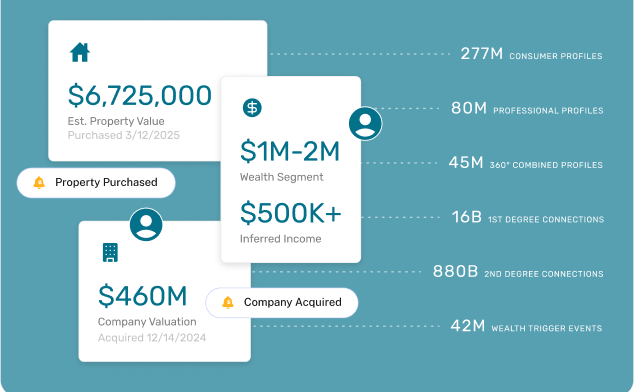
Platforms like Aidentified monitor 300M+ profiles, map 16B+ connections, and track 16 wealth event types, surfacing the prospects in your defined market at the moment they are most receptive. It then maps your existing network to show the fastest warm introduction paths, before a single cold call is made.
If you are ready to take your target market definition and turn it into a working prospecting workflow, try Aidentified for free.
FAQs: Financial advisor target market
How specific should my target market definition be?
Specific enough that it drives daily prospecting decisions. A target market definition that works should be describable in terms a data platform could filter by: minimum net worth, geographic area, life stage, and the key wealth events that create receptivity. If you cannot screen a prospect list against your definition and get a clear yes or no, the definition is still too vague.
The threshold is not narrow enough to feel exclusive but specific enough to act on. Advisors who have connected their ideal client profile to target market data in your CRM find that the discipline of defining the market forces the specificity that makes outreach land.
Can I have more than one target market?
Yes, but each target market needs its own strategy. Many advisors successfully serve two distinct segments, corporate executives and business owners for example, because the introduction paths and prospecting channels differ enough that they do not dilute each other. The problem is treating multiple markets as one: same messaging, same referral partners, same outreach sequence for everyone.
Effective target market segmentation means giving each segment its own lane. See how how target market shapes prospecting strategy changes when you have a defined segment strategy behind it.
Should I define my target market based on who I have or who I want?
Start with who you already have and genuinely enjoy working with. Your best existing clients, the ones who refer others and stay without friction, usually point toward your natural target market. They reveal the wealth level, life stage, and professional context where you already have credibility and relationship density.
Do not be locked in if a different market offers better economics or stronger network density. The strongest practices are built on a target market close enough to existing expertise to be credible, and different enough to represent real growth. See how target market and client base growth connects to this decision.
What is the difference between a target market and an ideal client profile?
A target market is a population-level definition: the segment you have chosen to pursue, defined by wealth level, life stage, industry, and geography. An ideal client profile is the individual-level description of the best client within that market, the specific characteristics and financial situation that make someone high-fit. You define the target market first. The ideal client profile lives inside it.
Both should live in your CRM as active filters, not just in a strategy document. Advisors who have connected both to a prospecting platform find that target market warm lead identification becomes systematic rather than opportunistic.



growth engine with the
LLM Prompting Guide.
Reveal the power of your network with Aidentified’s industry-leading AI.
Discover how Aidentified can transform your specialty services business. Contact us today for a personalized consultation and demo.
Explore a demo