Client segmentation in wealth management: Matching your service to each client's needs

This is a div block with a Webflow interaction that will be triggered when the heading is in the view.
Download the LLM 2026 Prompting Guide
Teach your AI to think like your firm with 10+ customizable prompts
Download TodayTL;DR
Segmenting clients by wealth, life stage and service needs lets you decide in advance how much advisor time and planning each household receives.
Tier on investable assets first (mass affluent at $100K to $1M, HNW at $1M to $10M, UHNW at $10M or more), then refine by life stage and complexity.
Each tier needs its own touchpoints, staffing and pricing, with the most advisor time set aside for households with complex needs and growth potential.
Aidentified attaches a wealth estimate to every profile and alerts you to wealth events, so you can tier clients and prospects on the same data.
Client segmentation in wealth management groups the households you serve by wealth, life stage and service needs, then sets a service model for each group. In its 2025 RIA Benchmarking Study, Charles Schwab drew on data from 1,288 registered investment advisor (RIA) firms and found that 55% of its top performing firms had a segmentation strategy.
A segment describes a household on the day you assigned it. A business sale, an inheritance or a retirement can move a client into a different tier, and wealth event monitoring alerts you when someone on a saved list has a wealth event. The same tiers can sort prospects before the first meeting, whether a name came from a client referral or a lead generation tool for RIAs.
Why wealth management client segmentation is important
Wealth management client segmentation decides in advance how much advisor time, planning depth and contact each client receives. Tailored advice starts with knowing which group a client belongs to.
Once every client is grouped into a segment, you can compare revenue with cost-to-serve, see the profitability of each group and plan resource allocation. A client segmentation strategy lets you track client satisfaction, client retention and operational efficiency tier by tier.
Step by step: How to segment clients by wealth, life stage and service needs
Three steps place each household in the right segment: first assess its investable assets, then consider its life stage and wealth events, and finally weigh its service needs and complexity. Wealth sets the initial tier, while the next two steps refine the level of service each household needs.
1. Start with investable assets
Sort households by the investable assets first. Mass affluent households hold $100K to $1M in investable assets, high-net-worth (HNW) households $1M to $10M, and ultra-high-net-worth (UHNW) households $10M or more. Leave net worth aside, because a home or a private business raises net worth without adding assets you can manage.
Record the assets under management (AUM) a client holds with you separately from their total investable assets. For a client with $400K of AUM with you and $3M in investable assets, the $2.6M held elsewhere is your growth potential. The planning needs of mass affluent and HNW households differ enough to justify a separate service model for each. Tier on total investable assets, and track AUM as the share of those assets you already manage.
2. Add life stage and wealth events
Life stage helps you understand which planning conversation a family may need next. For instance, a couple in wealth accumulation, saving through workplace retirement plans and buying a first home, needs a different plan from a business owner preparing to sell or a retiree drawing income.
Note how the wealth was built as well. A first-generation business owner and an heir with the same balance can ask very different questions about risk, family and legacy. Record the life stage next to the asset tier, because the next planning conversation depends on both.
3. Weigh service needs and complexity
Service needs measure how much work a client requires, whatever their assets. Count the planning areas in play, such as tax, estate, a private business, a concentrated stock position and insurance, and the professionals already involved, such as a CPA or an estate attorney. Add the client's risk tolerance and how often their plan changes.
Behavioral segmentation adds how each client prefers to work with you. Some clients prefer digital engagement through a client portal, while others expect a meeting before every decision. Two households with the same assets can require very different levels of service, so tailor service to the work each one requires.
Build a client service model for financial advisors
A client service model for financial advisors sets out what each group receives: who serves it, how often you meet, what planning it includes and what it costs. Write it down so every advisor delivers the same service across a tier.
Set touchpoints for each tier
List the touchpoints for each level of service: review meetings, planning updates, market commentary, milestone contacts and the response time you commit to. For the top tier, design the service around what HNW clients expect, including proactive contact and coordinated planning. For the largest group, the guide to mass affluent wealth management covers how firms deliver service at scale. A written touchpoint schedule also shows your advisor capacity: the number of clients in each tier one advisor can serve well.
Match pricing and staffing to cost-to-serve
Pricing each tier is a practice management decision. Estimate the advisor time, service team hours and specialist work each tier uses in a year, then compare that cost-to-serve with the revenue the tier brings in. When a tier costs more to serve than it earns, change the service, the staffing or the pricing, and hold the quality of advice to the same standard.
Client segmentation for financial advisors should include prospects
Client segmentation for financial advisors applies to prospects as well as clients, because the segment tells you what you would offer a family before the first meeting. Score prospects on the same three inputs you use for clients.
Apply your tiers to prospects
A prospect who fits your top service level is a candidate for a warm introduction and a prepared first meeting. A mass affluent prospect can start with a seminar or a newsletter. The outreach for each tier is set out in our list of prospecting strategies by segment. Define your ideal client for each segment, then prospect into the segment with the healthiest margin and the most room for new clients.
Re-segment when a household changes
Review your book of business each quarter, alongside client reviews, and move any client whose assets, life stage or service needs have shifted. Keep the tier as a field in your CRM, so reports, workflows and service calendars follow the change. Treat a wealth event as a reason to review a household's tier the same week.
Build segments from current wealth data with Aidentified
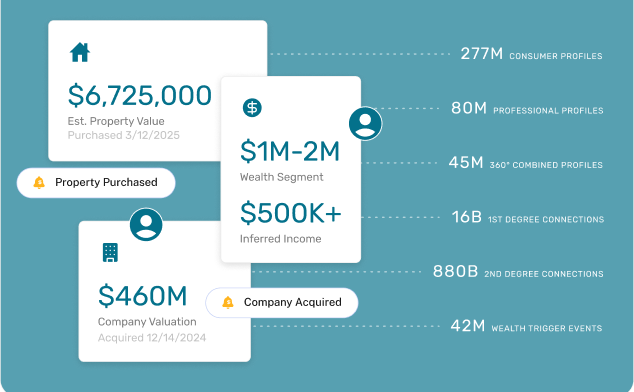
Platforms that combine household data, professional data and wealth events supply the inputs a segmentation model needs. Aidentified covers 300M+ profiles with up to 200 profile attributes each, and its 100% fill rate on wealth and income ranges gives every profile a wealth estimate. After you import your existing contacts by CSV or CRM sync, the modeled wealth and income on each profile give you an estimated range to tier against.
Consumer attributes such as family status, marital status and property ownership feed the life stage input. Professional attributes such as employment history, board seats, company ownership and stock holdings feed the complexity input.
Aidentified monitors 16 wealth event types, grouped as liquidity and equity events, corporate milestones, real estate transactions, and career and visibility signals. You get alerted when someone on a saved list has a wealth event. Therefore, keeping a list for each segment shows you when to review a client's tier or contact a prospect. For top-tier prospects, relationship mapping maps paths across 16B+ first-degree connections, and each path shows who in your network can make an introduction.
Aidentified runs alongside your CRM as a tailored insights enrichment layer, and profiles are updated continuously as new data becomes available. The same profile data supports prospecting, client management, service and strategic growth, so each tier rests on current information.
Keep every household in the right service tier
Service tiers based on CRM records reflect each household as it was when the record was last updated. Aidentified adds estimated wealth ranges, wealth events and household context to the contacts you already have, helping you place each household in the right tier and reassess it as its situation changes.
Start with your current contact lists, and see the wealth ranges and recent wealth events on their profiles.
FAQ: Do you have any questions?



growth engine with the
LLM Prompting Guide.
Reveal the power of your network with Aidentified’s industry-leading AI.
Discover how Aidentified can transform your specialty services business. Contact us today for a personalized consultation and demo.
Explore a demo