Mass affluent vs high-net-worth: A guide for financial advisors

This is a div block with a Webflow interaction that will be triggered when the heading is in the view.
Download the LLM 2026 Prompting Guide
Teach your AI to think like your firm with 10+ customizable prompts
Download TodayTL;DR
Mass affluent clients hold $100K to $1M in investable assets, high-net-worth clients $1M to $10M, and ultra-high-net-worth clients $10M or more.
Mass affluent clients need a repeatable plan delivered efficiently. Content, life-stage timing and model portfolios let you reach and serve them at scale.
High-net-worth clients bring tax, estate and private-market decisions. Winning them depends on knowing the household and arriving through a warm introduction.
Aidentified shows modeled wealth and income, wealth events and introduction paths for each contact, the three inputs you need as a financial advisor to choose a playbook.
Mass affluent vs high net worth is a distinction drawn on investable assets, and it shapes how you find, win and serve a client. A household with $400K in retirement accounts and one with $4M across a business stake, real estate and a brokerage account both want sound investment advice. The first needs a clear plan and a set review calendar, while the second needs its CPA, its estate attorney and you working to the same plan.
This guide sets out the thresholds for each segment, the financial planning needs that separate them, and two acquisition playbooks for your wealth management practice: one built for scale and one built for depth. Whether a prospect reaches you through a client referral, a seminar or a lead generation tool for RIAs, the segment tells you which playbook to run.
What are mass affluent prospects?
Mass affluent prospects are households with $100K to $1M in investable assets. The range covers mass affluent individuals at different stages, from a professional with $150K in a workplace retirement plan to a couple near retirement with $900K across an IRA and a brokerage account.
For a mass affluent prospect, the planning conversation centers on retirement savings, asset allocation, insurance and up-to-date wills and beneficiary designations.
What are high-net-worth prospects?
High-net-worth (HNW) prospects are households with $1M to $10M in investable assets. Above $10M, a household moves into the ultra-high-net-worth range, where prospects are ultra-high-net-worth individuals (UHNWIs). An HNW household can hold a business stake, rental property or a concentrated stock position alongside its portfolio, and each holding brings its own tax and estate decisions.
Expect to coordinate the investment, tax and estate decisions with any CPA or estate attorney who already advises the family.
Differences between mass affluent and high-net-worth prospects
Mass affluent and high-net-worth prospects differ in the assets they hold, the planning they need, who works on the plan and how you reach them. The table sets those differences side by side, and the sections that follow cover each one in detail.
| Mass affluent prospects | High-net-worth prospects | |
|---|---|---|
| Investable assets | $100K to $1M | $1M to $10M |
| Planning focus | Retirement accounts, asset allocation, life insurance, wills and beneficiary designations | Tax planning around capital gains, estate planning with trusts, private equity, real estate and concentrated stock |
| Who works on the plan | You and your service team | You, with the family's CPA and estate attorney |
| How you reach them | Newsletters, webinars and seminars, timed to life-stage changes | A warm introduction from a client, a CPA or an estate attorney |
| Service model | Model portfolios, a set review calendar and fast answers to routine questions | A named advisor, custom investment management and a call when their financial life changes |
| Playbook | Scale | Depth |
Mass affluent vs high net worth by investable assets
Investable assets set the ranges in this guide. Capgemini's World Wealth Report 2025 uses the same measure and defines high-net-worth individuals (HNWIs) as people with investable assets of $1 million or more, excluding their primary residence, collectibles, consumables and consumer durables.
When you size a household, count its liquid assets and other financial assets, such as cash, brokerage accounts and retirement accounts, and leave the home and the art collection out.
Net worth is a broader measure that adds the home, a private business and other holdings, then subtracts liabilities. The Federal Reserve's Survey of Consumer Finances puts the wealth entry point for the top 10% of households at $1.55 million in net worth. Two households with the same net worth can be placed in different segments once the house and the business are set aside.
Annual household income is a third measure, and the SEC uses it in its accredited investor standard. An individual qualifies with income above $200,000 in each of the past two years, or $300,000 with a spouse or spousal equivalent, and expects the same this year. A net worth over $1 million, excluding the primary residence, also qualifies. Only accredited investors may participate in certain securities offerings, including those from private funds such as hedge funds, and the standard decides which of those private investments a client can buy into.
How financial planning needs change as assets grow
A mass affluent plan and a high-net-worth plan cover many of the same subjects: retirement, taxes, insurance and the estate. The high-net-worth version brings more accounts, more asset classes and more professionals involved in each decision.
What mass affluent clients need first
Start a mass affluent plan with the accounts the client is building wealth in: workplace retirement accounts, IRAs and any rollover from a previous employer. Set an asset allocation that fits the client's risk tolerance and time horizon, and implement the investment strategy with mutual funds, ETFs and bonds. Check that life insurance covers the income the family depends on, and that wills and beneficiary designations are current.
For mass affluent clients, the deliverable is a plan they can follow every month, and each review updates it. For how firms structure service in this segment, check our guide on mass affluent wealth management for financial advisors.
Where high-net-worth clients need coordination
High-net-worth clients bring decisions that each involve a specialist: tax planning around capital gains, estate planning with trusts, and choices about private equity, hedge funds, real estate or a concentrated stock position. Ask who else advises the family, such as a CPA or an estate attorney, and agree how you will work together. Review risk management alongside the investment portfolio, including how life insurance fits the estate plan.
Ask about holdings outside the portfolio as well, from rental property and collectibles to cryptocurrency, because each one affects the tax return and the estate. Offer to coordinate the tax, estate and investment decisions under one plan, and agree on who owns each decision.
Two playbooks for winning clients in each segment
The two segments call for different acquisition playbooks. A mass affluent relationship starts smaller and its planning follows a standard path, which rewards reach and consistency. A high-net-worth relationship carries more assets and more advisors, and winning one takes depth: fewer prospects, more preparation and a warm introduction.
Reach mass affluent clients at scale
Reach mass affluent clients through channels that keep working between conversations: a newsletter, webinars and seminars on retirement planning or a first home purchase. Time your outreach to life-stage changes such as a new job, a rollover or a home sale, when the family has a specific question for a financial advisor.
Build the system once, and use those changes to choose which mass affluent contacts you call each month. The segment-by-segment approach in prospecting strategies for financial advisors shows how scale and depth divide between the tiers.
Win high-net-worth clients through introductions
Reach a high-net-worth prospect through someone they already trust: a client, a CPA, an estate attorney or a board colleague. Before the first meeting, learn the household, including the spouse, the business, any recent liquidity event and the professionals already involved. Open the meeting with what you know about their situation.
To map the people around a prospect before you reach out, follow the steps in prospecting high-net-worth clients. Ask a client or a CPA for one introduction to a named person, and arrive knowing the household.
Match the service model to the segment
Serve mass affluent clients with model portfolios, a set review calendar and a team that answers routine questions quickly. Give high-net-worth clients a named advisor, custom investment management and a call when something in their financial life changes. Staff each tier for the work it requires, and hold the quality of advice to the same standard in both.
When mass affluent households become high-net-worth individuals
Households move from the mass affluent range into the HNW range through events: a business sale, an IPO, equity vesting, a property sale or an inheritance. An heir who receives part of a parent's estate can cross the $1M line in a single transaction.
Organic growth runs in two directions: the clients you win and the existing contacts you already serve. Review your book of business each quarter for clients whose balance sheet has changed, and move them to the service model that fits. Treat a move into the HNW range as a planning event, and update the estate plan, the tax plan and the service model in the same review.
Segment your contacts and prospects with Aidentified
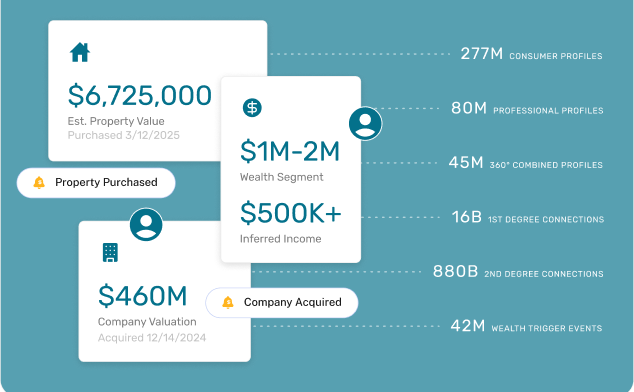
Platforms that combine household data, professional data and wealth events help you place each contact in a segment and choose a playbook. Aidentified covers 300M+ profiles, each with up to 200 profile attributes, including modeled wealth and income. With a 100% fill rate on wealth and income ranges, every profile includes a wealth estimate you can filter on.
Aidentified monitors 16 wealth event types, grouped as liquidity and equity events, corporate milestones, real estate transactions, and career and visibility signals. With wealth event monitoring, you get alerted when someone on a saved list has a wealth event. That alert tells you when to contact a mass affluent prospect on a long list, and when a client's liquidity event calls for a review.
For the HNW playbook, relationship mapping maps paths across 16B+ first-degree connections through household, alumni, employment and board ties, and each path shows who in your network can make an introduction.
Aidentified runs alongside your CRM as a tailored insights enrichment layer for advisors, RIAs and financial institutions. One profile shows the wealth estimate, the latest wealth event and the introduction path, and the same data supports prospecting, client management, service and strategic growth.
Know which playbook each contact needs
With Aidentified, you can filter the contacts you already have by wealth range, see their recent wealth events and find the warm path to the households that need depth.
Start with your current contact lists, and we'll show you the wealth range, events and connections behind each name. Try Aidentified for free.
FAQ: Do you have any questions?



growth engine with the
LLM Prompting Guide.
Reveal the power of your network with Aidentified’s industry-leading AI.
Discover how Aidentified can transform your specialty services business. Contact us today for a personalized consultation and demo.
Explore a demo