What do high-net-worth clients want? A guide for financial advisors

This is a div block with a Webflow interaction that will be triggered when the heading is in the view.
Download the LLM 2026 Prompting Guide
Teach your AI to think like your firm with 10+ customizable prompts
Download TodayTL;DR
High-net-worth clients hold $1M to $10M in investable assets and judge an advisor on personalization, proactive contact, discretion, and coordinated planning.
Record each client's goals and raise them at every review, since 42% of HNWIs have to restate their goals multiple times to the same firm.
Call when a sale changes a client's finances, coordinate with their CPA and estate attorney, and meet the heirs before any wealth transfers.
Aidentified shows you a potential client’s family, recent wealth events, and connections who can introduce you, so you can make your first conversation more relevant.
High-net-worth clients expect a financial advisor to build advice around their household, reach out when their financial life changes, handle what they share with discretion, and coordinate with their other professionals. Many clients find personalization missing: the Capgemini Research Institute's World Wealth Report 2026 found that only 17% of HNWIs describe their advisory experience as seamless and personalized.
Each priority below changes how you pitch, win, and keep clients. The priorities apply from the first meeting, whether a prospect reached you through a client referral or a lead generation tool for RIAs.
The clients that qualify as high-net-worth individuals
High-net-worth individuals are defined by investable assets, and this guide uses three wealth management bands. Mass affluent clients hold $100K to $1M in investable assets, high-net-worth (HNW) clients hold $1M to $10M, and ultra-high-net-worth individuals hold $10M or more.
Net worth is a broader measure. The Federal Reserve's Survey of Consumer Finances puts the wealth entry point for the top 10% of households at $1.55 million in net worth. Confirm whether a prospect list was built on net worth or investable assets before you work it. For households above $10M, see our guide on how to attract ultra-high-net-worth clients.
What high-net-worth clients want from a financial advisor
This guide groups what high-net-worth clients ask of an advisor into four priorities.
1. Advice built around their household
Personalization starts with knowing the household before you recommend anything: the spouse or partner, the business, the properties, and the children. Capgemini's 2026 research found that 42% of HNWIs have to restate their goals and preferences multiple times to the same firm.
Record the goals a client gives you, including the asset classes and investment strategies they prefer for their investment portfolio, and raise those goals at the next review. Open every recommendation with the client's own priorities, then explain how your firm delivers them.
2. An advisor who reaches out first
Proactive contact is a call you make because something in the client's life changed, before they think to call you. A business sale, a property sale, or a large stock transaction changes the household's liquid assets and its tax position.
Each of these events opens a decision window: where the proceeds go, how to diversify a concentrated position, and whether the estate plan still reflects the family's wishes. Reach out with a specific question about what changed, and keep the market update for the quarterly review.
3. Discretion with their personal information
Discretion covers how you collect, store, and share what a client tells you about their family, business, and assets. Security is part of what wealthy clients ask for beyond the portfolio.
Explain who on your team will see a new client's file, ask before you speak with their CPA, and never mention one client's situation to another. Cover these protections in the first meeting, without waiting for the client to raise them.
4. Coordinated tax and estate planning
Find out which professionals the client already works with: a CPA for tax planning, an estate attorney for wills and trusts, and an insurance specialist for risk management. Connect their advice to your investment management and financial planning, so a portfolio rebalance, a donor-advised fund gift, and a trust update follow one plan.
Bring tax optimization into investment decisions, such as when to realize a gain, and share your tax strategies with the CPA before year-end. Raise philanthropy early, because clients who give through donor-advised funds have goals that touch both the portfolio and the estate plan. Cover succession planning with business owners. Offer to coordinate the family's tax, estate, and investment decisions under one plan.
How to attract high-net-worth clients with these priorities
Shape your pitch around their household
Open a first meeting with the client's situation and explain your process through it. Restate their goals, name the professionals you would coordinate with, and say how you will contact them after their finances change. The client experience you describe in that meeting is the one they will hold you to, so promise only what your team can deliver.
Earn introductions through their other advisors
CPAs and estate attorneys work with the same households you want to serve, and a coordinated plan gives them a reason to introduce you. Our guide to referral sources for financial advisors covers which partners to approach first. Ask a CPA for one named introduction, and show them how you would work together on that client's plan.
Articles, webinars, and social media posts on the decisions HNW individuals face, such as a wealth transfer or a business sale, present you as a thought leader to prospects and to the CPAs who might refer them. Choose the topics your existing clients ask you about most.
What keeps HNW clients from moving their assets
Wealthy investors now spread their assets across more firms, and retention depends on how much of a family's planning you hold. Two groups decide whether those assets stay: the client and their heirs.
Most HNW investors use several firms
The World Wealth Report 2026 found that 39% of HNWIs worked with a single firm in 2019, a figure that fell to 19% in 2025. Product access is a significant driver: 88% of HNWIs say they work with multiple firms specifically to gain better access to alternative investments, a category that includes private equity and hedge funds.
Ask each client which other advisory firms hold their assets and why. If private markets are the reason, decide whether to offer that access or coordinate with the firm that does. Map where the family's other assets sit, and ask what would bring them to you.
Meet the heirs before the transfer
Cerulli Associates projects that $124 trillion in wealth will transfer between generations through 2048, with 42% coming from HNW and UHNW households. Most inheritors plan to move that wealth to a new firm: Capgemini’s World Wealth Report 2025 found that 81% of inheritors plan to switch firms within one to two years of inheritance.
Introduce yourself to the client's children while the parents are still your clients, and include them in estate planning meetings when the parents agree. Our article on verified mortality data explains how a death in the family can put money in motion. Building relationships with heirs early can help ensure you’re there when they’re ready for guidance.
Put these priorities into practice with Aidentified
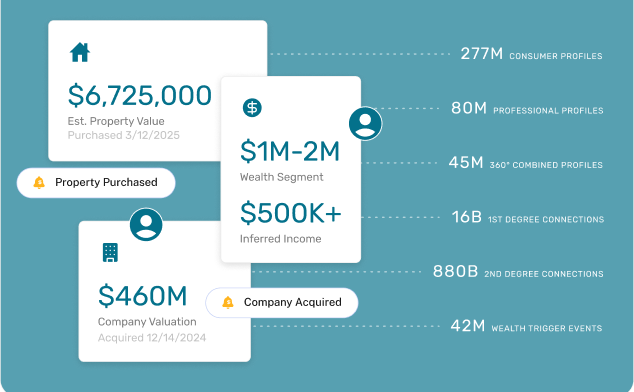
Platforms that combine household data, professional data, and wealth events supply the context these priorities depend on. Aidentified covers 300M+ profiles, each with up to 200 profile attributes and modeled wealth and income, with a 100% fill rate on wealth and income ranges. You can see the family, employer, board seats, and property ownership in one profile before your first conversation.
Aidentified monitors 16 wealth event types, grouped as liquidity and equity events, corporate milestones, real estate transactions, and career and visibility signals. With wealth event monitoring, you get alerted when someone on a saved list has a wealth event, and you can call a client about a trigger event before they mention it.
Relationship mapping maps paths across 16B+ first-degree connections through household, alumni, employment, and board ties, so you can see who in your network can make an introduction. One G2 reviewer described the value: "Aidentified can tell us that this person's spouse is actually a Director at XYZ firm, meaning this discussion might be more appropriate to be run by one of our more senior advisors." The same data supports prospecting, client management, service, and strategic growth.
Bring household context to every HNW conversation
A first conversation with a high-net-worth client can focus on their priorities when you already know the household, the recent change in their finances, and who in your network knows them. With Aidentified, you see the family, the wealth events, and the introduction paths before that conversation starts.
Start with the contacts you already have, and we'll show you the households, events, and connections behind them.
FAQ: Do you have any questions?



growth engine with the
LLM Prompting Guide.
Reveal the power of your network with Aidentified’s industry-leading AI.
Discover how Aidentified can transform your specialty services business. Contact us today for a personalized consultation and demo.
Explore a demo