Top lead enrichment tools that actually work for financial advisors

Download the LLM 2026 Prompting Guide
Teach your AI to think like your firm with 10+ customizable prompts
Download TodayAdvisors working from incomplete CRM records make the same prospecting mistake in two different ways. They call the wrong people, those whose professional profile looks right but whose household financial complexity does not justify the engagement. Or they reach the right people at the wrong time, after a wealth event has already closed and a competitor was first.
Lead enrichment solves both problems by appending verified data and signals to prospect records automatically. The challenge for financial advisors is that most enriched warm lead identification platforms were built for B2B sales teams, not wealth management, and the data layers they prioritize, company size, buying committee structure, and technology stack, have almost no bearing on whether an individual prospect has the financial complexity to need an advisor.
This guide covers what lead enrichment actually requires for advisor prospecting, how to evaluate platforms across the criteria that matter, and how the leading enriched prospecting platform for advisors categories compare. The goal is a transparent comparison so advisors can understand which tool fits their specific use case, not just which one has the largest contact database.
What lead enrichment tools do, and why advisors need them
Lead enrichment takes a contact record, typically just a name, email, and maybe a job title, and adds layers of useful data: household composition, estimated net worth, property ownership, equity holdings, professional background, and relationship connections.
The core value is straightforward. A prospect who looks unremarkable by job title alone becomes a qualified opportunity with enrichment context. An executive whose professional record shows a standard corporate role may carry a multi-million dollar equity position, a recent inheritance, and a property portfolio that makes them a high-priority prospect. None of that is visible without enrichment.
The distinction between a CRM and an enrichment layer is important. A CRM stores what you already know: contacts logged, interactions recorded, deals tracked. Enrichment reveals what you did not know at the time of contact, and, in the best implementations, continues revealing what changes after the initial record is created. But not all enrichment is created equal. The right tool depends entirely on which data layers matter most to your prospecting workflow. See how enriched data in your prospecting workflow changes the quality of outreach decisions.
How to evaluate lead enrichment tools: a lead enrichment software comparison framework
Three criteria determine whether a lead enrichment platform actually serves advisor prospecting or just fills contact fields with professional data: what the data layer covers, how fresh it stays, and how well it fits into the existing workflow without requiring a parallel system.
Data coverage: contact enrichment tools for wealth management vs. B2B
Different tools enrich different field sets. B2B platforms focus on company data, job title, employment history, intent signals, and technology stack. Wealth management platforms focus on household data, net worth estimates, property records, wealth events, and relationship connections.
For advisor prospecting, the data coverage gap is not a minor inconvenience, it is the entire problem. A platform that enriches professional fields accurately but carries no household wealth data cannot tell you whether a prospect is financially qualified for an advisory relationship. It can tell you their employer and title. It cannot tell you their liquidity position, household asset base, or whether a wealth event has recently opened a decision window.
Accuracy and data freshness
Enrichment accuracy varies significantly by data source. Professional data from database tools, sourced from business records and verified email delivery, is typically highly accurate for the fields it covers. Consumer wealth data from property and public records is more variable but far more specific to the decisions that drive wealth management prospecting.
Freshness matters as much as accuracy. A net worth estimate that is eighteen months old does not tell you whether a prospect is currently in a financial decision window. Static enrichment describes who someone was. Real-time enrichment, updated when qualifying events occur, describes who someone is right now and whether the timing is right to reach out. For advisors, this distinction determines the entire prospecting conversation.
Speed, integration, adoption, and enrichment tool pricing and features
Real-time enrichment, triggered on form submission or event detection, reduces workflow friction for inbound and event-driven prospecting. Batch enrichment, uploading a list for processing, is better for existing record hygiene and one-time list qualification.
Integration is the adoption variable most platforms underestimate. If enrichment happens automatically inside your CRM, adoption is high. If advisors have to toggle between tools to see enriched data, adoption drops sharply. Cost structure varies widely across the category: some platforms charge per record, others per user seat, others on fixed annual tiers. Per-record pricing scales with prospecting volume, which matters for advisors running high-frequency outreach against a defined target market. See how why your prospect records need enrichment intersects with CRM integration depth.
Best lead enrichment tools for financial advisors
Six platform categories serve this space, differing in data coverage, update frequency, and whether they were built for wealth management or adapted from adjacent markets.
1. Aidentified
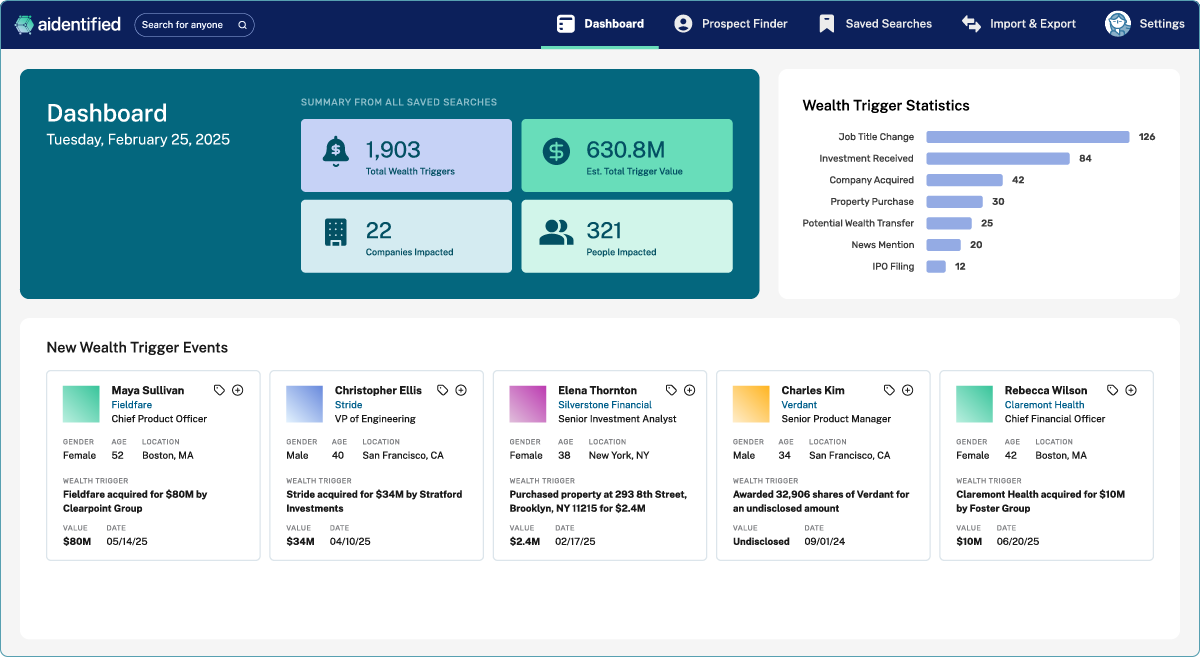
Aidentified is built specifically for identifying wealth management prospects rather than B2B enterprise buyers. It continuously monitors 300M+ profiles combining consumer and professional signals, surfaces real-time wealth events across 16 categories, and maps 16B+ relationship connections for warm introduction paths.
The core distinction is event monitoring. Records update automatically when a qualifying wealth event occurs, meaning the pipeline reflects current financial reality rather than a static snapshot. CRM integrations with Salesforce, HubSpot, Redtail, Lofty, and Wealthbox mean enriched data flows directly into the existing workflow. Explore how enrichment for wealth management prospecting changes when the data layer is built around wealth events rather than professional records.
2. Professional data enrichment platforms
Professional data enrichment platforms specialize in business records: job titles, company information, contact details, career history, and verified email addresses at scale. Their focus is breadth of professional information and deep integration with outreach workflows.
For financial advisor prospecting, the limitation is the complete absence of wealth and household context. These platforms excel at identifying decision-makers at companies and tracking career moves, but they cannot tell you whether a prospect has liquidity, household wealth, or the right timing for an advisor conversation. They are the right tool for sales development teams and the wrong tool for advisors whose core qualification variable is individual financial complexity.
3. Enterprise B2B intelligence platforms
Enterprise B2B intelligence platforms maintain large contact databases with company data, firmographics, and intent signals. They are built for identifying companies in a buying cycle, verifying contact data at scale, and building prospecting lists by specific professional criteria.
Pricing in this category ranges from entry-level tiers to enterprise contracts exceeding $15K annually, reflecting the scale of the database and the depth of integrations. The limitation for advisor use is the same as professional enrichment platforms: firmographic and intent signals cannot proxy for wealth complexity. A Fortune 500 company title does not tell you whether the individual behind it has recently experienced a liquidity event or inherited assets. See how enriched HNW prospect intelligence requires a different data layer than enterprise B2B contact enrichment provides.
4. Wealth data specialists
Wealth data specialist platforms approach enrichment from the wealth-first angle: property records, estimated net worth, equity holdings, business ownership, and liquidity events. Their strength is precision screening for high-net-worth prospects and identifying household wealth more accurately than professional data sources.
The limitation is workflow integration. Many require manual checking rather than automated CRM enrichment, and most lack the relationship mapping layer that shows how to reach a qualified prospect through an existing warm connection. They tell you a prospect is financially qualified. They do not tell you the fastest path to reach them or whether this week is better than last month. Layering a platform like this with enriched relationship paths and data closes that gap.
5. General CRM-native enrichment
Some CRM platforms offer built-in enrichment or easy integrations that append professional data and basic company information directly to contact records. The strength is convenience: enrichment arrives inside the existing system without a platform switch.
The limitation is depth. CRM-native enrichment typically focuses on professional data and lacks the consumer-layer wealth and household context that matters for financial advisor prospecting. An advisor whose CRM enriches job titles and email addresses gets cleaner records. They do not get the signal that a contact in their database just sold a business or received a significant inheritance. See how enrichment as part of advisor prospecting extends beyond what CRM-native tools can provide.
6. Intent data platforms
Intent data platforms track which companies or individuals are researching relevant topics online and flag buying signals based on web activity. For B2B software sales, where a prospect actively searches a category before committing, this is a meaningful signal.
For financial advisor prospecting, this signal is largely irrelevant. High-net-worth individuals do not reveal wealth management decisions through search activity. The events that matter, business sales, equity vesting, inheritance, major life changes, occur whether or not the prospect searches for an advisor afterward. Intent data misses the actual triggers that matter. See how enriched data for advisor lead generation uses event monitoring rather than intent signals to surface the right moment.
How to choose the right lead enrichment tool: data enrichment tools comparison for advisors
The right enrichment tool depends on what data layers actually drive your prospecting decisions. If you are screening purely by professional role and company, basic professional data enrichment may be enough. If household context, estimated wealth, and financial events shape your outreach, you need enrichment that covers all three, and most platforms in this category cover one at best.
Most CRMs store contacts but do not add depth. They are built for organization and tracking, not for surfacing the wealth context and timing signals that make advisor prospecting effective. Aidentified fills the gaps your CRM leaves open, layering household wealth data, continuous event monitoring, and relationship paths directly into your existing Salesforce, HubSpot, Redtail, Lofty, or Wealthbox workflow. Explore how enriching your referral network data and layering event monitoring on top of existing records changes the quality of prospecting decisions.
If you are ready to see how enrichment designed specifically for advisor prospecting works, try Aidentified for free.
FAQs: Lead enrichment tools
What is the difference between lead enrichment and wealth screening?
Wealth screening helps you identify which prospects in a target market are qualified by wealth level or profile. Lead enrichment takes existing prospect records and adds depth to them: household data, estimated wealth, professional history, and relationship connections.
Screening answers "who should I target." Enrichment answers "what should I know about this prospect I already have." Advisors typically use both: screening to build a target list, then enrichment to deepen records before outreach. See how enriched HNW prospect intelligence combines both functions in a single platform.
Do I need lead enrichment if I already have a CRM?
A CRM stores and organizes the information you provide. It does not automatically add new data to existing contacts, flag when a prospect's financial situation changes, or surface the warm introduction path to someone you have never contacted.
Lead enrichment fills those gaps. The tools work together: the CRM organizes and tracks, enrichment deepens and updates. An advisor with a CRM and no enrichment layer knows who is in their pipeline. An advisor with both knows who in their pipeline just entered a financial decision window. See how AI-powered wealth data enrichment automates this update process.
How often should lead enrichment data be updated?
The most valuable enrichment updates in real time or near-real time, especially for wealth events like business sales, equity vesting events, or significant property transactions. Platforms that refresh monthly or quarterly will miss the timing windows that make advisor outreach land.
For continuous monitoring of wealth events, real-time or weekly updates are the baseline expectation. The difference between a real-time alert and a monthly batch refresh is often the difference between reaching a prospect during an open decision window and reaching them after the window has closed. See how enrichment layer for lead generation handles event-driven enrichment updates.
Can lead enrichment replace a wealth screening tool?
Enrichment deepens prospect records you already have. Wealth screening identifies new prospects who meet your criteria from a broader universe. They serve different purposes and address different stages of the prospecting workflow.
Advisors typically need both: screening to build a qualified target list, then enrichment to deepen records for prioritized outreach. A platform that combines real-time wealth event monitoring with relationship mapping closes both gaps in one layer rather than requiring two separate tools. See how enriched relationship intelligence integrates with the enrichment workflow.



growth engine with the
LLM Prompting Guide.
Reveal the power of your network with Aidentified’s industry-leading AI.
Discover how Aidentified can transform your specialty services business. Contact us today for a personalized consultation and demo.
Explore a demo