Selling to high-net-worth clients: Strategies for financial advisors

This is a div block with a Webflow interaction that will be triggered when the heading is in the view.
Download the LLM 2026 Prompting Guide
Teach your AI to think like your firm with 10+ customizable prompts
Download TodayTL;DR
Selling to high-net-worth clients follows five steps: prepare, run discovery, protect their privacy, present a specific proposal, then ask for a decision.
In discovery, ask about liquidity events, estate and tax planning and the family, so the prospect sees you can serve the whole household.
Discretion is part of the service. Explain who sees their information and how you handle it before the prospect has to ask.
Aidentified gives you household context, wealth events and introduction paths before the first meeting, so discovery starts from what you already know.
Selling to high-net-worth clients means asking someone to trust you with their investable assets, their family's plans and information they have good reason to keep private. That trust develops over several conversations, and prospects start evaluating your process from the first meeting, long before they make a decision.
This guide covers that process for financial advisors and wealth management firms, from the first meeting to the signed agreement. Whether a prospect came through referrals, an event or a lead generation tool for RIAs, the steps that turn a meeting into a client are the same. If you are still deciding who to approach, start with our guide to prospecting high net worth clients, which covers the stage before this one.
Who are high-net-worth individuals and what do they expect
High-net-worth individuals (HNWIs) are best defined by investable assets, and this guide uses three bands. Mass affluent clients hold $100K to $1M in investable assets, high-net-worth (HNW) clients hold $1M to $10M, and ultra-high-net-worth (UHNW) clients hold $10M or more. For prospects in the top band, see how to attract ultra-high-net-worth clients.
Net worth is a broader measure. The Federal Reserve's Survey of Consumer Finances puts the wealth entry point for the top 10% of households at $1.55 million in net worth, so check which measure is used in each case before you segment by it.
Wealthy individuals and affluent individuals in every band expect advice built around their own situation. Often, investors feel the advice they receive is too generic. Every step below aims to make your advice specific to one household.
A five-step sales process for HNW clients
Each of the five steps below covers one conversation or decision point in the sales process for HNW clients.
Step 1: Prepare before the first meeting
With good preparation, the first meeting can center on the prospect's life from the opening question. Learn what you can about the household: the spouse or partner, the business they own or run, any recent liquidity events such as a business sale or an IPO, and the CPA or estate attorney they work with. Walk in with two or three questions about what changed for them recently, and save your firm's presentation for later.
Step 2: Run discovery around their priorities
Discovery shows the prospect whether you understand the household or only the portfolio. Ask about the decisions in front of them: retirement planning, tax planning ahead of a liquidity event, estate planning and legacy planning, charitable giving and wealth transfer. Ask what they hold, including private equity stakes, hedge funds or other alternative investments, and which investment management or asset management firms look after each piece.
A prospect who asks about family governance or about preparing their children to inherit is telling you the relationship will cover the family as well as the portfolio. The most useful discovery questions are about decisions the household is facing now. For questions you can adapt, our guide to financial advisor prospecting scripts has a set built around recent changes in a prospect's life.
Step 3: Make discretion part of service
Discretion belongs in the sales conversation, because you are asking the prospect to share details about their family, their business and their assets. Explain who on your team will see their information, how it is stored, and how you will work with their other advisors. Ask before you share anything with their CPA or estate attorney, and keep every exchange compliant with the regulatory requirements your firm operates under.
Mention a public event when it is the reason for the meeting, and keep the rest of your preparation unspoken. Let the prospect describe their wealth to you, even when you already know the outline of it.
Step 4: Present a tailored value proposition
Your value proposition should describe their household, in their words, before it describes your firm. Restate the priorities you heard in discovery, then show how your financial planning, investment management and service model address each one. If you offer personalized service such as concierge services or exclusive events, say exactly what is included and who delivers it. A proposal where every recommendation matches something the prospect told you is the clearest evidence that you listened.
Step 5: Ask for the commitment clearly
Ask for the commitment as a specific next step with a date: signing the agreement, moving the first account, or a meeting that includes their spouse and their CPA. If the prospect raises an objection, such as already working with another advisor, ask what they would want to see change before they move assets. Every meeting should finish with a next step and a date you have both agreed on.
Building trust with wealthy clients through their advisors
The CPA, the estate attorney and the family office that serve a wealthy client can introduce you, vouch for you or slow the decision down. Treat these centers of influence (COIs) as strategic partnerships: share useful thinking, refer work back when it fits, and keep them informed. Our guide to referral sources for financial advisors covers CPAs, estate attorneys and the other partners to approach.
Referrals from the contacts you already have work the same way, and a formal referral program should go past your compliance team before it launches. Ask each COI for an introduction to one specific person, and offer a short note they can forward.
Content marketing helps when it is useful to the people who refer. Whitepapers on wealth transfer or webinars for clients' families give a COI something to pass on, and your thought leadership and digital presence, LinkedIn included, let a referred prospect see how you think before you meet.
Keeping the relationship after the agreement is signed
Treat the first months after signing as the end of the sales process, and deliver what you presented in Step 4. Use each quarterly review to revisit the priorities from discovery and ask what has changed. Organic growth runs in two directions: the clients you win and the existing contacts you already serve, so retention belongs in your growth strategies alongside new AUM.
The next generation belongs in that work early. Cerulli Associates projects that $124 trillion in wealth will transfer between generations through 2048, with 42% coming from HNW and UHNW households. Meet the heirs while the relationship is new, and bring family governance into the planning conversation before the transfer begins.
Prepare for every HNW sales meeting with Aidentified
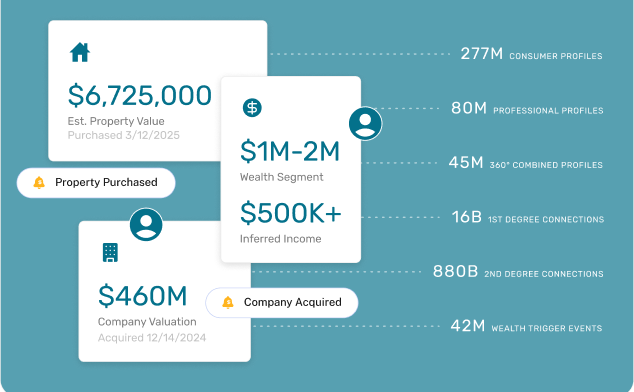
Platforms that combine household data, professional data and wealth events put the preparation from Step 1 in one place. Aidentified does this across 300M+ profiles, each with up to 200 profile attributes and modeled wealth and income, with a 100% fill rate on wealth and income ranges. It monitors 16 wealth event types, grouped as liquidity and equity events, corporate milestones, real estate transactions, and career and visibility signals, and you get alerted when someone on a saved list has a wealth event.
Relationship mapping maps paths across 16B+ first-degree connections, through household, alumni, employment and board ties, so you can see who in your network can make an introduction. One G2 reviewer explained the value for a sales meeting: "Aidentified can tell us that this person's spouse is actually a Director at XYZ firm, meaning this discussion might be more appropriate to be run by one of our more senior advisors."
Aidentified runs alongside your CRM as a tailored insights enrichment layer, and the Sidecar Chrome extension shows Aidentified data while you browse LinkedIn and company websites. In a recent internal analysis, around 200 advisors averaged $5.6M in new net assets during a 3-month pilot directly attributable to Aidentified.
The same data supports client management after the sale, when a client in your book of business has a trigger event that calls for a review. Aidentified doesn't replace the relationship-building that HNW prospecting requires, and the discovery, the discretion and the close are yours to run.
Walk into your next HNW meeting already prepared
A first meeting with a high-net-worth prospect that opens with basic facts about the household leaves less time for the questions that decide the sale. With Aidentified, you arrive knowing the household, the recent wealth events and the people who connect you to the prospect.
Book a demo to see that picture for a prospect you are meeting this month.
FAQ: Do you have any questions?



growth engine with the
LLM Prompting Guide.
Reveal the power of your network with Aidentified’s industry-leading AI.
Discover how Aidentified can transform your specialty services business. Contact us today for a personalized consultation and demo.
Explore a demo