ChatGPT for Financial Advisors: A Practical Guide for 2027

This is a div block with a Webflow interaction that will be triggered when the heading is in the view.
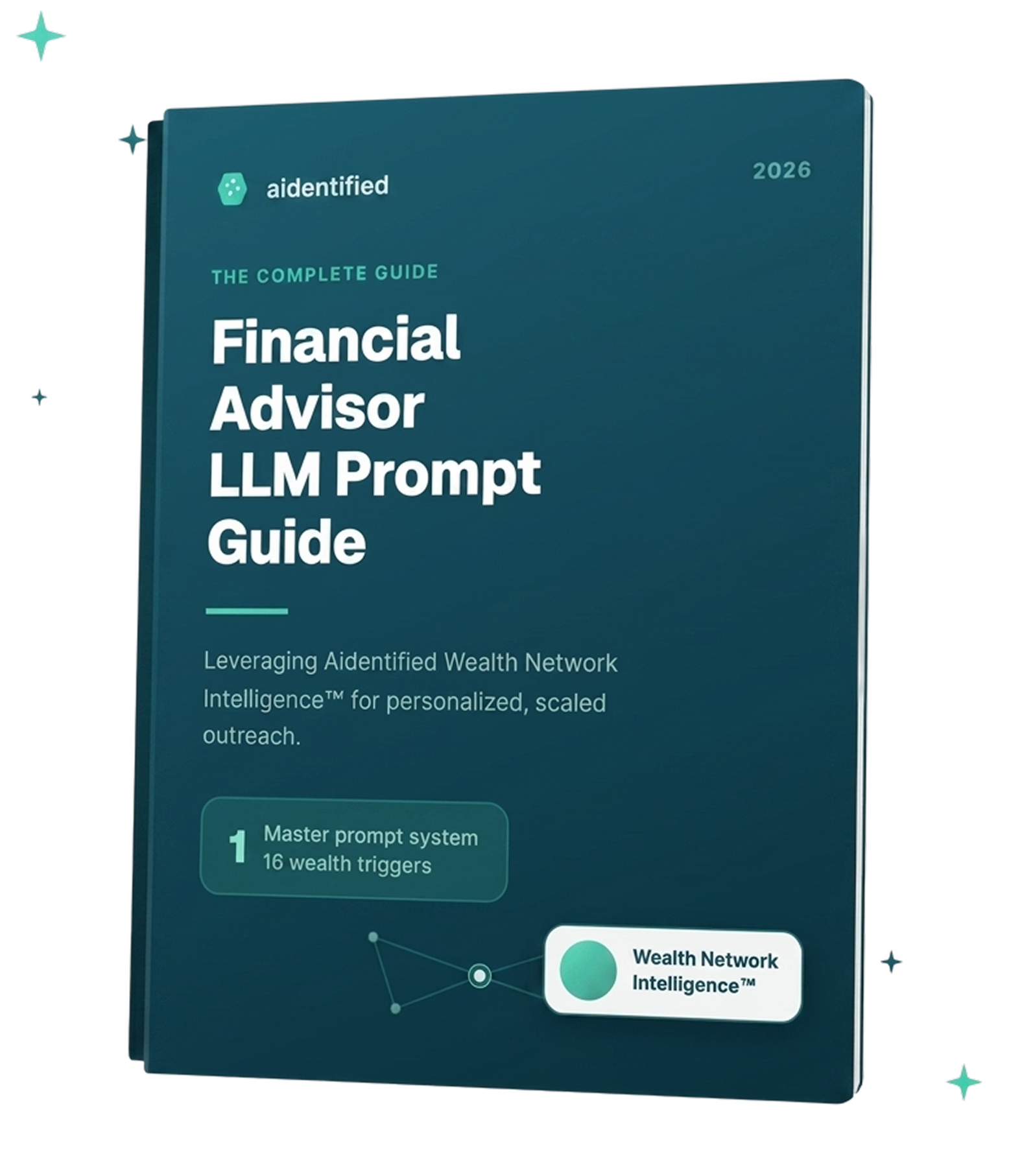
Download the LLM 2026 Prompting Guide
Teach your AI to think like your firm with 10+ customizable prompts
Download TodayTL;DR
ChatGPT for financial advisors works as a drafting assistant for introduction letters, intake forms, agendas, and client explanations you review before use.
OpenAI launched ChatGPT for Financial Services for eligible financial institutions, starting with investment banking and equity research.
FINRA says Rule 2210’s content standards apply whether a person or a technology tool creates a communication, so AI-generated content still needs to go through your usual review process.
Aidentified adds wealth events, modeled wealth and income, and warm introduction paths, so you know who to contact, when, and through whom.
ChatGPT for financial advisors covers two separate products from OpenAI: the general ChatGPT assistant, available on plans that include Plus, Pro, Business, and Enterprise, and ChatGPT for Financial Services, an institutional version. The general assistant is an artificial intelligence tool that writes text from the instructions and material you give it.
For an individual advisor, the general assistant is the more practical place to start, since the institutional version has its own eligibility requirements and is arranged directly through OpenAI. For prospecting, Aidentified’s LLM Prompting Guide provides structured prompts to evaluate leads against your firm’s ideal prospect profile, with human review of every draft before it goes out.
Where ChatGPT fits in a financial advising practice
ChatGPT can handle the writing and document work around client meetings, creating spreadsheets, documents, and slides. For an advisory practice, that could include an introduction letter to a prospective client, an intake form, a meeting agenda, or a recap email.
Writing tasks to hand off first
The lowest-risk documents to test ChatGPT on are the ones you already write from a template and check line by line. Any error is then caught in that check, before a client reads it.
Limits to plan around
ChatGPT has no view of a client's household, goals, or risk tolerance unless you or a connected tool supply that information. That’s why a general answer to a personal finance question can read well and still miss the details that shape financial advice for one family. FINRA's Regulatory Notice 24-09 names accuracy, privacy, and bias among the concerns raised by generative AI tools, which write text from prompts. Check every figure in a draft against your own records.
Your firm in ChatGPT search results
ChatGPT's search features can also show your firm's website. OpenAI's crawler documentation says OAI-SearchBot "is used to surface websites in search results in ChatGPT's search features," and recommends allowing it in your site's robots.txt file. Ask whoever manages your website to check that file.
Three steps to set up ChatGPT in your practice
Setting up ChatGPT starts with your compliance team, before anyone writes a prompt. Your firm sets the workspace and review process, while advisors shape the prompts they use.
Step 1: Choose a firm-approved workspace
Client names, account numbers, and holdings should only be entered into a business workspace approved by your firm, never a personal account. OpenAI says on its enterprise privacy page that it does not train its models on business data or use your business activity to improve them. The same page says ChatGPT Enterprise customers control how long their data is retained.
Step 2: Write prompts with context
A prompt that defines your role, audience, purpose, tone, and format gives ChatGPT the context it needs to match your voice and speak to your reader. For example, “Write as a fee-only advisor to a recently retired engineer, in a warm and formal tone, in under 200 words” sets several clear constraints in one sentence. If the draft needs changes, add another constraint in the same conversation.
Step 3: Review, approve, and keep records
Give an AI-drafted letter the same review, approval, and recordkeeping as one you write yourself. FINRA’s Regulatory Notice 24-09 says Rule 2210’s content standards apply whether a communication is created by a person or a technology tool. It also calls for firm policies to address technology governance, including model risk management, which means AI tools and agents that act on your behalf should follow the same oversight. The notice applies to FINRA member firms, while advisors working solely through an RIA should follow the equivalent requirements in their firm’s compliance program.
Five ChatGPT prompts for financial advisors to adapt
These ChatGPT prompts for financial advisors use bracketed placeholders, so no client detail enters the conversation. Swap in general descriptions, and edit every draft before it reaches anyone.
1. Introduction letter to a prospective client
"Write an introduction letter from [your role] at [type of firm] to a prospective client I know through [shared connection]. Mention one service relevant to [their situation], keep it under 200 words, and close by suggesting a short call." Open the letter with the shared connection, because it answers the reader's opening question about any client outreach: why this advisor, and why now.
2. Client intake form with risk tolerance
"Create a client intake form for a [household type] with sections for goals, income, expenses, savings, existing accounts, and risk tolerance. Use plain language, and add a one-line explanation under each risk tolerance question." Compare the result with your firm's existing forms, since compliance may require set wording for that section.
3. Meeting agenda and recap email
"Draft a [length] review meeting agenda for a client approaching retirement, covering [topics]. Then write a recap email from my notes that lists each decision and each next step with an owner." Strip identifying details from your notes before you paste them. A recap that names owners and dates gives each of your client interactions a written next step.
4. Plain-language explanation for a client
"Explain [concept, such as required minimum distributions] to a client with no finance background, in three short paragraphs, without recommending any action." That last instruction keeps the draft educational, and the recommendation remains yours to make in the meeting.
5. Spreadsheet formulas and cleanup
"I have a spreadsheet with columns for [column names]. Write a formula that flags any row where [condition], and explain each step." For larger structured data, such as an export of anonymized holdings, describe the columns and ask only for the formula, so the records never enter the chat.
What ChatGPT for Financial Services offers financial institutions
ChatGPT for Financial Services is OpenAI's version of ChatGPT for the financial services industry, described in its announcement as "a tailored ChatGPT Work experience." It pairs built-in financial data with GPT-6 Astra for research, financial models, and client materials.
Who the first release serves
OpenAI states that the product "is available to eligible financial institutions," and its early work with design partners pointed it toward "investment banking and equity research." The announcement does not mention financial advisors or wealth management, or say whether an advisory firm counts as an eligible institution, so confirm eligibility with OpenAI first.
Data, citations, and governance controls
The product includes premium datasets from different providers and it connects to data subscriptions a firm already holds. Its controls build on ChatGPT Enterprise, with single sign-on, role-based access, compliance log exports, and separate workspaces to enforce information barriers.
Find the right prospects with Aidentified
Every prompt above depends on what you know about the person you are writing to. Aidentified, a wealth network insights platform for financial professionals, adds what your CRM and notes leave out and it runs alongside your CRM as a tailored insights enrichment layer.
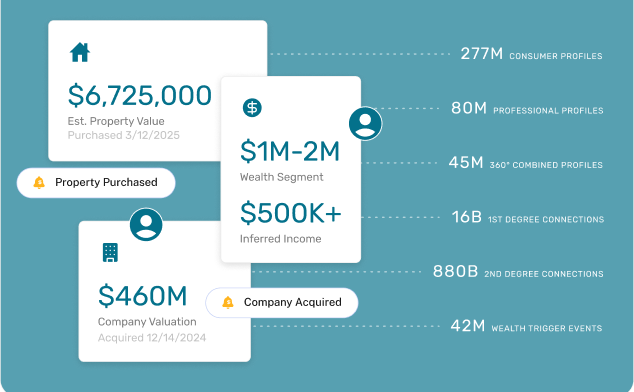
Aidentified monitors 16 wealth event types across liquidity and equity events, corporate milestones, real estate transactions, and career and visibility signals. With wealth event monitoring, you get alerted when someone on a saved list has a wealth event. Its relationship mapping software maps the paths from your existing contacts to the person you want to reach, across 16B+ first-degree connections.
As an AI wealth management tool, Aidentified uses AI models to estimate wealth ranges, and each of its 300M+ profiles includes modeled wealth and income. That context tells you which letter to write, who should receive it, and who in your network can make an introduction. Aidentified powers those decisions across prospecting, client management, service, and strategic growth.
Write your next introduction letter with context
An introduction letter drafted in ChatGPT can only use the reasons you provide in the prompt, while the CRM data behind those reasons may only reflect past activity. Aidentified shows which of your contacts recently had a money-in-motion event, giving you a timely reason to start the conversation.
Start with the contact lists you already keep and see which names had a recent wealth event.
FAQ: Do you have any questions?



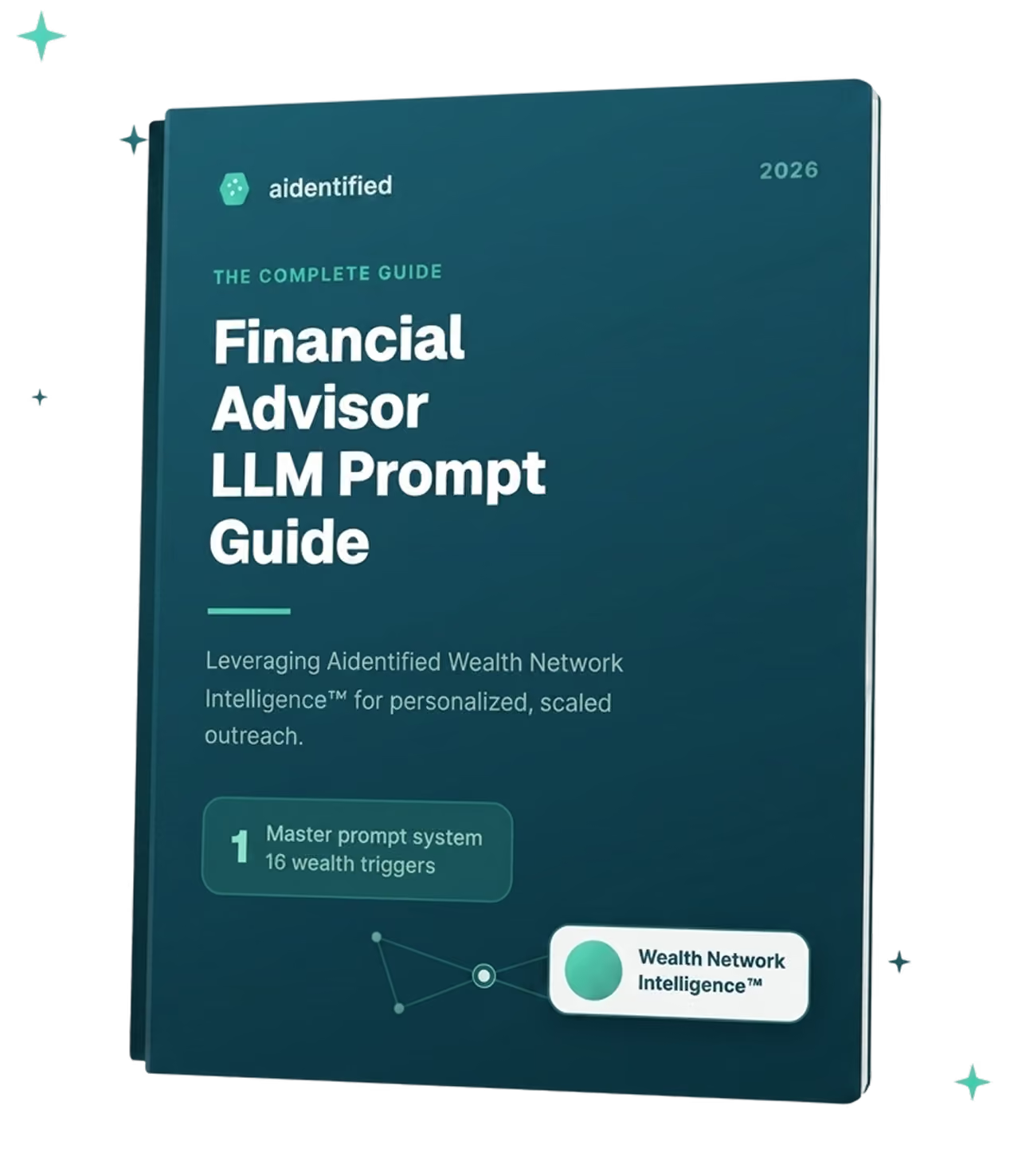
growth engine with the
LLM Prompting Guide.
Reveal the power of your network with Aidentified’s industry-leading AI.
Discover how Aidentified can transform your specialty services business. Contact us today for a personalized consultation and demo.
Explore a demo