Why most “AI for Wealth Management” tools are solving the wrong problem
.png)
Download the LLM 2026 Prompting Guide
Teach your AI to think like your firm with 10+ customizable prompts
Download TodayOver the past two years, wealth management has seen an explosion of AI-powered tools promising to transform how advisors work. From meeting summarization and email drafting to workflow automation and CRM enhancements, the market is rapidly filling with solutions designed to make advisors more efficient.
These tools are not without value. Saving time on administrative tasks, improving documentation, and streamlining communication can meaningfully enhance day-to-day operations. But there is a fundamental issue at the center of this wave of innovation in that most of these tools are solving for efficiency, not growth. And in wealth management, those are not the same thing.
The industry’s core challenge has never been how quickly an advisor can draft a follow-up email. It has always been how effectively they can identify, engage, and convert the right prospective clients into long-term relationships. Improving workflow efficiency without addressing that core challenge is, at best, incremental progress. At worst, it creates the illusion of advancement while leaving the most important constraint untouched.
Efficiency Is Only Half of Bottleneck
It is worth asking a simple question of “what actually limits growth for most advisors?”
The answer is not time spent on note-taking or email writing. The real constraint is pipeline quality. Advisors don’t struggle because they can’t send messages fast enough. They struggle because they don’t consistently know who to reach out to, when to do it, or why that outreach will be relevant in the first place.
This is where much of today’s AI conversation misses the mark. By focusing on making existing workflows faster, many solutions assume that the underlying inputs like the prospects, the timing, the context are already sound. In reality, they often are not.
You can move faster than ever, but if none of it actually lands, you’ve simply accelerated wasted effort. Faster outreach to the wrong person at the wrong time is still ineffective.
The Difference Between Workflow AI and Opportunity AI
Most of today’s tools fall into what could be called “workflow AI.” They help advisors complete tasks more quickly by summarizing meetings, generating emails, and updating records. These capabilities are useful, but they operate at the edges of the advisory process. Many of them could be industry-agnostic, in fact.
What the industry has yet to fully embrace is what we might call “opportunity AI.” Our ai for financial advisors guide goes deeper into what separates this category from workflow tools.
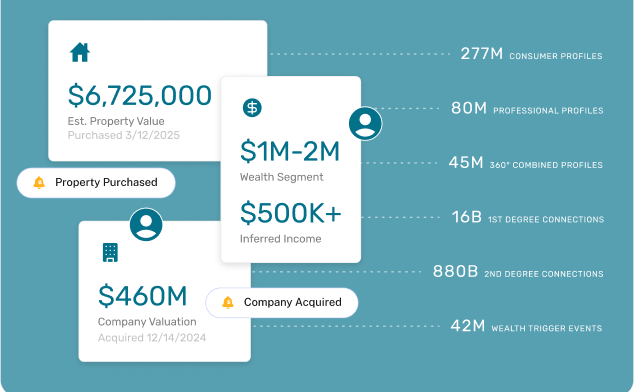
Opportunity AI focuses not on how work gets done, but on what work should be done in the first place. It helps advisors answer more fundamental questions: Who are my next best clients? Where are the most relevant opportunities within my network? What signals indicate that now is the right time to engage?
This shift from execution to identification is where the real transformation lies.
In practice, this means moving beyond static client profiles and generic prospect lists toward a more dynamic understanding of people, relationships, and timing. It means recognizing that wealth creation and transfer are not random events, but patterns that can be observed, interpreted, and acted upon with the right data and context.
Why Timing and Context Matter More Than Speed
One of the most overlooked aspects of prospecting is timing. The same outreach can be ignored one day and welcomed the next, depending on what is happening in a person’s life.
Career changes, liquidity events, board appointments, business exits, and family transitions all create moments where financial decisions become more immediate and more complex. These are the moments when advisors can add the most value. Yet they are also the moments that are hardest to identify without the right data.
Similarly, relationships matter. Very few meaningful client relationships begin with a cold introduction. They are built through networks like shared affiliations, professional overlaps, and mutual connections. Understanding these networks at scale has historically been difficult, which is why many advisors still rely on memory, intuition, or manual research.
This is where a more advanced approach to AI can play a different role. Not by drafting the outreach, but by identifying the opportunity itself, surfacing the right person, at the right time, through the right path.
From Data Activation to Data Intelligence
There is a growing narrative around “activating data” in wealth management, but activation alone is not enough. The industry is not suffering from a lack of data; it is suffering from a lack of actionable insight.
Turning data into intelligence requires context. It requires understanding not just who someone is, but how they are connected, what is changing in their world, and why that change matters.
Without that layer of intelligence, even the most sophisticated AI tools risk becoming accelerants without direction. They enable faster execution, but not better decision-making.
The Next Phase of AI in Wealth Management
The next generation of AI in wealth management will not be defined by how efficiently advisors can complete tasks. It will be defined by how effectively they can identify and act on opportunity.
This does not mean workflow tools will disappear. They will continue to play an important role in improving productivity and consistency. But they will increasingly become table stakes rather than differentiators.
The real competitive advantage will come from platforms that help advisors build better pipelines identifying high-potential prospects, understanding relationship pathways, and engaging with relevance at the moments that matter most.
For firms navigating a historic wealth transfer and rising competition, this shift is critical. As more clients evaluate their advisory relationships, the ability to find and engage the right clients will determine long-term success.
A Shift in Perspective
AI has the potential to reshape wealth management in meaningful ways. But realizing that potential requires a shift in perspective.
The question is not how we make advisors more efficient at what they are already doing. It is how we help them do the right things in the first place.
Until the industry focuses more on opportunity than productivity, many AI solutions will continue to fall short of their promise. The tools may get faster. The workflows may get smoother. But the outcomes will remain largely the same.
And in a business built on relationships, that is a problem worth solving.



growth engine with the
LLM Prompting Guide.
Reveal the power of your network with Aidentified’s industry-leading AI.
Discover how Aidentified can transform your specialty services business. Contact us today for a personalized consultation and demo.
Explore a demo