5 Sales intelligence tools for financial advisors that improve outreach

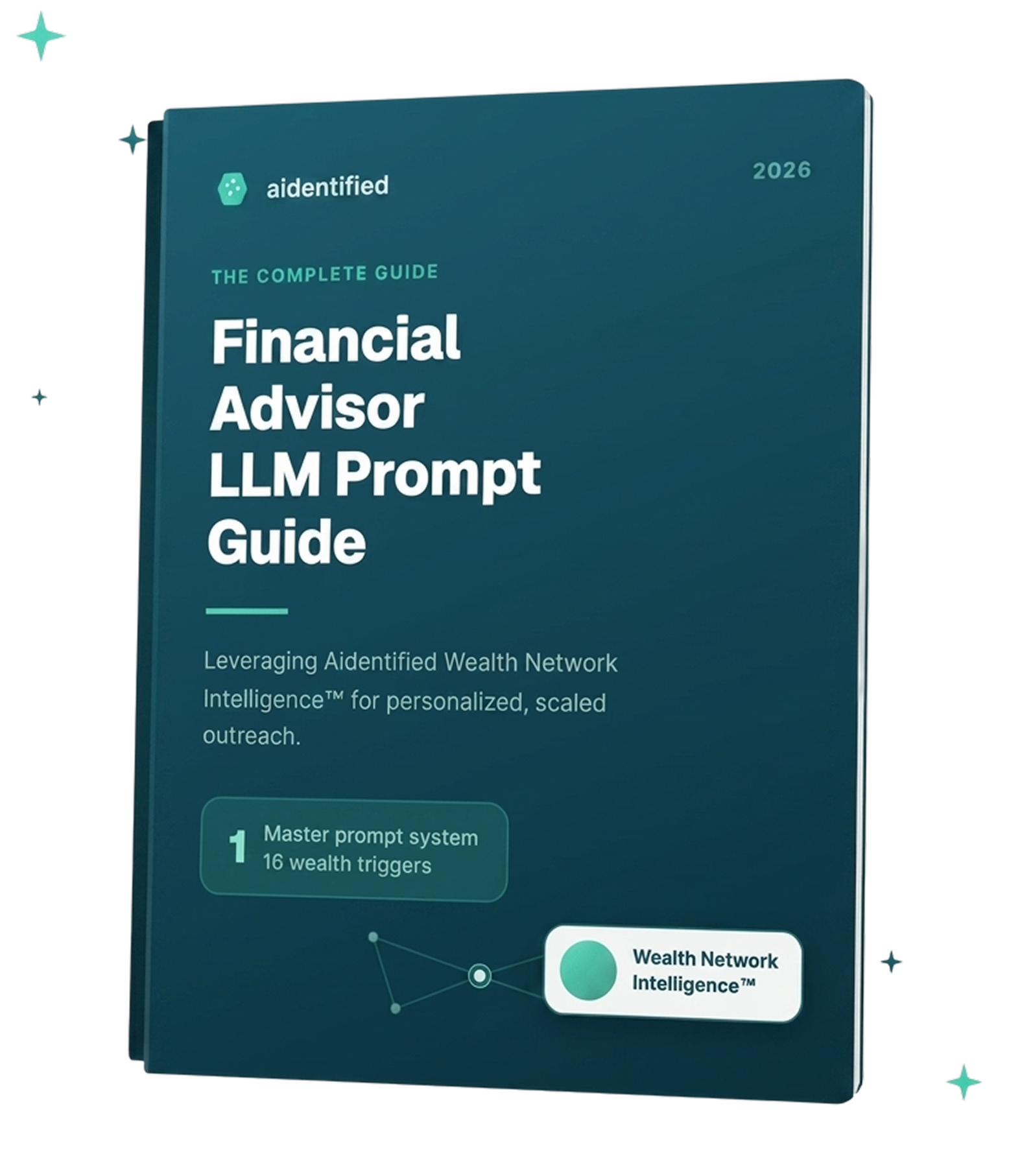
Download the LLM 2026 Prompting Guide
Teach your AI to think like your firm with 10+ customizable prompts
Download TodaySales intelligence was built for B2B pipelines. Contact data, firmographics, job change signals, buying intent scores, all of it was designed for teams selling software or services to procurement committees. The prospect universe is a set of companies with identifiable buyers and predictable purchasing cycles.
Financial advisors work in a fundamentally different universe. Their prospects are individuals, not companies, and the question that matters is not who holds a budget but who has recently entered a financial decision window. A job title change does not tell you whether a prospect just received a liquidity event. A firmographic profile does not tell you whether someone inherited wealth last month.
The gap between what standard platforms provide and what advisors actually need to surface qualified prospects at the right moment is the subject of this guide. It covers where standard sales intelligence for financial advisors falls short, what wealth-specific criteria actually matter, and which platform categories close that gap. Advisors who want to act on warm leads for financial advisors at the moment they become warm, rather than months later, need a different data layer than B2B contact enrichment provides. For a wider category view, see prospecting tools for financial advisors.
Where standard financial services sales intelligence platforms fall short
Standard sales intelligence platforms solve real problems for enterprise sales teams. The issue is not that they are built poorly. It is that their data layer was designed for professional records, not consumer wealth, and the signals they surface are the wrong signals for advisor prospecting.
What the advisor prospecting data gap actually costs
Advisors working from professional contact data are missing the signals that determine whether outreach is timely: net worth estimates, household composition, equity events, and recent property transactions. These are not nice-to-have data points, and it's exactly why more practices are turning to ai for financial advisors to close the gap. They are the difference between an outreach that arrives at a moment of genuine financial complexity and one that arrives at random.
Outreach arriving at the wrong moment erodes trust rather than building it. The window to reach a prospect who just received liquidity, inherited an estate, or sold a business is not visible in a job title field, and by the time the event surfaces in professional data, weeks or months may have passed. This is the core cost of the advisor prospecting data gap: not the absence of contacts, but the absence of timing.
Why firmographic signals miss the wealth moment
A job title change at a high-growth company can suggest new equity. A promotion at a public company can suggest an equity event is approaching. But interpreting these signals correctly requires context the contact record does not carry: vesting schedules, prior liquidity history, and personal asset depth.
Standard platforms fill these fields with estimates at best. For advisors, the relevant signal is an event, not a score. A prospect whose company was just acquired is in a different financial position than one whose employer changed names after a rebranding. Professional data cannot make that distinction. Household-level consumer data, updated in real time, can.
What to look for in financial advisor outreach tools and prospect data
Most platforms in this category will tell you they offer sales intelligence. Fewer will meet the criteria that actually matter for advisor prospecting. The three criteria below are a practical framework for evaluating any platform, based on what the absence of each element costs in a real prospecting workflow.
Consumer and household data depth for HNW prospect intelligence
Wealth management prospecting depends on household-level data: property ownership, family composition, estimated assets, and equity holdings. A contact who looks average by professional data alone may represent a multi-generational wealth relationship when household context is layered in. Financial advisor research tools can help close that gap.
Consumer data depth is what separates genuine HNW prospect intelligence from standard B2B contact enrichment. Without it, advisors are prospecting in the dark, qualifying by profession when they should be qualifying by financial complexity. A platform that cannot answer basic household-level questions about a prospect is not a wealth management sales tool. It is a contact database.
Real-time wealth event monitoring
A static prospect profile, however detailed, is a snapshot of a moment that has already passed. The profile describes who someone was at the time the data was collected. It does not tell you whether a wealth event has opened a decision window in the intervening period.
Platforms that monitor for wealth events continuously, covering business sales, liquidity events, senior role changes, equity grants, and property transactions, allow advisors to act when the window is open. Advisors acting on static data are making a timing bet without information. This is the most consequential criterion in evaluating any sales intelligence tool for advisory use: not the size of the database, but whether the data moves in real time.
Relationship mapping and warm introduction paths
Knowing a qualified prospect exists is step one. Knowing who in your existing network can make a warm introduction is what converts a qualified name into a meeting.
A warm introduction path built on verified network data changes the prospecting calculus entirely. The advisor with a mutual connection to a prospect has a different first conversation than one arriving cold, and that difference compounds over time into a measurably higher conversion rate. Relationship mapping is the feature that separates wealth management sales tools built for advisors from those adapted from B2B contact intelligence. Without it, even a perfectly timed outreach starts from zero credibility.
Best sales intelligence tools for financial advisor prospecting
Five platform categories operate in this space. They differ significantly in what data they surface, which stage of the prospecting workflow they address, and whether they were designed for advisor use or adapted from adjacent markets. For a broader set of prospecting ideas, it helps to see how these categories fit into a complete advisor workflow.
1. Aidentified
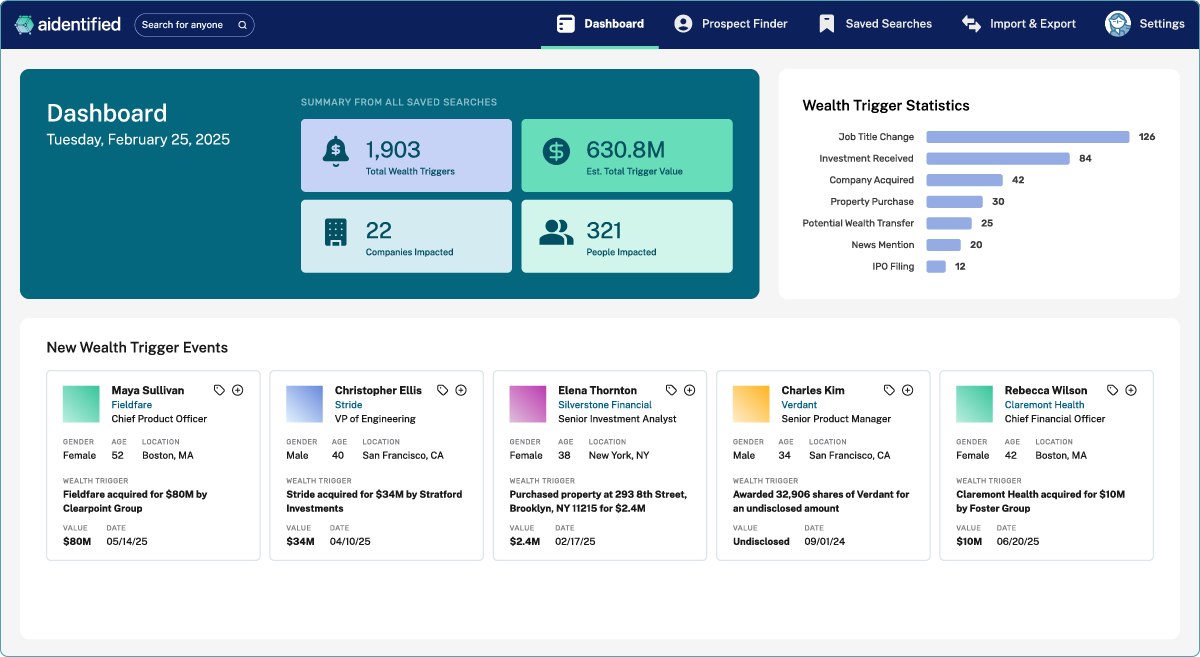
Aidentified is the platform built specifically for financial advisor prospecting rather than adapted from B2B or nonprofit data. It combines consumer and professional signals across 300M+ profiles, surfaces wealth events across 16 event types, and maps 16B+ connections for warm introduction paths.
Where other platforms in this category surface contact data, Aidentified surfaces the moment. Records update automatically when a qualifying wealth event occurs rather than requiring manual re-screening, meaning the advisor's pipeline reflects current financial reality rather than a static snapshot. CRM integrations with Salesforce, HubSpot, Redtail, Lofty, and Wealthbox mean the intelligence flows directly into the advisor's existing workflow without requiring a parallel system. Explore how a prospecting tool for financial advisors purpose-built around wealth events changes the prospecting workflow.
2. B2B contact intelligence platforms
B2B contact intelligence platforms aggregate professional contact data, firmographics, and job change signals from business data sources. They are useful for contact hygiene, verified email delivery, and identifying leads by employer, title, or industry.
They do not include the consumer data layer that determines whether a prospect is in a financial decision window, and they do not monitor for wealth events or household changes. For advisors, they address a real but secondary problem: keeping contact records accurate. They do not address the primary problem: knowing when a prospect is ready and who can make the introduction. A lead generation tool for RIAs that combines contact accuracy with wealth event monitoring closes a gap these platforms leave open.
3. CRM-native intelligence tools
CRM-native intelligence is built into the advisor's existing platform: contact enrichment, activity scoring, and engagement signals drawn from the current database. It adds context to contacts the advisor already has and improves workflow efficiency within the CRM.
The structural limitation is that it depends on the advisor having a prior record of the contact. It does not monitor for new wealth events outside the existing pipeline. An advisor whose CRM contains 500 contacts will get better data on those 500 contacts. They will not discover the 50 prospects who just entered a financial decision window and are not yet in the system. See how integrating sales intelligence with your CRM extends the value of CRM-native tools without replacing them.
4. Conversation intelligence platforms
Conversation intelligence tools record and analyze calls and meetings to surface talk patterns, objection handling, and engagement signals. They help advisors improve how they communicate once a conversation is already happening.
They are retrospective by design. They do not address the upstream prospecting problem: identifying who to reach, when, and through which relationship path. For advisors who have already solved the prospecting problem and are optimizing conversion, conversation intelligence is a valuable layer. For advisors still working out who to call and why, it solves a downstream problem while leaving the core gap untouched.
5. Intent data and buying signal tools
Intent data platforms monitor digital behavior, including website visits and content engagement, to flag accounts in an active buying cycle. They perform well for software purchases, where a prospect actively researches a category before committing.
Financial advisory relationships are not triggered by website behavior. The events that open a decision window are life events, not search queries, and they require a monitoring layer built around consumer data, not digital footprint. An executive who just vested a significant equity tranche is unlikely to immediately search for "financial advisor near me." They are likely to receive a call from someone who already knew the event was coming. See how AI-powered lead generation for advisors uses event monitoring rather than intent signals to surface that moment.
Find the right sales intelligence approach for your practice
Most sales intelligence platforms will surface contact information and flag when a job title has changed. Few will tell you which prospects have entered a financial decision window and show you the shortest path to reach them through someone they already know. That is the gap between generic B2B contact data and wealth-specific sales intelligence built for advisors. The right client acquisition strategies are built around wealth events rather than static contact lists.
Platforms like Aidentified are built to close that gap. By combining household-level consumer data, real-time wealth event monitoring across 16 event types, and relationship mapping across 16B+ connections, they surface the advisor prospecting data that determines not just who to contact but when and how. For more prospecting ideas, explore how financial advisors build and qualify their prospect pipeline when the data layer reflects current financial reality rather than a static snapshot.
If you are ready to move from contact data to wealth-specific intelligence, try Aidentified for free.
FAQs: Sales intelligence tools for financial advisors
How do financial advisors find high-net-worth prospects?
Financial advisors typically identify HNW prospects through referral networks, wealth event monitoring, and household-level data platforms.
The most effective approach combines relationship mapping, meaning identifying mutual connections who can make a warm introduction, with real-time monitoring for triggering events like business sales, equity vesting, or inherited assets. Cold outreach from a static list performs significantly worse than outreach timed to a financial decision window.
What is the difference between a lead generation tool and a sales intelligence platform for financial advisors?
Lead generation tools focus on producing a list of names or contacts that match a target profile. Sales intelligence platforms go further by layering context onto those contacts, including net worth estimates, household data, recent wealth events, and relationship paths. For financial advisors, the distinction matters because a list of names without timing or context produces the same cold outreach problem that referrals were always meant to solve. Intelligence is what tells you which names to prioritize and when to act.
Can financial advisors use CRM data to identify new prospects?
CRM data helps advisors manage and enrich relationships they already have, but it does not surface new prospects who haven't entered the system yet. A CRM records activity on known contacts. It does not monitor for wealth events happening outside the existing pipeline. Advisors who rely solely on CRM-native intelligence will improve data quality on their current list but miss the prospects who just entered a financial decision window and are not yet a contact in any database.
How do sales intelligence tools fit into a financial advisor's existing workflow?
Most platforms in this category offer CRM integrations that push enriched contact data and event alerts directly into the advisor's existing system. The intelligence layer runs in the background, and the advisor receives alerts when a prospect in their defined market triggers a qualifying wealth event.
The practical result is that prospecting becomes a pull process rather than a push process. Instead of manually screening a prospect list each quarter, the advisor receives a prioritized set of contacts who have recently entered a decision window, ranked by event type and relationship proximity. Explore what wealth management prospecting tools worth knowing about look like when built around this model.

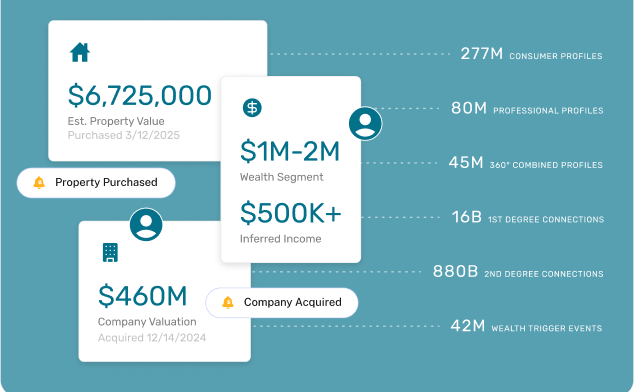


growth engine with the
LLM Prompting Guide.
Reveal the power of your network with Aidentified’s industry-leading AI.
Discover how Aidentified can transform your specialty services business. Contact us today for a personalized consultation and demo.
Explore a demo